
Unbiased headlines. Facts, not spin.
Every story is an unbiased news briefing written from 110+ sources across the spectrum — sources linked so you can verify it yourself.
 defense
Notable (6/10)
June 4, 2026 at 10:57 PM
defense
Notable (6/10)
June 4, 2026 at 10:57 PM
Trump Floats Meeting New Iranian Supreme Leader, Softens Stance on Enriched Uranium, as 40 Ships Quietly Exit Hormuz
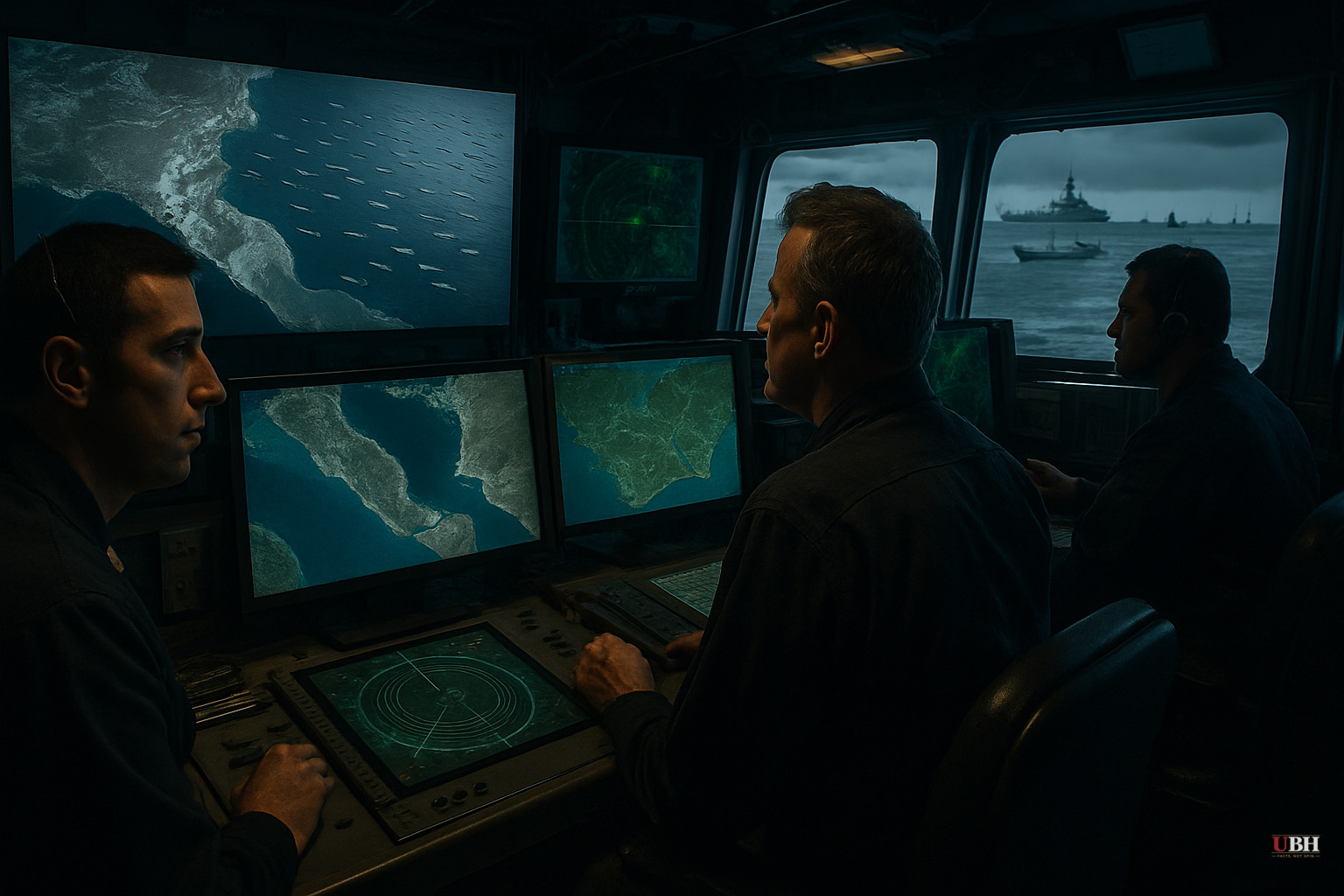
Since the Iranian missile strikes on Kuwait International Airport earlier this week and the ongoing dispute over CENTCOM's claim that all missiles were 'defeated,' the U.S.-Iran conflict has entered a new and murkier phase — part ceasefire, part proxy skirmish, part diplomatic theater.
Trump Opens the Door to Meeting Khamenei
On Thursday, Trump told reporters in the Oval Office that he would be 'honored' to meet Iranian Supreme Leader Ayatollah Mojtaba Khamenei — the son of Ali Khamenei, who was killed on the first day of fighting. According to CNBC, Trump said he expects the new supreme leader to be 'professional' and noted he has 'a very good reputation in some circles.'
The shift marks a departure from an administration that launched the war in the first place.
Trump's condition: a deal has to be in reach first. 'If we make a deal, it's possible that I would meet,' he said. 'I'd be okay with that.'
The U.S. is demanding Iran pledge never to acquire a nuclear weapon and reopen the Strait of Hormuz. Iran wants an end to hostilities and the U.S. naval blockade of its ports lifted. Neither side has moved significantly on either demand — yet Trump's language is softening publicly.
The Enriched Uranium Pivot
Trump on Thursday downplayed what was previously a central U.S. demand: physically recovering or securing Iran's remaining stockpile of enriched uranium. According to ZeroHedge, Trump called the material 'dust' and said there was 'no reason' to retrieve it because it is effectively 'entombed' underground after U.S.-Israeli strikes.
He said the U.S. is 'not considering' any covert operation to seize Iran's uranium and pointed to 'powerful cameras watching Iran's uranium' as sufficient oversight.
This represents a major rhetorical retreat from earlier in the conflict, when securing or destroying Iran's fissile material was treated as a non-negotiable war objective. Whether it reflects genuine confidence in U.S. surveillance capabilities — Trump separately claimed Space Force has nine satellites watching the destroyed sites around the clock — or a negotiating concession remains unclear, and neither administration officials nor CENTCOM have fully clarified the rationale.
Trump did still insist that Iran 'can't have a nuclear weapon' as the 'main part' of any agreement. But dropping the enriched uranium recovery demand, even rhetorically, hands Iran a talking point.
40 Ships Quietly Slipped Out — Nobody Noticed
A significant logistics development occurred largely unnoticed in Thursday's news cycle.
According to Lloyd's List Intelligence, cited by CNBC, nearly 40 ships that had been stranded in the Persian Gulf have exited through the Strait of Hormuz over the past three weeks. They did it quietly, coordinating with the U.S. Navy's Naval Cooperation and Guidance for Shipping group in Bahrain.
Richard Meade, editor-in-chief of Lloyd's List, said shipowners are submitting transit plans and the assumption is that the U.S. Navy is providing limited assurances to intercept incoming threats — but the Navy is NOT formally escorting anyone.
'Transit decisions remain solely with ship operators,' Meade said. 'Industry operators tell us that they are not being centrally coordinated.'
A defense official confirmed to CNBC that U.S. forces are communicating with ships seeking to transit but are NOT running escort missions. Trump shut down the formal escort program, called Project Freedom, in early May.
So: 40 ships out, through a semi-informal handshake arrangement with the U.S. Navy, while full commercial shipping through Hormuz remains WAY below prewar levels. Traffic through Hormuz hit its lowest point of the entire war in May, according to Lloyd's List. That strait still carries roughly one-fifth of the world's oil supply.
Gas prices nationally sat at $4.24 per gallon on Thursday according to AAA — notably lower than the $4.50-plus figures cited in earlier coverage this week, though whether that reflects the 3% oil price drop Thursday or a data discrepancy between sources isn't fully clear.
Oil Drops 3% on Ceasefire Confidence
West Texas Intermediate crude fell 3.1% to $93.04 per barrel Thursday. Brent crude dropped 2.8% to $95.03. The Wall Street Journal reported that Trump told aides the ceasefire is holding and he has no intention of resuming full-scale war unless American troops are killed. The White House declined to comment on the report but said Trump 'always prefers a diplomatic solution.'
Markets believe the ceasefire holds. For now.
Congress Is Getting Restless
The House passed a War Powers resolution Wednesday calling on Trump to either withdraw U.S. forces from the Iran conflict or seek formal congressional authorization to continue it. According to CNBC, Trump lashed out specifically at the four Republicans who voted for it.
The resolution still needs the Senate and faces a near-certain veto. But the fact that House Republicans are splintering on an active war is a political problem Trump can't dismiss with a Truth Social post.
What Mainstream Coverage Is Missing
Left-leaning outlets are zeroing in on Trump's ceasefire rhetoric and the War Powers vote — framing this as Trump's war unraveling politically. Right-leaning outlets are focused on the enriched uranium 'entombed' framing as a win.
The quiet exit of 40 ships through an informal Navy coordination system — while the formal escort program is officially dead — is the most consequential logistics development in weeks. It suggests a de facto partial reopening of Hormuz is happening below the diplomatic radar, with zero formal policy backing it.
The critical question remains unanswered: If an Iranian missile hits one of those 40 ships that 'coordinated' its exit, what exactly is the U.S. commitment? Is that an act of war? A self-defense situation? A diplomatic incident? Trump and CENTCOM have not addressed what happens if Iran targets one of these vessels.
Those answers need to come before the next ship burns.
Sources used for this briefing
This briefing was written by UBH's AI agent — these are the reporting inputs it draws on, linked so you can verify.


