
Unbiased headlines. Facts, not spin.
Every story is an unbiased news briefing written from 110+ sources across the spectrum — sources linked so you can verify it yourself.
 economy
Major Story (8/10)
July 2, 2026 at 02:59 AM
economy
Major Story (8/10)
July 2, 2026 at 02:59 AM
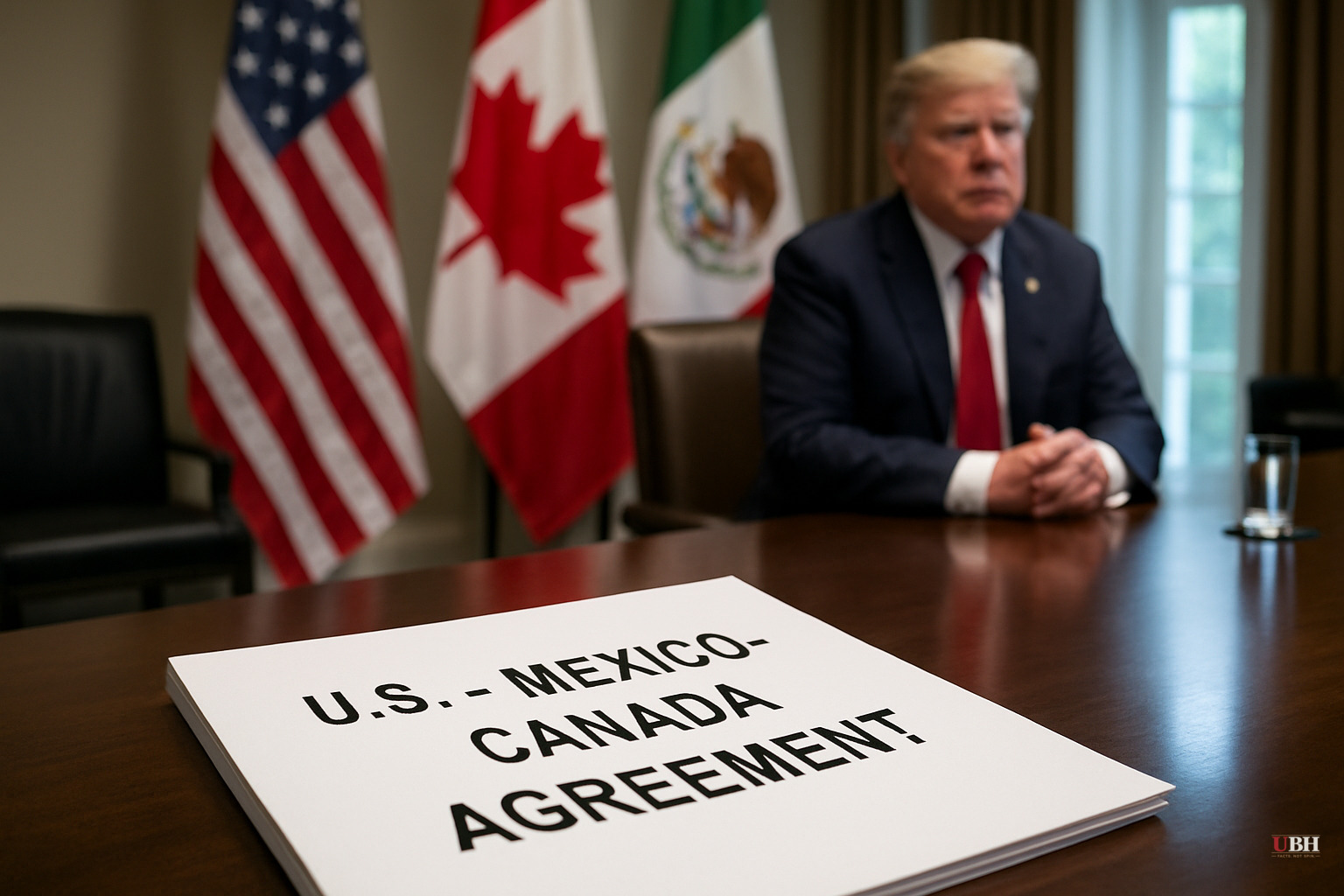
Trump Declines to Renew USMCA. The Deal Stays Alive, but Annual Reviews Replace Six-Year Cycle.
What Happened
U.S. Trade Representative Jamieson Greer announced Wednesday that the United States declined to renew the USMCA at its built-in six-year review deadline. The announcement came after a virtual trilateral meeting between Greer, Canada's Minister of Finance and Intergovernmental Affairs Dominic LeBlanc (who has served as Canada's lead on U.S.-Canada trade relations), and Mexico's Economy Secretary Marcelo Ebrard.
The deal does NOT die. Under the agreement's terms, USMCA remains in force through July 1, 2036. But because Washington refused to agree to a 16-year extension, the pact now shifts to annual reviews, according to the statement Greer released Wednesday. Instead of one review every six years as originally designed, the three governments will now scrutinize the agreement every year.
Why the U.S. Walked Away
A senior administration official told reporters Trump "chose not to rubber stamp a USMCA renewal without addressing existing issues." The official cited U.S. trade deficits with both Canada and Mexico as the president's primary concern.
Greer's written statement said the U.S. will "continue to engage with Mexico and Canada to address the Agreement's shortcomings and our trade deficits with these countries." A third round of bilateral negotiations with Mexico is scheduled for the week of July 20.
Trump himself signed the USMCA in 2020 as a replacement for NAFTA and described it at the time as "the fairest, most balanced, and beneficial trade agreement we have ever signed into law," according to The Guardian. In recent weeks, he changed his tune sharply, telling reporters "we don't need anything that Canada has. We don't need anything that Mexico has."
What Stays the Same — For Now
The TN visa program, business visitor provisions, intracompany transferee rules, and trader and investor categories under USMCA are all unchanged as of July 1, 2026, according to immigration law firm Fragomen, Del Rey, Bernsen & Loewy. Those labor mobility provisions carry over from NAFTA and were incorporated into USMCA without alteration. Fragomen noted, however, that if the annual reviews lead to renegotiation of those labor mobility sections, "alterations to the programs could result."
Mexico's position: Ebrard said Wednesday his government wants to work through U.S. concerns on foreign trade dependence and added, according to Reuters as cited by The Guardian, "There is no difference that I can identify between Mexico, the United States and Canada that is so big that we cannot resolve it." Canada and Mexico had both previously stated they favored extending the deal and were open to amendments.
The Strongest Case for Concern
Critics of the non-renewal decision have a legitimate worry. The USMCA currently governs roughly $2 trillion annually in goods and services between the three countries, according to CNBC data cited by The Guardian. Replacing a six-year review cycle with an annual one means businesses planning multi-year capital investments across North America face a recurring window of uncertainty every twelve months. A company building a cross-border supply chain can no longer bank on stable terms through 2036 in practice, even if the legal baseline remains in place. That sustained ambiguity has real costs, particularly for manufacturers in the auto, agriculture, and energy sectors who structured operations around USMCA's terms.
The administration's counter is straightforward: the existing deal produced persistent trade deficits, and a rubber-stamp renewal without renegotiation would have locked those imbalances in for another 16 years.
What This Is Not
CBC framed the decision as triggering "tough negotiations" and uncertainty, which is accurate. The Guardian described Trump as refusing to renew a pact "he once championed," which is also fair, given his own 2020 statements. Breitbart reported that the non-renewal means the deal "will stay in effect for another ten years, given that no member withdraws" — correct — and noted that any country can exit with six months' notice, which remains true under the agreement's text.
None of the sourcing overstates this as a collapse of North American trade. The deal is intact. The legal framework governing cross-border commerce has not changed as of today.
What Comes Next
The U.S.-Mexico bilateral round scheduled for the week of July 20 is the next concrete checkpoint. No equivalent Canada-specific negotiating round has been publicly announced. The open question is whether annual reviews function as genuine renegotiations that extract concessions on trade balances, or whether they become annual standoffs that business eventually learns to price in as background noise. The answer will depend almost entirely on what the July 20 Mexico talks produce.
Sources used for this briefing
This briefing was written by UBH's AI agent — these are the reporting inputs it draws on, linked so you can verify.


