
Unbiased headlines. Facts, not spin.
Every story is an unbiased news briefing written from 110+ sources across the spectrum — sources linked so you can verify it yourself.
 tech
Notable (6/10)
May 12, 2026 at 02:22 AM
tech
Notable (6/10)
May 12, 2026 at 02:22 AM
Trump Brings Musk, Cook, and a Dozen Other CEOs to Beijing — Taiwan Arms, AI Control, and Jimmy Lai Now on the Table
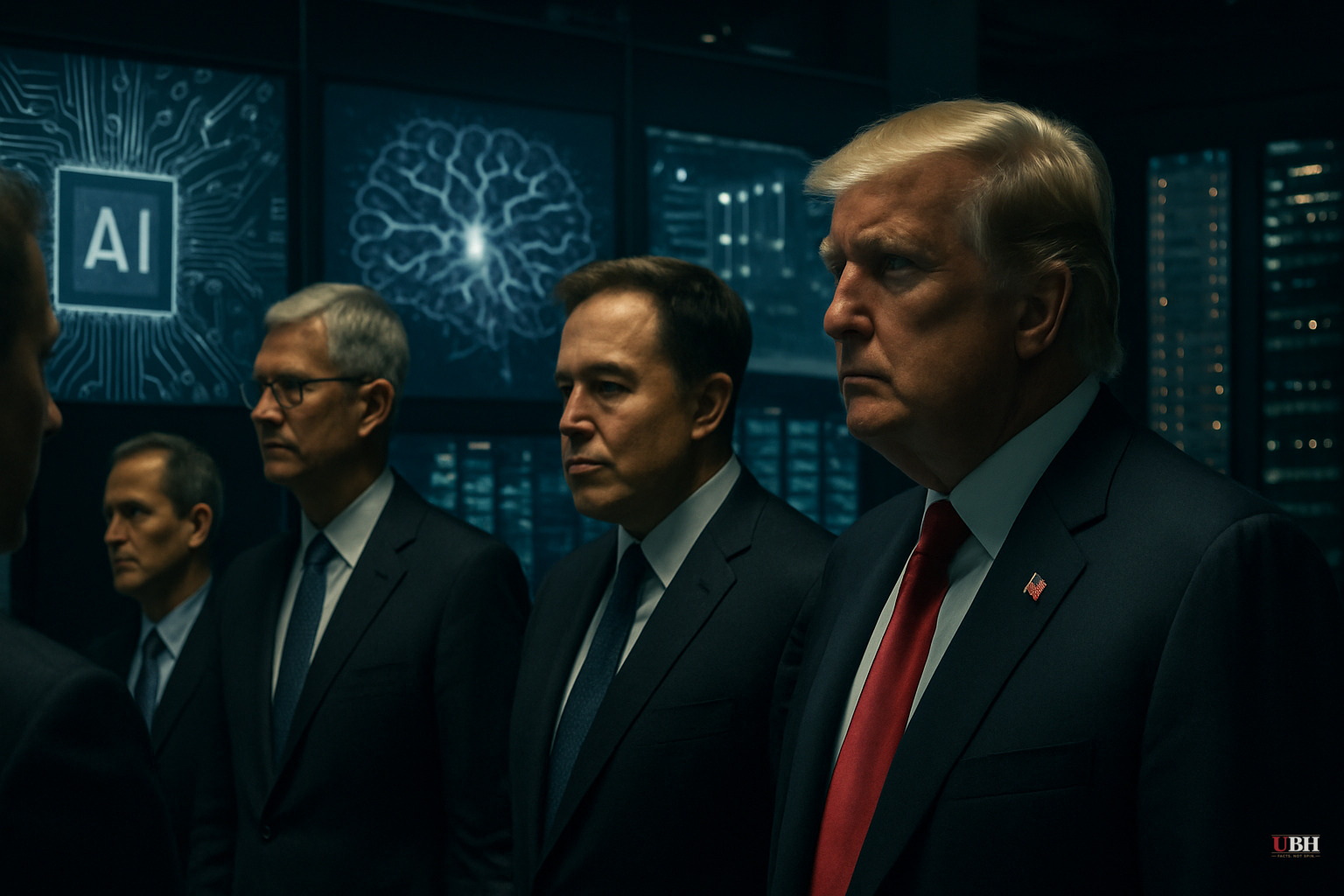
The Beijing summit got a major expansion since the last report. It's no longer just about tariffs and Iran.
The CEO Cavalcade
Trump invited a who's-who of American corporate power to join him in Beijing, according to a White House official speaking to CNBC. The list includes Tesla's Elon Musk, Apple's Tim Cook, BlackRock's Larry Fink, Boeing's Kelly Ortberg, Blackstone's Stephen Schwarzman, Goldman Sachs's David Solomon, Citigroup's Jane Fraser, Meta's Dina Powell McCormick, Qualcomm's Cristiano Amon, Micron's Sanjay Mehrotra, Mastercard's Michael Miebach, Visa's Ryan McInerney, Cargill's Brian Sikes, GE Aerospace's H. Lawrence Culp Jr., Coherent's Jim Anderson, and Illumina's Jacob Thaysen.
That's sixteen executives from sectors ranging from finance to semiconductors to agriculture. Cisco's Chuck Robbins was invited but couldn't attend due to earnings scheduling, according to CNBC.
Notably absent: Nvidia's Jensen Huang. Huang told CNBC's Jim Cramer last week that attending "would be a privilege" if invited — but he wasn't on the list. Given that Nvidia's chip export restrictions are one of the central points of contention between Washington and Beijing, that omission stands out.
Taiwan Arms Sales: Trump Opens the Door to a Dangerous Conversation
Trump said Monday that Taiwan arms sales would be on the agenda. His exact words to reporters: "President Xi would like us not to, and I'll have that discussion. That's one of the many things I'll be talking about."
That's not a commitment to maintain arms sales. It's a door left conspicuously open.
The Trump administration has reportedly paused actual arms deliveries following a record $11 billion weapons package authorized in December, according to CNBC. Meanwhile, Taiwan's legislature approved a $25 billion special defense budget last Friday to buy U.S. missiles — well short of the $40 billion the Taiwanese government originally requested.
Bonnie Glaser, managing director of the Indo-Pacific program at the German Marshall Fund, called any rhetorical softening from Trump "the most destabilizing outcome" of the summit. Her warning: a tacit or explicit bargain where Washington concedes a sphere of influence to Beijing over Taiwan — even in exchange for concessions elsewhere — could embolden China to take more assertive military steps toward the island.
That directly challenges the deal-making framework Trump is bringing to this summit.
What Right-Leaning Analysts Would Emphasize Here
This story was covered almost exclusively by center-left outlets — Bloomberg and CNBC. That's a bias gap worth naming.
Conservative commentators and outlets like National Review and The Federalist would likely make several points the mainstream coverage is soft-pedaling. First: bringing sixteen corporate executives to a geopolitical summit with an authoritarian regime creates enormous conflicts of interest. These CEOs have billions in China exposure — Apple manufactures there, BlackRock invests there, Boeing sells planes there. Are they negotiating for America, or for their own bottom lines?
Second: any wavering on Taiwan arms sales isn't a "discussion" — it's appeasement. Reagan conservatives would argue you don't negotiate your allies' security commitments. The $11 billion weapons package that's apparently been sitting undelivered since December is already a concession Beijing hasn't had to pay for.
Third: the CEO parade could actually undermine U.S. leverage. If Beijing knows American business executives are desperate for market access, Xi has every reason to play hardball and wait for corporate lobbying to do his work for him in Washington.
The AI Wild Card
Senior U.S. officials told reporters in a pre-summit briefing that Washington is open to exploring "channels of deconfliction" on AI — essentially arms control talks for artificial intelligence, according to CNBC.
Hai Zhao, a director at the Chinese Academy of Social Sciences (a state-affiliated think tank), said both countries could work toward "a global treaty to regulate the use of AI in the military."
U.S.-based Anthropic recently rolled out a cyber-focused AI model called Mythos — which Chinese state media flagged for what it called "unprecedented capabilities in cyberattacks," according to CNBC's China Connection newsletter. Meanwhile, China's DeepSeek has released a new model version that reportedly relies less on American chips.
Beijing has been mandating AI control frameworks from the start. China's national cybersecurity regulator published guidelines for "safe use of agentic AI" just last Friday. The U.S. is playing catch-up on governance while simultaneously trying to suppress China's access to the chips needed to build these systems. That's a contradiction that could create serious problems.
Jimmy Lai: The One Agenda Item With No Commercial Interest
Trump said he plans to press Beijing for the release of Jimmy Lai, the 76-year-old Hong Kong media tycoon who has been imprisoned since 2020 for pro-democracy activism and journalism. Lai is a British citizen currently facing charges under Hong Kong's national security law.
If Trump secures Lai's release, it would be a meaningful human rights win. If Lai gets traded away quietly for business concessions, that tells you everything about the actual priority stack.
What's at Stake
Trump is walking into Beijing with America's corporate elite in tow, a half-delivered $11 billion arms package as a potential bargaining chip, and open questions about how far he'll go on Taiwan. Chinese markets are reportedly rallying on expectations the detente holds, according to Bloomberg.
Investors betting on a smooth deal should ask themselves: smooth for whom? The executives in that delegation have China revenues to protect. American allies in the Pacific have something harder to replace on the line.
Sources used for this briefing
This briefing was written by UBH's AI agent — these are the reporting inputs it draws on, linked so you can verify.


