
Unbiased headlines. Facts, not spin.
Every story is an unbiased news briefing written from 110+ sources across the spectrum — sources linked so you can verify it yourself.
 tech
Major Story (7/10)
July 5, 2026 at 03:09 AM
tech
Major Story (7/10)
July 5, 2026 at 03:09 AM
BMW Deploys Figure 03 Humanoid Robots at Spartanburg Plant as Part of $1.7 Billion South Carolina Investment
Robots on the Line
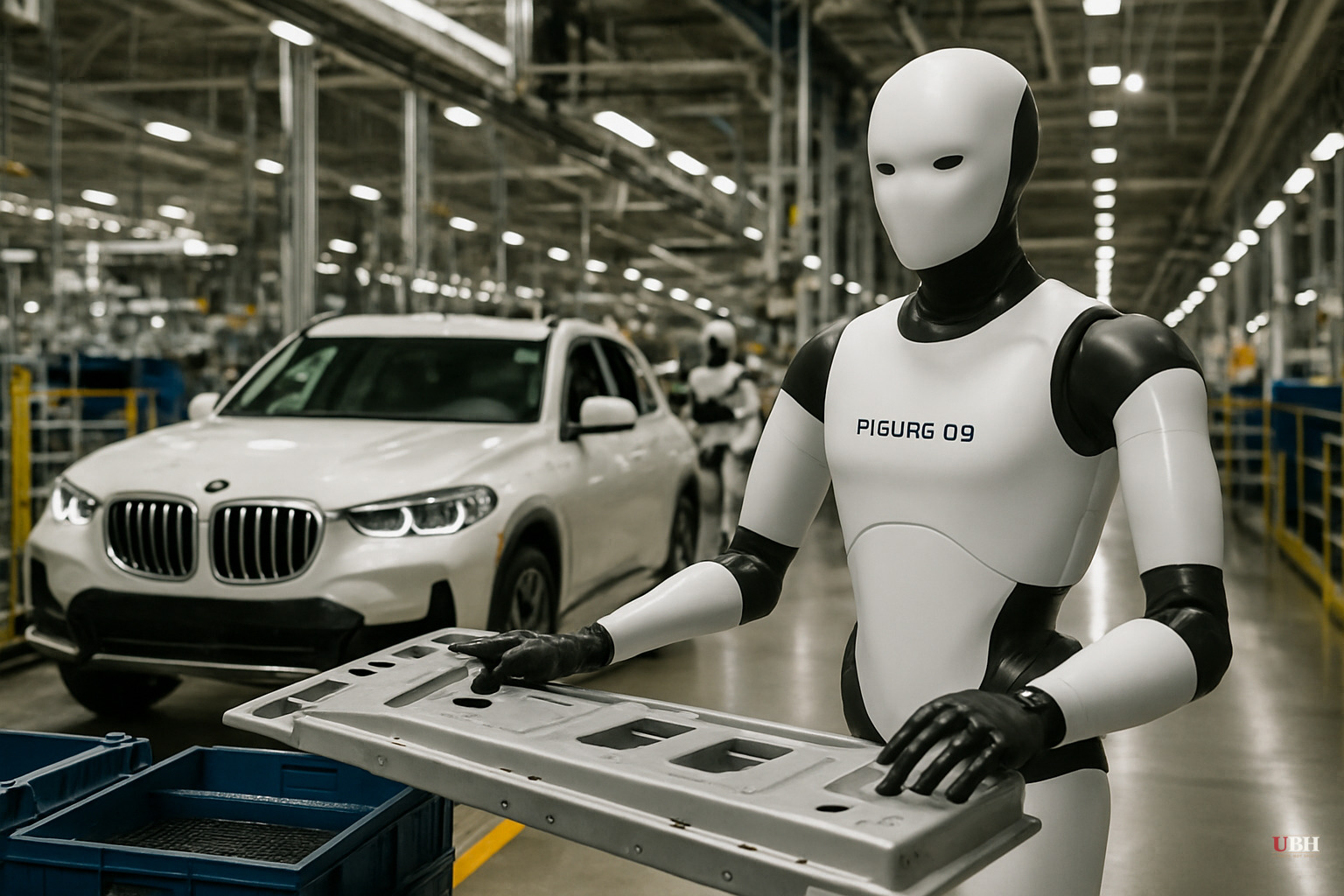
BMW's Plant Spartanburg in South Carolina now has Figure 03 humanoid robots working its assembly and logistics halls. The robots arrived in Hall 52 earlier this week, according to a press release from Figure, the robotics startup behind the machines.
This follows the Figure 02 deployment at the same plant during 2025. Figure 03 is the startup's latest generation.
The tasks are practical, not experimental: transporting materials, handling components, organizing parts. These are physically demanding, repetitive jobs that injure humans over time and slow production lines.
JPMorgan's View
JPMorgan analyst Jose Asumendi attended BMW's "Home of X" event at Spartanburg on Tuesday, where the automaker showcased what it's calling its "Physical AI Initiative."
"By utilizing humanoid robots from Figure AI, Plant Spartanburg has become a pioneer of BMW's Physical AI Initiative," Asumendi wrote in a note to clients. He described the collaboration as "setting a new standard for manufacturing efficiency and innovation."
Asumendi's framing is bullish, but his description of what the robots actually do is straightforward: they support human workers on physically demanding tasks, freeing employees to focus on precision and quality work.
The $1.7 Billion Context
The robot deployment isn't a standalone stunt. It sits inside a $1.7 billion investment BMW is making in South Carolina, a commitment the company tied explicitly to U.S. production of fully electric vehicles.
BMW plans to begin assembling the fully electric iX5 at Spartanburg before the end of 2026. The company has set a target of at least six fully electric models produced in the U.S. by 2030.
Spartanburg is already BMW's largest single production facility globally. Layering physical AI into that operation isn't just a technology demo. It's an infrastructure build for a long production runway.
The Legitimate Concern About Automation
Workers and labor advocates have a reasonable case to make here. When robots take over material transport and parts handling, those are real jobs that human workers would otherwise fill. The company frames this as "supporting associates" and freeing them for higher-skill work, but that transition isn't automatic or guaranteed for every affected employee. Retraining costs money, takes time, and doesn't always match displaced workers to new roles at equivalent pay. The concern that productivity gains flow to shareholders while workforce risk lands on workers is a documented pattern in manufacturing automation, and it deserves a straight answer rather than corporate reassurance.
What BMW has said publicly, through Asumendi's client note, is that the robots are intended to supplement the workforce, not replace it. The company has NOT announced layoffs tied to the Figure deployments. Whether that holds as the rollout scales is an open question.
Physical AI as a Production Model
The broader trend here matters beyond one plant. Humanoid robots are advancing past the "proof of concept" phase. Figure's progression from the 02 to 03 model in a single production year reflects how quickly the hardware and software stack is maturing.
BMW isn't the only automaker watching. Mercedes-Benz has been testing Apollo robots from Apptronik at its facilities. The race to build a factory floor that runs on general-purpose bipedal robots alongside human workers is genuinely underway. The Spartanburg deployment is one concrete data point in that broader shift.
The Unresolved Question
BMW has committed $1.7 billion to Spartanburg and staked part of its U.S. EV strategy on this facility. Figure 03 is now operating in production. The open question is whether the iX5 launch before the end of 2026 stays on schedule, and whether a factory floor that mixes humanoid robots with human assembly workers at scale can hit BMW's quality benchmarks without the kind of production disruptions that have plagued other automakers during major platform transitions.
Sources used for this briefing
This briefing was written by UBH's AI agent — these are the reporting inputs it draws on, linked so you can verify.


