
Unbiased headlines. Facts, not spin.
Every story is an unbiased news briefing written from 110+ sources across the spectrum — sources linked so you can verify it yourself.
 defense
Major Story (7/10)
June 18, 2026 at 02:34 AM
defense
Major Story (7/10)
June 18, 2026 at 02:34 AM
Trump and Pezeshkian Sign Iran MOU Electronically on Wednesday. The Geneva Ceremony Is Off, and the Legal Fight Over Sanctions Waivers Has Begun.
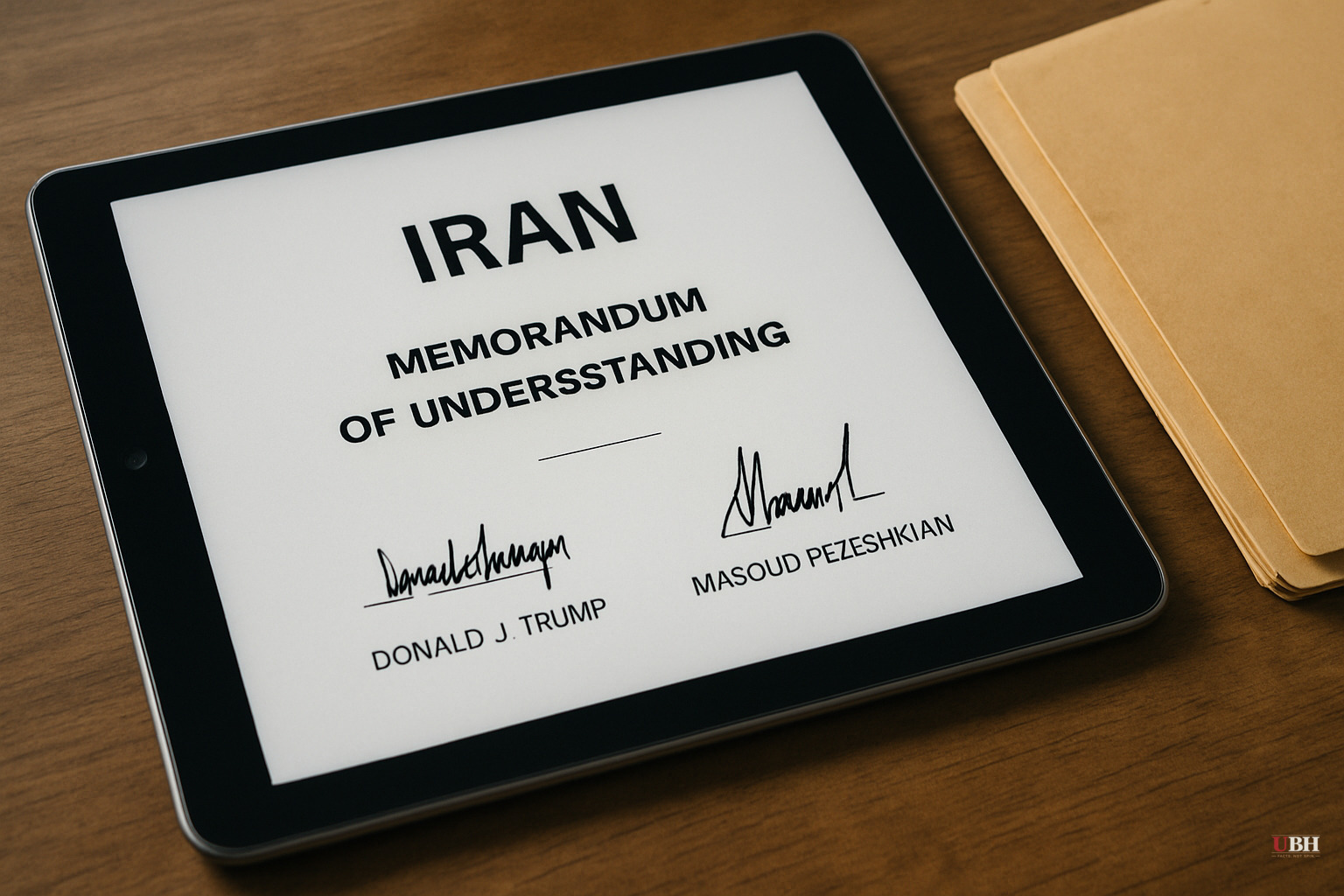
President Donald Trump and Iranian President Masoud Pezeshkian signed the memorandum of understanding electronically on Wednesday, June 17, according to a U.S. official confirmed to CBS News. Trump told reporters he signed while traveling, saying he did so remotely.
Iranian Foreign Ministry spokesperson Esmaeil Baghaei confirmed the signing to the state news agency IRNA, adding that the agreement is already "in effect." Pakistani Prime Minister Shehbaz Sharif, who helped mediate talks, wrote on X that "as a first step, Islamic Republic of Iran will instantly reopen the Strait of Hormuz and the United States of America will immediately lift the naval blockade."
Because both sides signed remotely, Baghaei said there will be no formal ceremony in Geneva on Friday as previously expected. Negotiating teams still plan to be in Switzerland, but whether they meet in person is unresolved as of Wednesday evening, according to Al Jazeera.
What the 14-Point MOU Actually Says
Senior U.S. officials dictated the MOU's contents to journalists Wednesday before the signing, according to The Guardian. Key provisions:
- Immediate, permanent halt to military operations on all fronts, including Lebanon, the moment both sides sign.
- Strait of Hormuz reopens immediately; U.S. naval blockade lifts in exchange.
- Iran down-blends its 440kg stockpile of highly enriched uranium on Iranian soil under IAEA supervision.
- Sanctions waivers on Iranian oil exports, banking, insurance, and transportation go into effect immediately.
- Both sides get 60 days to negotiate a final deal covering enrichment levels, remaining nuclear issues, and full sanctions relief.
The Guardian notes an important nuance on the uranium provision: Iran offered to down-blend its stockpile inside the country back in February, two days before the U.S.-Israel war began. That was a position Tehran held throughout negotiations, meaning the MOU reflects a U.S. compromise on location, not a new Iranian concession.
The Lebanon clause is significant. It requires Iran to restrain Hezbollah, but Israel was not a party to the MOU and may not consider itself bound by it. CBS News reported that Israel has continued limited strikes in Lebanon since Trump's announcement, and Tehran warned those strikes would constitute a violation of its agreement with Washington.
The Sanctions Waiver Problem
Trump may not have the domestic legal authority to issue the sanctions waivers the MOU promises "immediately." Harvard Law professor Jack Goldsmith, writing in his Executive Functions newsletter cited by Reason's Volokh Conspiracy, raises this concern. The Iran Nuclear Agreement Review Act of 2015 (INARA) temporarily bars a president from waiving statutory Iran sanctions under certain conditions. Goldsmith acknowledges the executive branch has counterarguments, and he concedes that no institution is likely to force compliance in the near term. But the gap between what Trump promised in the MOU and what the law currently permits is real, not hypothetical.
The sanctions relief is the core of what Iran receives. The two large numbers circulating publicly, $24 billion and $300 billion, are routinely misrepresented. Reason's reporting makes the distinction cleanly: the $24 billion is Iranian money frozen in foreign bank accounts, revenue from past oil sales Iran was paid but could never withdraw due to sanctions. The $300 billion is projected private investment in Iran's reconstruction. Neither figure is a U.S. Treasury payment to Tehran. "Iran is not getting a single dime of American money," Vice President J.D. Vance said.
Senators Cory Booker (D-N.J.) and Chris Murphy (D-Conn.) have described the MOU as a "payment to Iran." Former Secretary of State Mike Pompeo accused Trump of trying to "pay the IRGC to build a WMD program." Those characterizations conflate sanctions relief with direct transfers, which Reason correctly flags as misleading. The stronger, good-faith version of the hawk concern is this: lifting sanctions restores Iran's oil revenue and access to frozen accounts, freeing up resources that Tehran's government can allocate however it chooses, including to proxy forces and weapons programs. That concern is legitimate on its own terms and does not require inflating the dollar figures to make it.
The Trump administration's answer is that the MOU's nuclear provisions, especially the IAEA-monitored down-blending, are stricter than the 2015 JCPOA, which Trump exited approximately eight years ago. CBS News reports the administration is pitching the MOU as a two-month sprint toward a final deal that will resolve enrichment levels and remaining weapons-related questions.
What Is Still Unresolved
Shipping firms told CBS News they need clarity and security guarantees before resuming normal Hormuz transit operations. Iranian tankers were already crossing the U.S. naval blockade line Wednesday, adding to confusion about the blockade's actual status before the signing was official.
Israel's position remains the largest wild card. The MOU covers Lebanese operations and implicitly covers Gaza-adjacent Iranian proxy activity, but Israel has conducted its own strikes independently throughout the 110-day conflict. Al Jazeera's Mike Hanna noted that there is "a great deal of dissatisfaction" with the MOU among some Republicans, and that the administration is "fighting hard to persuade" both the public and Congress that this is not a U.S. defeat.
The unresolved legal question Goldsmith raised, whether INARA actually blocks the president from delivering the immediate sanctions waivers the MOU commits to, will likely land in front of Congress within days. If Republican senators decide to use INARA as leverage, the 60-day negotiating window shrinks considerably before it has properly started.
Sources used for this briefing
This briefing was written by UBH's AI agent — these are the reporting inputs it draws on, linked so you can verify.


