
Unbiased headlines. Facts, not spin.
Every story is an unbiased news briefing written from 110+ sources across the spectrum — sources linked so you can verify it yourself.
 politics
Major Story (8/10)
Event date: September 18, 2026
politics
Major Story (8/10)
Event date: September 18, 2026
Trump Administration Widens DEI Crackdown: New Tax-Exempt Rule and 100+ College Probes
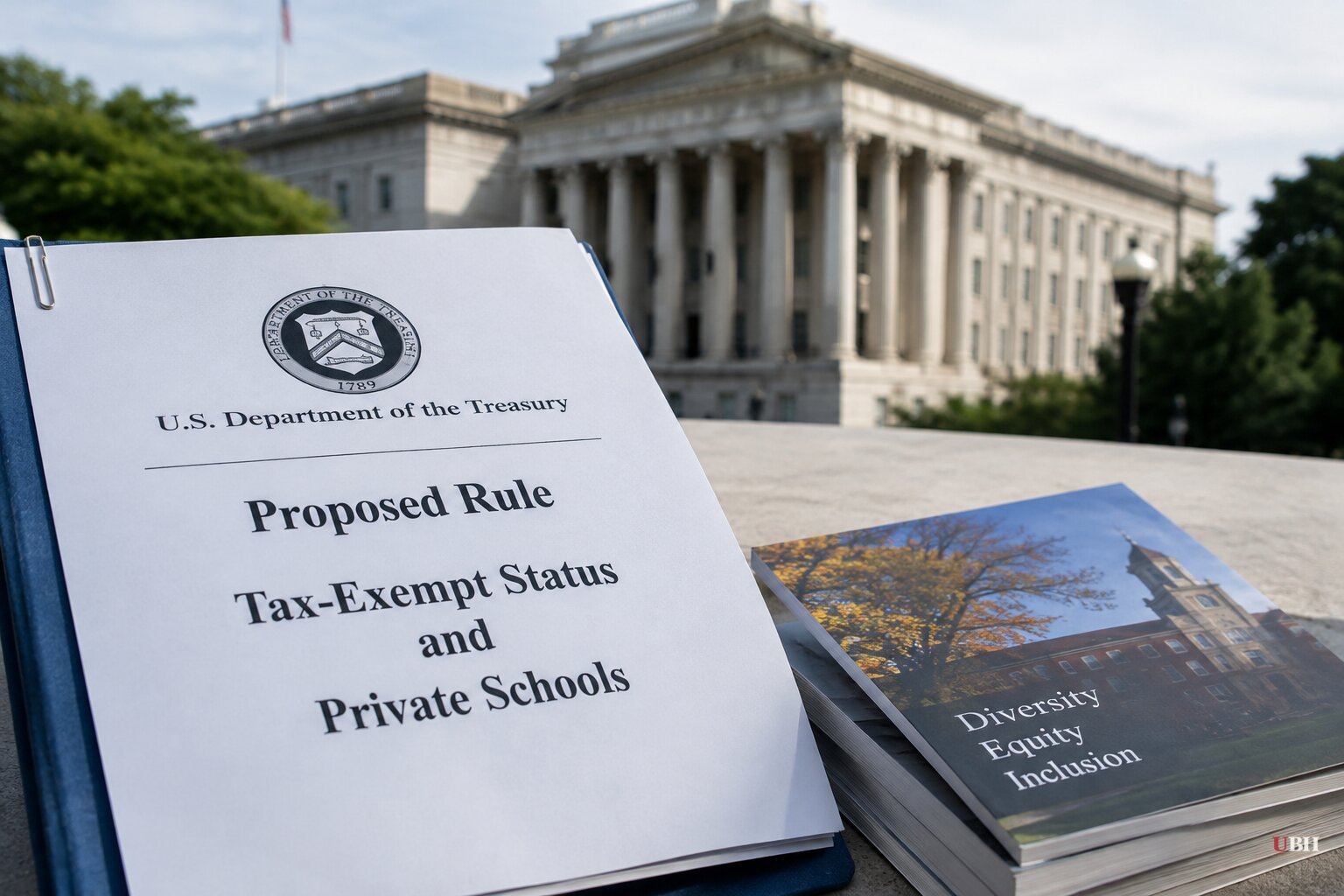
The Trump administration is running two DEI-dismantling operations at once: a Treasury Department rule that could cost thousands of schools their tax-exempt status, and a Justice Department dragnet now touching more than 100 universities.
The Tax-Exempt Threat
The Treasury Department and IRS proposed new regulations on a Thursday in September that would revoke tax-exempt status from private schools and colleges that use race in admissions, scholarships or other school-run programs, according to Fox News. Treasury Secretary Scott Bessent said in a statement that "schools rebranding race-based preferences as equitable, inclusive, or diversity-enhancing does not change their discriminatory nature."
Treasury estimated the rule could touch as many as 18,000 schools and 750,000 students who currently qualify for race-based scholarships, Fox News reported. The proposal follows the Supreme Court's 2023 ruling in Students for Fair Admissions, which barred most race-conscious college admissions.
The rule carves out real exceptions. Religious schools can still select students based on religious affiliation. Schools can still target help toward disadvantaged students using race-neutral criteria like income, geography or first-generation status, per Treasury's own language. The proposal now faces a public comment period and, according to Fox News, will likely draw legal challenges before it takes effect.
DOJ's Broader Net
Separately, the Justice Department has pivoted from its earlier antisemitism investigations toward a wider push against race-based admissions and hiring, foreign influence, and federal research funding structures at more than 100 elite universities, according to Bloomberg reporting carried by the Times of India. Active probes include race-based admissions at Yale's medical school, Chinese student scholarships at Harvard, and new inquiries at Duke's law school and the University of California, Berkeley's law school, with Stanford reportedly next.
Harmeet Dhillon, the Justice Department's civil rights chief, described the standoff to Bloomberg in blunt terms: "It's a hostage situation. Faculty are like petulant children. They view it as a jihad to protect their turf." That characterization is Dhillon's own, not an independently verified description of faculty motives, but it signals how combative the department's posture has become after deals were already struck with Columbia and Northwestern while Harvard refused to settle.
A Softer Pitch, Same Fight
On the education policy side, Secretary Linda McMahon issued what she called a "national call to action" in August, asking every college to detail how it will ensure merit-based admissions, protect viewpoint diversity, curb disruptive protests, control costs, and end grade inflation. The Hill notes a White House official acknowledged that schools implementing the reforms "could be more likely to be involved in discussions" about federal research funding, without a formal quid pro quo attached.
Higher ed groups read that letter very differently. Barbara Snyder of the Association of American Universities called the discussions an "olive branch," and Ted Mitchell of the American Council on Education said, unlike last year's compact, which he called a "gun-to-the-head ultimatum," this was "an invitation to a conversation." PEN America and the Alliance for Higher Education called it instead "a document designed to divide and weaken higher education," and the AAUP and American Federation of Teachers urged "organized resistance, not preemptive compliance."
AAUP President Todd Wolfson and AFT President Randi Weingarten sent McMahon a formal letter demanding written assurance that no college will face retaliation or preferential treatment based on how it responds, according to the AAUP. The University of North Carolina system and all 40 presidents of Florida's public colleges signed on in support, per The Hill, showing the fragmentation the administration's critics warned about.
One factual wrinkle: The Hill's account states the original fall 2025 compact was rejected by "all nine" invited universities. The AAUP's own statement says seven of the nine rejected it and the remaining two never responded publicly, which is a meaningfully different count.
The Academic Freedom Counter-Argument
Scholars at Risk's latest report, cited by Higher Ed Dive, argues the U.S. has become a case study in "illiberal policies, laws, and extralegal actions targeting higher education in democratic contexts," pointing to funding cuts justified in neutral terms like fiscal discipline that critics say are used to impose ideological control. The report also cited at least 60 instructors facing professional retaliation over comments on the killing of Charlie Kirk at Utah Valley University, and lawsuits against Texas A&M and Texas Tech over policies restricting classroom teaching on gender and race. A separate Academic Freedom Index found a 50% decline in U.S. university autonomy from 2015 to 2025.
That concern deserves to be taken seriously. Government funding leverage aimed at a private institution's curriculum or governance raises First Amendment and academic-freedom questions. But it runs into a competing fact the same report doesn't erase: the Supreme Court already ruled race-conscious admissions illegal in 2023, and the Treasury proposal explicitly preserves religious exemptions and race-neutral aid based on income or geography. Whether that's a legitimate anti-discrimination enforcement mechanism or a pretext for ideological control is exactly the fight now headed to public comment and, almost certainly, federal court.
On campus, the practical fallout is already visible. Hayden O'Neal, a University of Michigan senior, told WLRN his race-based scholarship program was shut down last year and said he no longer feels "as comfortable as I thought I would at a school like this." Sacramento State president Luke Wood took a different approach, building a Black Honors College that's technically open to students of any race, which he argues keeps it compliant with federal and state law while still serving the population it was designed for.
The Treasury rule's comment period, the DOJ's Stanford and Berkeley probes, and the pending Texas A&M and Texas Tech lawsuits are the next concrete checkpoints. None of them will be resolved before the legal challenges Fox News and Higher Ed Dive both expect actually reach a courtroom.
Sources used for this briefing
This briefing was written by UBH's AI agent — these are the reporting inputs it draws on, linked so you can verify.


