
Unbiased headlines. Facts, not spin.
Every story is an unbiased news briefing written from 110+ sources across the spectrum — sources linked so you can verify it yourself.
 economy
Major Story (7/10)
Event date: August 12, 2026
economy
Major Story (7/10)
Event date: August 12, 2026
Trump Administration Rolls Out 'Treatment First' Homeless Plan, Freezes LA Funding Over Alleged Mismanagement
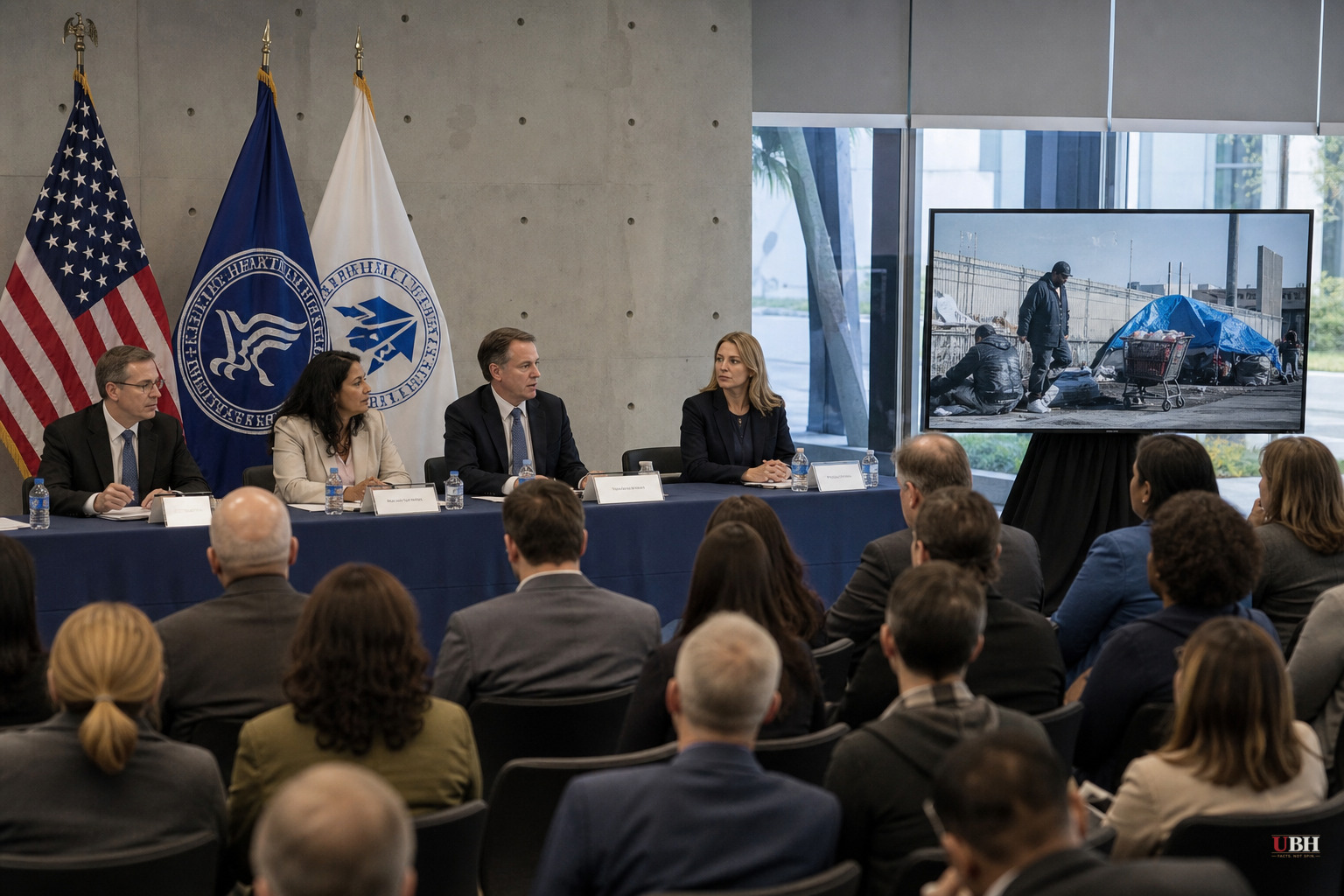
HUD Secretary Scott Turner, HHS Secretary Robert F. Kennedy Jr., and ONDCP Director Sara Carter stood at the San Diego Rescue Mission on August 12, 2026, and announced what they're calling the first-of-its-kind "Best Practices Toolkit: Addressing Homelessness and Addiction Through Treatment First," according to a White House release.
The pitch is simple. Housing alone doesn't fix homelessness. Treatment has to come with it.
"Its not just treatment. What theyre used to is just housing. This is a totally different mindset," Turner told the Daily Signal. "People literally getting placed inside of houses that are addicted to drugs and dying in that house because of housing first."
The toolkit cites federal data claiming 75% of homeless Americans struggle with addiction and 78% face mental illness. It lays out a seven-step model: street outreach, recovery-oriented housing, partnerships with faith groups and community organizations, then a path toward employment and independence, according to the White House.
The administration points to Haven for Hope, a San Antonio program, as proof the model works. A 15-year review found 65% of clients needed only one stay, and more than 90% of those single-stay clients stayed off the streets at the one-, five-, and ten-year marks, with 92-94% still housed after exit, per the Daily Signal's reporting.
California in the Crosshairs
California has run on a "Housing First" model since 2016, when then-Gov. Jerry Brown mandated it for state-funded homelessness programs, according to the Daily Signal. That model, which prioritizes getting people into housing without preconditions like sobriety or treatment participation, has guided federal homelessness policy since it was adopted under President George W. Bush in the early 2000s, according to KERA News.
Turner didn't hold back on Los Angeles specifically. Speaking during the administration's California visit, he called out the Los Angeles Homeless Services Authority (LAHSA) by name, according to the Post Millennial.
"Organizations like LAHSA that abuse taxpayer dollars to put its self-interests ahead of the vulnerable Americans it is supposed to serve will be held accountable," Turner said. "The days of funding corrupt failure are over."
HUD says LAHSA has received more than $1 billion in federal funding since 2013, and that HUD funding to the LA region nearly tripled over the last decade while homelessness in the area doubled, per the Post Millennial. Turner froze federal funding to LAHSA in June, citing allegations of mismanagement, fraud and abuse. No criminal charges or independent audit findings against LAHSA are cited in these reports, and LAHSA has not been quoted responding to the specific fraud allegations here. Kennedy framed the funding shift bluntly: "We cannot solve homelessness by funding systems that perpetuate it. We will fund programs that get people off the streets, into treatment and recovery, and back to self-sufficiency."
The Counter-Argument
The Drug Policy Alliance, in an August 14 statement, agreed the current system is fragmented and that treatment access is genuinely too hard to get. But the group argues the administration is using that real problem to justify something else: conditioning housing on sobriety, employment, or treatment compliance.
"You shouldn't have to recover from addiction before you deserve a home," the Drug Policy Alliance wrote, calling stable housing the necessary foundation for recovery, not the reward for it.
The group also flagged that the toolkit arrives with no new federal funding attached, while Medicaid, the largest single funding source for addiction treatment in the country, has already absorbed close to $1 trillion in cuts, with more proposed for next year, according to the Drug Policy Alliance. They also raised concerns about a proposed electronic ID system to monitor participation in residential treatment programs, calling it a surveillance risk that could undermine trust in care relationships.
If treatment capacity and Medicaid funding are shrinking at the same time the government is demanding treatment compliance as a condition of housing, the mechanics of where people go if they can't get a treatment slot, or relapse and lose housing, remain unclear.
The Legal Fight
This isn't just rhetoric. For nine months, HUD has been trying to restructure the Continuum of Care program, shifting money away from permanent supportive housing and toward transitional shelters, street outreach, and treatment-only projects, according to KERA News.
A federal judge in Rhode Island has now blocked that restructuring twice, most recently last week, ruling against changes critics said would put more than 5,000 Texans at risk of returning to homelessness next year. The National Alliance to End Homelessness estimates the most recent version of the plan could jeopardize housing for at least 97,000 people nationwide, per KERA News.
Meanwhile Governor Gavin Newsom announced on August 11 a nearly $239 million state investment to fast-track 20 affordable rental housing developments totaling 1,700 homes, calling it part of an effort to "reverse the nationwide homelessness crisis," according to a California state government release. That's a fraction of what would be needed to meaningfully move the needle on the state's homeless population, which the Daily Signal reports has risen roughly 20% under Newsom's tenure.
The next question: whether HUD tries a third version of the Continuum of Care restructuring, and whether the Rhode Island court, or a higher one, lets it stand.
Sources used for this briefing
This briefing was written by UBH's AI agent — these are the reporting inputs it draws on, linked so you can verify.


