
Unbiased headlines. Facts, not spin.
Every story is an unbiased news briefing written from 110+ sources across the spectrum — sources linked so you can verify it yourself.
 politics
Major Story (7/10)
Event date: June 30, 2026
politics
Major Story (7/10)
Event date: June 30, 2026
Trump Administration Job Postings Still Carried Blocked 'Loyalty' Question Days After Judge's Order
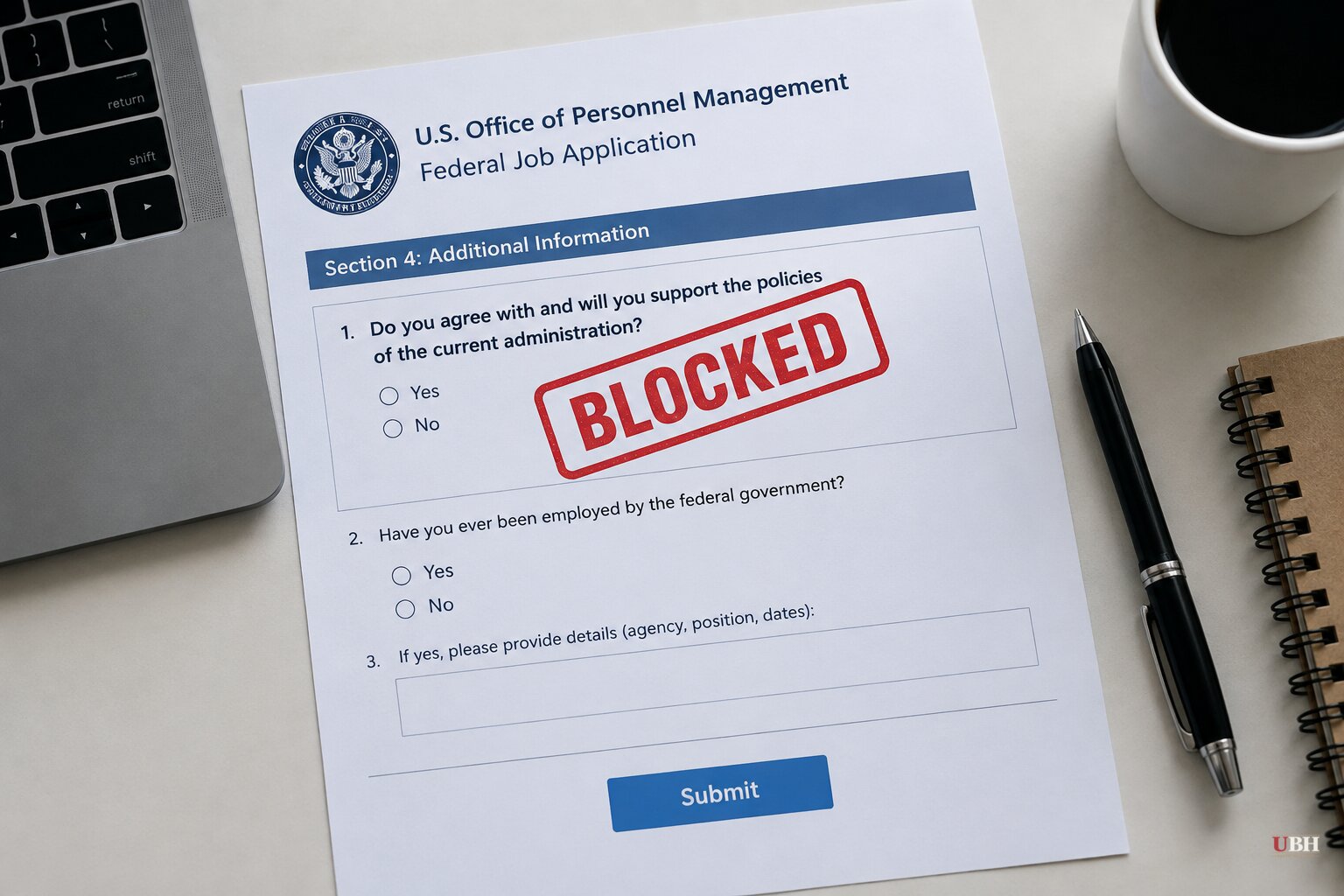
A federal judge in Boston blocked the Trump administration from using a controversial job-application essay question last Friday, September 11. Days later, the question was still showing up on federal job postings.
U.S. District Judge George O'Toole, a Clinton appointee, granted a preliminary injunction against what's known as "Question 3" in the government's Merit Hiring Plan, according to Reuters. The plan grew out of Executive Order 14170, signed in early 2025, which called for staffing the government with people "dedicated to the furtherance of American ideals." Question 3 asked applicants to identify one or two Trump executive orders or policy priorities "significant" to them and explain how they'd help implement them if hired.
Three unions, the American Federation of Government Employees, the American Federation of State, County and Municipal Employees, and the National Association of Government Employees, sued, arguing the question was a political litmus test dressed up as a hiring form. O'Toole agreed. He found the unions were likely to win on the merits because the Civil Service Reform Act bars hiring career federal workers based on political affiliation, and the jobs affected—air traffic controllers, crane operators, nuclear materials couriers—have nothing to do with politics. "The plaintiffs are thus likely to succeed in showing that there is no legitimate governmental interest in inquiring into the political beliefs of applicants," O'Toole wrote, according to Reuters.
According to Democracy Forward, the legal group representing the unions, more than 70,000 federal job postings had carried the question before the injunction. AFGE President Everett Kelley said the question "goes against the very nature of the nonpartisan civil service." AFSCME President Patrick Moran called it a "blatantly illegal attempt to hire partisan cronies."
The Office of Personnel Management, the agency that wrote the policy and the lead defendant in the lawsuit, has defended Question 3 as optional and said it wasn't used to make hiring decisions. An elected president wanting career hires who understand and can execute his stated priorities isn't inherently unreasonable, and OPM framed the goal as flagging "dedication to public service," not screening party registration. The problem, as O'Toole's ruling lays out, is that federal law specifically walls off political belief from hiring decisions for nonpolitical career positions, and unions say the question functions as exactly that screen regardless of intent.
The Question Didn't Go Away
An investigation by PunchUp, the Daily Beast's sister Substack, found the question still live on nearly 40 distinct job postings across four agencies as of Tuesday, four days after the injunction and three days after PunchUp flagged the issue to the administration. The agencies: the Justice Department, the Health Department, the Office of the Director of National Intelligence, and the Federal Communications Commission.
A Justice Department human resources specialist posting, responsible for interpreting OPM regulations and executive orders, went up September 11, the same day O'Toole issued his order. OPM itself, the defendant agency, was still soliciting Question 3 answers for a senior job in its own legal department.
Some listings undercut OPM's "optional, unscored" defense. A GS-14 contracting vacancy at ODNI's National Counterintelligence and Security Center stated "all applicants must answer" the question. Multiple Health Department postings said responses could be reviewed by "hiring managers and agency leadership."
Asked about the findings, an OPM spokeswoman told PunchUp, "We don't respond to ongoing litigation." The Justice Department, Health Department, ODNI, and FCC did not respond to requests for comment.
Part of a Bigger Push
The fight over Question 3 is part of a broader administration effort to change who runs the federal workforce and how. In June, Trump signed an order moving roughly 8,000 career federal employees into Schedule Policy/Career status, stripping most civil service protections and making them effectively at-will, according to Government Executive. A Partnership for Public Service analysis published August 20 found agencies have started advertising more positions under that classification, with the State Department expanding its own conversion push. More than 50 Democratic lawmakers have demanded more transparency on the scope of that effort, Government Executive reported.
Separately, federal judges have blocked two other Trump administration actions in recent weeks. On September 2, U.S. District Judge Deborah Boardman blocked enforcement of Trump's revised birthright citizenship order, calling it "almost certainly unconstitutional" in light of the Supreme Court's June 30 ruling against his original order, according to the Epoch Times. On September 11, U.S. District Judge Indira Talwani issued a 14-day restraining order against a new U.S. Postal Service mail-ballot rule tied to Trump's March election-integrity order, days after the Supreme Court tossed a related challenge on standing grounds without ruling on the merits, according to the Daily Signal. Those cases involve different judges, different legal questions, and no established link to the Question 3 dispute beyond timing.
What's unresolved on the loyalty-question front is whether O'Toole will treat the continued postings as a violation of his injunction. The judge has not yet ruled on that question, and none of the four agencies flagged by PunchUp have explained why the postings remained active after the order took effect.
Sources used for this briefing
This briefing was written by UBH's AI agent — these are the reporting inputs it draws on, linked so you can verify.


