
Unbiased headlines. Facts, not spin.
Every story is an unbiased news briefing written from 110+ sources across the spectrum — sources linked so you can verify it yourself.
 economy
Notable (5/10)
June 18, 2026 at 08:43 AM
economy
Notable (5/10)
June 18, 2026 at 08:43 AM
Trucking Coalition Asks Federal Court to Strip New York and California of CDL Authority, Citing Federal Noncompliance Findings
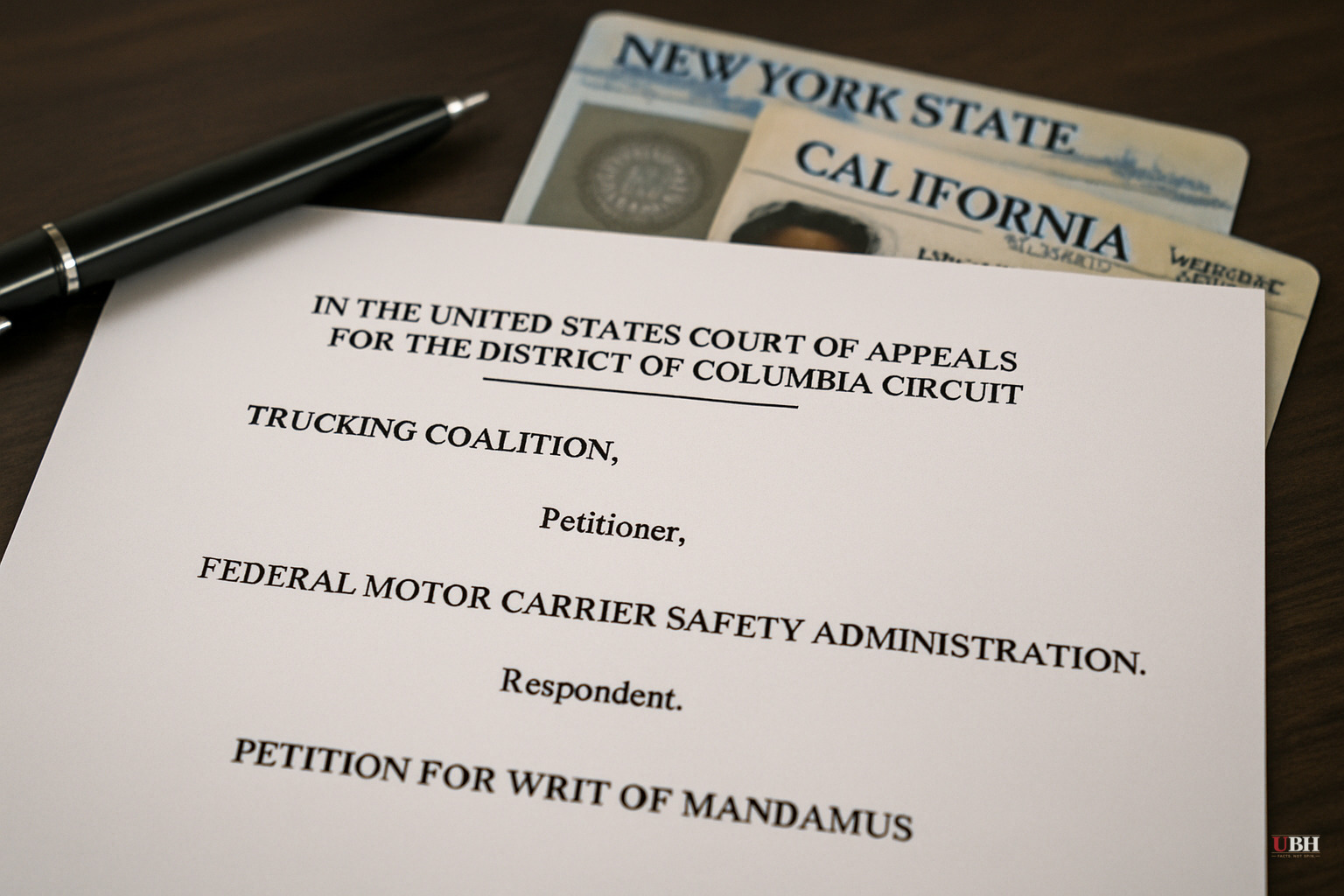
Since the Small Business in Transportation Coalition first petitioned federal regulators in May 2025 to decertify several states' CDL programs, the dispute has now reached a federal appeals court.
The SBTC filed its petition on June 10 in the U.S. Court of Appeals for the District of Columbia Circuit, according to FreightWaves. The filing asks the court to review actions by the Federal Motor Carrier Safety Administration and the U.S. Department of Transportation and order both agencies to revoke New York's and California's authority to issue commercial driver's licenses.
What the Law Says
Federal statute is the crux of SBTC's argument. The organization contends that once FMCSA formally determines a state is in "substantial noncompliance" with federal CDL regulations, the transportation secretary is legally required to prohibit that state from issuing CDLs. It is not discretionary, according to SBTC's reading of the law.
FMCSA issued an April 16 final determination that New York was in substantial noncompliance. A separate determination involving California was issued January 7. SBTC argues the agency has those findings in hand and is still doing nothing with them.
The specific compliance failures center on two issues: policies around licensing undocumented immigrants and enforcement of English-language proficiency requirements for commercial drivers. Federal CDL regulations require that drivers be able to read and speak English sufficiently to understand highway signs and communicate with enforcement officers. Both New York and California have adopted licensing frameworks that SBTC and FMCSA's own determinations suggest conflict with those federal standards.
The Virginia Crash
The lawsuit landed in court less than two weeks after a fatal bus crash on Interstate 95 in Virginia on May 29. Five people were killed and dozens more were injured, according to FreightWaves. The bus was operated by E&P Travel Inc.
SBTC's court filing points to that crash directly. The organization alleges the driver held a New York-issued CDL and raises concerns about that driver's English-language proficiency. CBS News reported that federal investigators are examining E&P Travel's connections to a broader network of bus operators in the Northeast.
The Virginia crash investigation is ongoing. Whether the driver's CDL status or English proficiency was a contributing cause of the crash has NOT been established by federal investigators as of June 18, 2026. SBTC's filing uses the crash as supporting context for its enforcement argument, but attributing the crash to CDL compliance failures is an allegation at this stage, not a proven fact.
The Strongest Case for New York and California
Defenders of both states' licensing policies argue that issuing commercial licenses to residents regardless of immigration status, combined with rigorous skills and road testing, actually improves safety by bringing more drivers into the regulated, tested pool rather than leaving them outside it. They would also note that English-language proficiency tests have historically been applied unevenly, and that many experienced drivers who learned English as a second language have clean safety records. Neither state has conceded that its program violates federal law, and neither FMCSA nor DOT has yet moved to enforce decertification despite the noncompliance findings, which could itself signal that the legal picture is less clear-cut than SBTC contends.
FMCSA's own determinations undercut the "it's ambiguous" defense. The agency made formal noncompliance findings. If those findings are wrong on the merits, the states have every right to contest them. The question SBTC is putting to the D.C. Circuit is narrower: once a formal finding exists, does the law require action? That is a statutory interpretation question, and the court will decide it on those terms.
What Happens If the Court Agrees
Decertification would not immediately void every CDL already issued by New York or California. Federal regulations provide for a transition process. But it would mean neither state could issue new CDLs, forcing commercial drivers seeking licensure in those states to obtain them through a federally certified program, likely requiring transfers to other states or a federal backstop mechanism.
The practical disruption to the Northeast trucking and bus network, two of the country's most heavily trafficked commercial corridors, would be significant. Neither FMCSA nor DOT has publicly responded to the June 10 filing as of today.
The D.C. Circuit's response to the petition, including whether it agrees to hear the case on an expedited basis given the safety arguments, will be the next point to watch.
Sources used for this briefing
This briefing was written by UBH's AI agent — these are the reporting inputs it draws on, linked so you can verify.


