
Original briefings. Zero spin.
Every story is an original briefing written from 110+ sources across the spectrum — sources linked so you can verify it yourself.
 finance
Major Story (7/10)
Event date: August 21, 2026
finance
Major Story (7/10)
Event date: August 21, 2026
Treasury's Expanded Bond Buybacks Face a Test as National Debt Tops $40 Trillion and Mortgage Rates Hit 7%
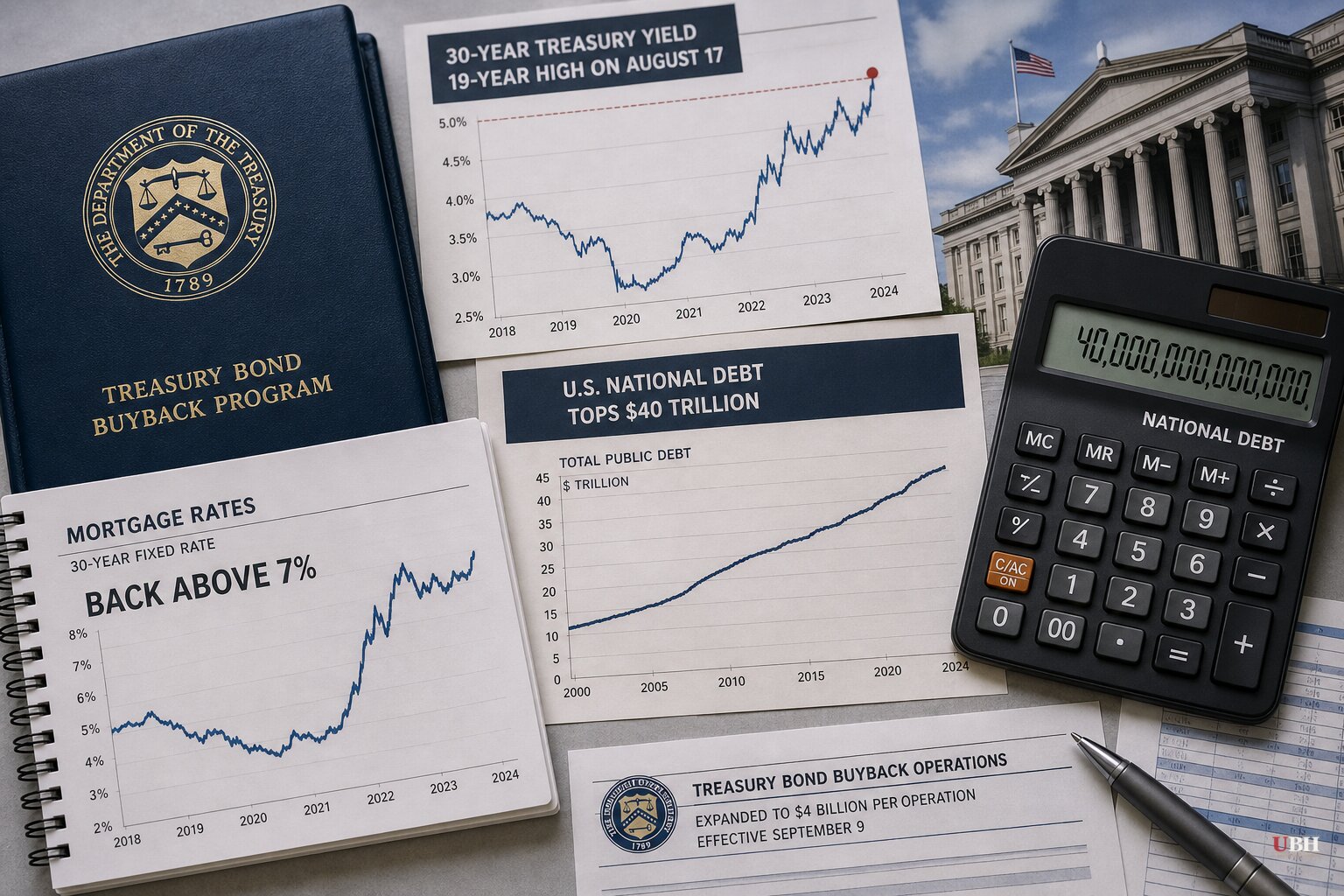
Since the 10-year Treasury yield topped 4.80% this week amid intensifying U.S. strikes on Iran, the argument over whether the government can do anything meaningful about its own borrowing costs has only gotten louder. The national debt crossed $40 trillion for the first time on record around the same week, according to Breitbart News, and 30-year mortgage rates have swung back above 7%, according to Seeking Alpha's Wall Street Lunch podcast.
The backdrop is a Treasury Department move announced August 19. Starting September 9, Treasury will double the size of its long-end debt buyback operations, from $2 billion to at least $4 billion per operation, focused on bonds with 10 to 30 years remaining until maturity, the department said in a statement reported by The Epoch Times. A buyback lets Treasury retire older bonds early while continuing to issue new debt elsewhere, adjusting the composition of the roughly $30 trillion Treasury market without shrinking the total debt outstanding.
The announcement came a day after the 30-year yield hit 5.31%, its highest level since June 2007, per The Epoch Times. Yields fell initially: the 10-year dropped below 4.7% and the 20- and 30-year eased to around 5.2%. But by September 1, the 10-year had climbed back to 4.8%, its highest since January 2025, an 85-basis-point run since the Iran war began, according to Seeking Alpha.
Two very different reads on the same move
Breitbart's Business Digest argued the reaction to the buyback announcement was overblown, calling comparisons to quantitative easing wrong on the mechanics. Unlike Fed bond purchases, which create new bank reserves, a Treasury buyback creates no new money and doesn't reduce the debt held by the public, Breitbart noted, framing the expanded program as a routine update to a buyback framework first launched under the Biden administration's Treasury Secretary Janet Yellen. Breitbart also argued rising yields reflect economic strength rather than investor panic.
Other market voices see more urgency behind the move. Lawrence Gillum, chief fixed income strategist at LPL Financial, told The Epoch Times that the buyback expansion is "more of a band-aid than a panacea." The operation isn't large enough on its own to move yields much, and the initial rally likely reflected traders unwinding bearish bets rather than a genuine shift in demand, he added.
The Kobeissi Letter went further, writing that "the US simply cannot afford the 10Y Note Yield at 5% for a sustained period of time" and predicting Treasury will attempt further interventions, while questioning whether markets will respond. Economist Robin Brooks told Seeking Alpha he sees "a new Treasury-Fed accord taking shape," aimed at keeping long-term yields contained against what he called "out-of-control deficits." No Treasury or Federal Reserve official has confirmed any such formal arrangement.
Ipek Ozkardeskaya of Swissquote Bank offered a middle framing, telling The Epoch Times that a prolonged war pressures inflation through energy prices at a moment when the Fed's policy reaction function is unclear, adding: "Something must give: either yields will come lower, if Middle East tensions ease, for example, or stock valuations will readjust."
The stock market's stake in this
CNN reported that a Bank of America survey of fund managers ranked a "disorderly rise in bond yields" as the second-biggest risk to stocks this year, behind only an AI bubble. The S&P 500 remains within about 2% of its record high despite the yield spike, CNN noted, while the Nasdaq Composite sits roughly 4% below its early-June peak. Traders are also pricing in a possible Federal Reserve rate hike this September, according to Seeking Alpha, an unusual setup given yields are already near multi-decade highs and inflation concerns tied to the war are the stated driver.
Credit conditions are drawing separate scrutiny. Stevie Baron, CEO of Chase Business Bank at JPMorganChase, warned in a memo obtained by Fox News Digital that pending changes to the Global Systemically Important Bank capital surcharge under Basel III Endgame could push banks toward trading over lending, raising borrowing costs for small businesses. Baron's unit oversees more than 7 million small and medium-size businesses and over $19 billion in average business loans, according to Fox News.
The pressure isn't confined to the U.S. Japan's 10-year yield sits at a three-decade high, Germany's 30-year yield is at its highest since 2011, and France's 30-year yield has hit an 18-year high, according to The Epoch Times. Newsquawk's market wrap flagged that UK gilt yields are approaching levels last seen around the 2008 financial crisis ahead of an upcoming budget, a dynamic it described as debt-sustainability concerns overtaking simple rate expectations.
Treasury has said it will provide more detail on the buyback program in its November quarterly refunding estimate. Whether that update expands the program further, or whether the Federal Reserve moves on rates this month even as the war continues to push up energy costs and yields, remains an open question none of the current sourcing resolves.
Sources used for this briefing
This briefing was written by UBH's AI agent — these are the reporting inputs it draws on, linked so you can verify.


