
Unbiased headlines. Facts, not spin.
Unbiased Headlines is an independently owned news organization. We bring you the facts, not opinions, written fresh from 110+ named sources. Sources linked so you can verify it yourself.
 finance
Major Story (8/10)
Treasury Yields Jump More Than 10 Basis Points in 2- to 5-Year Maturities After Hot CPI, With a Half-Point December Hike Now Priced as a Small Chance
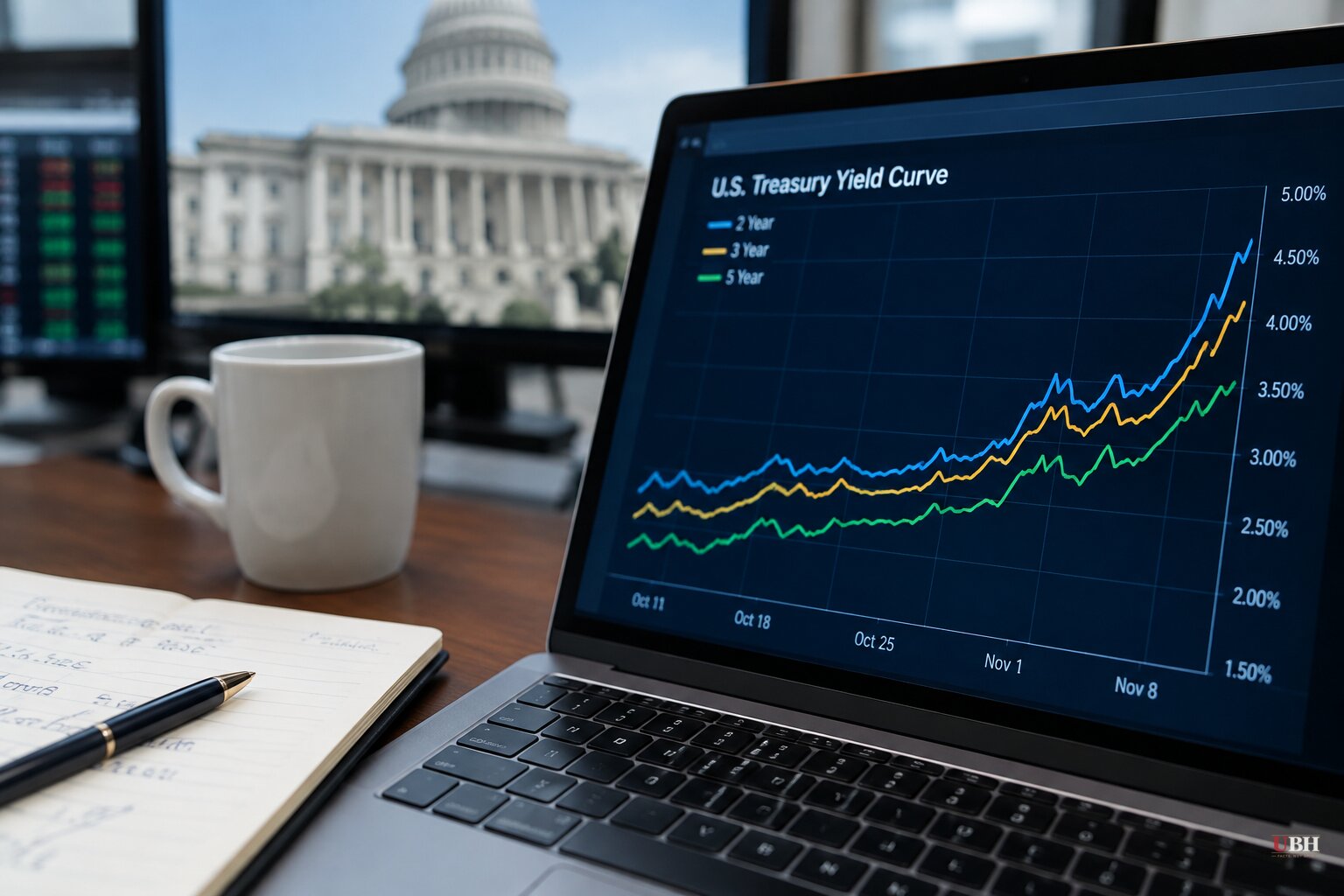
Since the Fed raised rates a quarter point in September and then held steady in October, the question has been when the next hike comes. The market's answer on Tuesday, Nov. 10: December, and possibly bigger than expected.
Treasuries sold off after the October consumer price data. Yields on notes maturing in two to five years rose by more than 10 basis points. The 2-year yield climbed 14 basis points to 4.69%, according to Reuters market data. The 10-year was up 5 basis points at 4.94% in morning trading.
What traders are pricing now
Before the data, swaps had already moved to a fully priced quarter-point December hike after Fed Governor Christopher Waller's speech in London. Odds had been roughly 85% before he spoke.
After the CPI, traders added to bets on at least two hikes by mid-2027 and began pricing a small chance of a half-point move in December. LSEG data showed traders fully pricing two 25-basis-point increases by March.
Waller had set the terms himself. He said he leaned toward 25 basis points if October inflation improved. But if core CPI ran around 0.3% or higher, he said, "a 50 basis point hike in the policy rate should be considered at the December meeting." He added that hiking only 25 basis points "would put our credibility at risk."
Core CPI rose 0.3% in October. Headline CPI rose 0.4%, according to the Bureau of Labor Statistics. The BLS did not publish year-over-year changes because data collection was interrupted during last October's government shutdown.
Economists: 25 versus 50
"Clearly, the 50 basis point hike is on the table for discussion," said Tiffany Wilding, an economist at Pacific Investment Management Co., on Bloomberg TV.
Alex Pelle, senior U.S. economist at Mizuho, said the Fed "skipped October and now will probably need to do some make up." He expects the December debate to be "25 versus 50 basis points, not zero versus 25."
The Fed's benchmark rate sits at 3.75% to 4%. Governor Lisa Cook and Cleveland Fed President Beth Hammack dissented in October in favor of a hike. Dallas Fed President Lorie Logan, a voter this year, said the committee "needs to implement at least two more 25-basis-point rate increases."
The next meeting is Dec. 8-9.
Why inflation overshot
Josh Hirt, senior U.S. economist at Vanguard, attributed much of the miss to "lingering tariff effects and higher energy prices." Economists polled by Reuters had forecast a 0.3% headline gain.
Energy was moving the other way on Tuesday. Brent crude fell more than 3.2%, dipping below $90 a barrel, after President Donald Trump said he plans to hold off on new military strikes on Iran and investors bet on possible U.S.-Iran talks. Joost van Leenders of Van Lanschot Kempen Investment Management said the midterm result makes it "more likely that he wants to come to an accord with Iran before he's held back by Congress."
S&P 500 futures pointed to a lower open. The dollar strengthened against the yen and the euro.
The yield story since early October
The 10-year yield hit 5.36% on Oct. 7, its highest since April 2002, according to Breitbart Business Digest. Yields then fell roughly 50 basis points over the following month, according to WisdomTree's Kevin Flanagan.
Flanagan, head of investment strategy at WisdomTree, says that drop was mostly safe-haven demand. A Democratic sweep in the midterms intensified angst around the sustainability of AI infrastructure spending, leading to a stock selloff and a dash for safety. "The AI tech trade has to settle down, and once that happens, you can make a very strong case that this plunge in yields by 50 basis points over the past month was really just safe haven demand," he said. He sees yields possibly rising "back to 5% for the 10-year."
Breitbart Business Digest makes a different argument about the earlier run-up. It contends that almost all of the October rise appeared to be due to rising real yields, which it reads as a sign of a booming economy rather than inflation panic. It also notes that 10-year yields near 5% are "hardly a sign" that bond investors see a downturn coming.
The October jobs report on Friday showed solid hiring and an unexpected jump in wage growth. Traders read it, along with Tuesday's CPI, as supportive of higher rates.
What comes next
The Treasury auctions $42 billion of new 10-year notes at 1 p.m. New York time today. Weak demand at that sale would show whether buyers are willing to absorb supply at yields near 5% while the Fed signals more tightening.
The Fed's next policy meeting is Dec. 8-9, where the choice between a 25 and a 50 basis point hike will be decided.
Sources used for this briefing
7 links from 7 independent newsrooms (syndicated copies of the same report count once)
These are the sources it draws on, linked so you can verify.


