
Unbiased headlines. Facts, not spin.
Unbiased Headlines is an independently owned news organization. We bring you the facts, not opinions, written fresh from 110+ named sources. Sources linked so you can verify it yourself.
 finance
Major Story (7/10)
SoftBank Posts $7 Billion Quarterly Loss on Ohio Data Center Charge and Doubled Financing Costs
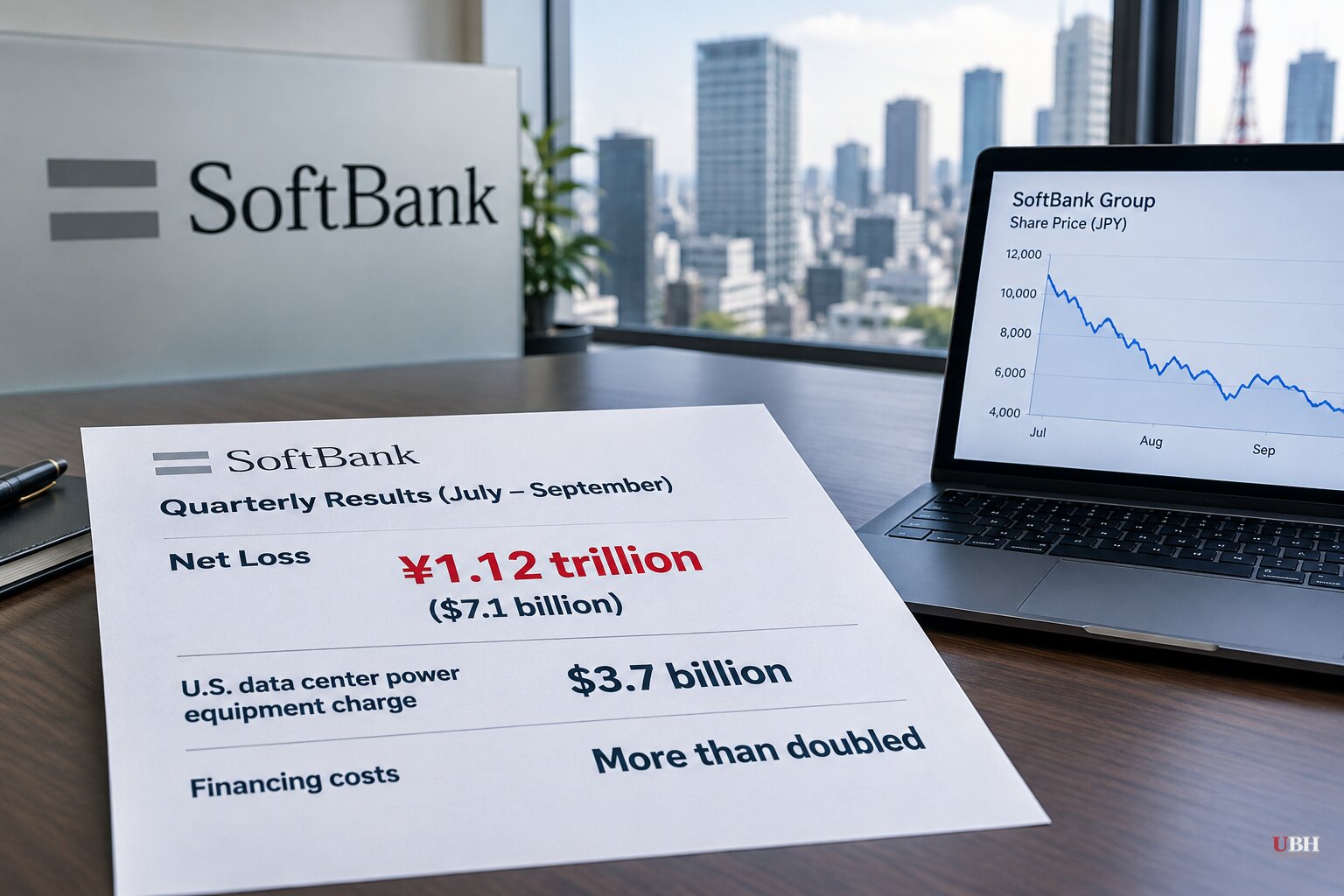
SoftBank Group reported a net loss of ¥1.12 trillion ($7.1 billion) for its fiscal second quarter, the July-September period, on Tuesday, Nov. 10. A year earlier it booked a ¥2.5 trillion profit, largely on a gain in the value of its OpenAI stake.
The result missed badly. Analysts polled by Bloomberg had expected an average profit of ¥129 billion. Three analysts polled by LSEG ranged from a ¥233 billion profit to a ¥113 billion loss.
SoftBank's shares closed 13.9% higher in Tokyo on Tuesday, before the results landed. They remain down more than 50% from a record high in June, according to Bloomberg.
The Ohio write-down
The biggest single hit was a ¥597.2 billion ($3.7 billion) loss tied to power generation equipment for U.S. AI data center projects, including the PORTS-Pike Technology Campus in Pike County, Ohio.
SoftBank said a subsidiary revised its procurement plans as project requirements changed. The charge includes ¥457 billion in non-refundable advance payments and ¥140.2 billion tied to contract changes and settlements.
Cumulative payments for that equipment totaled $9.48 billion at the end of September, the company said.
A SoftBank executive defended the spending on the earnings call. "We made bridge investments in advance to secure power generation equipment in anticipation of shortage," the executive said. Power has become a key constraint on AI data center buildouts as grids field applications from large energy users.
SoftBank said the subsidiary is entitled to rebates of up to $2.1 billion on future purchases. It has not booked an asset for that amount.
Debt is the pressure point
Financing costs more than doubled to ¥462 billion ($2.9 billion) for the quarter. For the six months through September they reached ¥790.7 billion, up from ¥340 billion a year earlier.
During the quarter SoftBank took on an $11.87 billion term loan, a $10 billion dollar-denominated bond and a ¥1 trillion yen-denominated bond. It also raised the margin loan against its Arm stake by $5 billion, to roughly $25 billion. Dollar bonds sold in September carried yields of up to 9.75%.
Net interest-bearing debt stood at ¥10.8 trillion at the end of June, against ¥6.6 trillion a year earlier. Bloomberg reported that SoftBank's credit default swaps have hit their highest levels in years.
Junji Sakurada of Marina Bay Capital Advisors warned Bloomberg before the results that worsening credit conditions could disrupt planned fundraising.
The portfolio
The Vision Fund segment lost ¥81.6 billion in the quarter, compared with a ¥2.38 trillion profit a year earlier. Shares of public holdings such as Coupang and Grab fell. Declines in Arm and Intel shares also dragged on results, according to Bloomberg.
ByteDance was a bright spot, generating a $1.3 billion gain.
For the six months through September, SoftBank posted a net loss of ¥768 billion, against a ¥2.92 trillion profit a year earlier. Revenue rose 13.3% to ¥4.24 trillion on growth in telecommunications and AI computing.
OpenAI is still carried at a gain
The quarter's loss does not come from a markdown of OpenAI. SoftBank's cumulative investment stood at $54.6 billion at the end of September, with a fair value of $99.6 billion, a $45 billion cumulative gain. The company invested another $10 billion on Oct. 1, bringing its total to $64.6 billion for roughly 13% of the company.
The filing left the valuation unchanged from March. SoftBank said a higher valuation from OpenAI's new funding round is not yet reflected and could show up in the fiscal third quarter. The company said that could lift its net asset value and improve its loan-to-value ratio.
Bloomberg News reported that OpenAI raised about $11 billion at a $1.25 trillion valuation, after first seeking $30 billion at $1.4 trillion.
Analysts have pushed back on the idea that investors are writing off AI itself. Johan Shamshad wrote on Investing.com before the results: "The market is not saying SoftBank's AI investments are worthless." His concern was the rising risk premium on financing them.
Politics adds uncertainty
The Democratic Party's strong showing in last week's U.S. midterm elections has raised expectations of tougher regulatory scrutiny of AI, Reuters reported. Bloomberg reported that investors worry the result could stall some of founder Masayoshi Son's projects. Neither the company nor any official has announced a specific policy action affecting SoftBank's projects.
It is unclear what happens to those projects now that the Ohio plans have been revised. SoftBank has not detailed what the revised procurement plans mean for the campus's timeline. The next test is the fiscal third quarter, when the company says an OpenAI revaluation could improve its balance sheet while its interest bill keeps climbing.
Sources used for this briefing
7 links from 7 independent newsrooms (syndicated copies of the same report count once)
These are the sources it draws on, linked so you can verify.


