
Unbiased headlines. Facts, not spin.
Unbiased Headlines is an independently owned news organization. We bring you the facts, not opinions, written fresh from 110+ named sources. Sources linked so you can verify it yourself.
 finance
Notable (6/10)
Coinbase, Kalshi, Payward and Three Trading Firms Ask Court to Hear Their Defense of CFTC on Stock Perpetual Futures
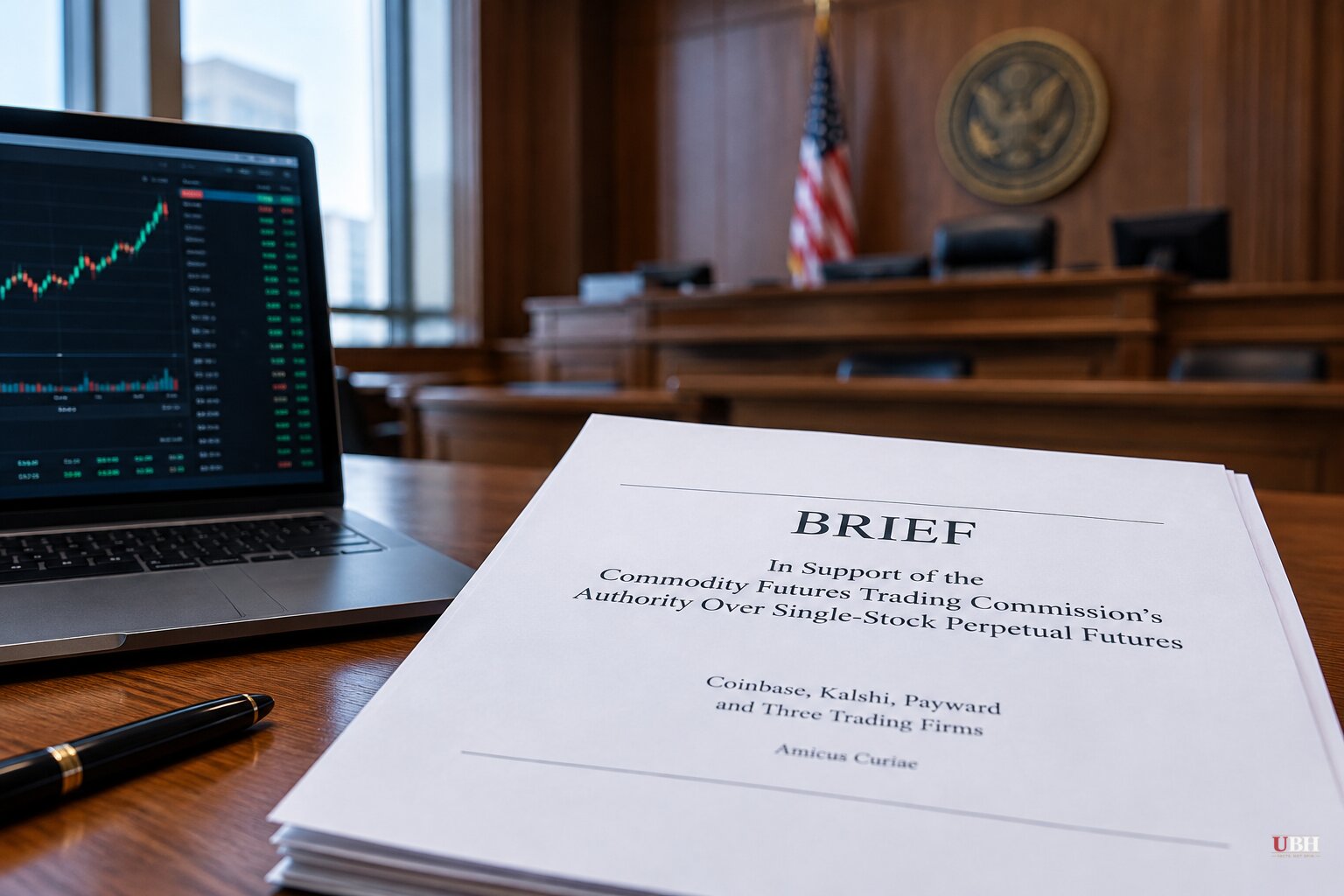
Six firms want a say in the fight over who regulates stock perpetual futures. Coinbase, Kalshi, Payward (the parent of Kraken), DRW Holdings, Jump Trading and Paradigm Operations filed a motion on Monday, Nov. 9, asking the U.S. District Court for the Southern District of New York for leave to file an amicus brief backing the Commodity Futures Trading Commission.
The case is Capital Markets Alliance Association v. Commodity Futures Trading Commission, No. 1:26-cv-09608. The docket lists Judge Lorna G. Schofield as the assigned judge.
How the products got to market
Three exchanges, KalshiEX, Coinbase Derivatives and Bitnomial Exchange, applied on Sept. 18 to list perpetual futures on individual large-cap U.S. stocks. A perpetual future has no expiration date. It rolls until the trader closes it.
The filings went through CFTC Regulation 40.3, under which a filing takes effect if the agency does not act within its review window. The 45-day clock ran out on Nov. 2 with no objection and no separately published approval order.
The next day, Nov. 3, CFTC Chairman Michael Selig issued a statement saying the contracts were deemed approved as security futures products. He said they "can begin trading for the first time on CFTC-registered exchanges." The CFTC said the products remain subject to the Commodity Exchange Act, federal securities laws and both CFTC and SEC frameworks. It also noted that the two agencies signed a memorandum of understanding earlier this year.
Kalshi was listing perps on Qualcomm, McDonald's, Amgen and Costco by Wednesday, Nov. 4, with maximum leverage of 4.9 times, according to Bitcoin Magazine.
The challenge
The Capital Markets Alliance Association sued the same day, naming the CFTC and Selig. Its members include Cboe Global Markets, Citadel Securities and the Healthy Markets Association, according to a declaration from its secretary, Adam Ford.
The group argues that a contract with no expiration date and no delivery obligation is a security-based swap. Those fall under the SEC, not the CFTC. Its complaint also invokes the Administrative Procedure Act, alleging the CFTC never explained its decision, never acknowledged its own past treatment of perpetual derivatives as swaps, and never weighed the effects on investors and securities markets.
Ford said that launching products outside existing regulatory requirements could weaken investor protections and market oversight. Cboe CEO Craig Donohue said the issue "is about investor protection for securities trading and the rule of law."
The alliance wants the approvals vacated, a declaration that the products are security-based swaps, and an order barring the CFTC from giving the approvals effect while the case runs.
What the judge did
Judge Valerie Caproni denied the alliance's request for a temporary restraining order on Nov. 3 after a teleconference. She ruled that declarations from Cboe, Citadel Securities and Healthy Markets were conjectural about the harm members would suffer and did not show irreparable harm that was actual and imminent.
On the merits, her preliminary view went the other way. She wrote that the alliance is likely to succeed on its claim that the CFTC lacks statutory authority to allow perpetual derivatives on individual stocks to be offered to retail investors on CFTC-regulated platforms. Because the contracts do not provide for a sale for future delivery of a single security, she wrote, they cannot be security futures. They appear instead to meet the definition of a swap.
She also found that the balance of equities and the public interest favored the alliance, writing that the agency's actions appear to represent "a major disruption to the equities market."
The order does not decide the case or the alliance's separate motion for a preliminary injunction. The approvals remain in place.
The firms' argument
The six firms say the judge's framing misses the legal test. Their proposed brief argues the Commodity Exchange Act lets perpetual contracts fit within the security futures framework even without a fixed expiration date. "A security future—by definition—cannot be a swap," they wrote.
They say the question is whether equity perpetuals meet the statutory definition of security futures, not whether they resemble other derivatives. They also argue that reclassifying the contracts as swaps would shut U.S. retail investors out of the market. Coinbase general counsel Molly Abraham said Congress set up a framework for security futures in legislation enacted in 2000.
The coalition is not a set of neutral bystanders. Coinbase Derivatives and KalshiEX are two of the three exchanges whose filings are under attack. Payward, which owns Kraken, acquired Bitnomial earlier this year, according to the filing. DRW, Jump Trading and Paradigm described existing or potential interests in trading equity perpetuals.
What comes next
The schedule set at the TRO stage had the CFTC's opposition due Friday, Nov. 6, and the alliance's reply due today, Nov. 10, subject to change by the assigned judge. The court has not yet ruled on whether the six firms may file their brief.
The open question is whether the judge, who has already questioned the CFTC's position, grants a preliminary injunction that suspends products already listed and trading. Operators planning to offer U.S. equity perpetuals face that legal uncertainty until she rules.
Sources used for this briefing
7 links from 7 independent newsrooms (syndicated copies of the same report count once)
These are the sources it draws on, linked so you can verify.


