
Unbiased headlines. Facts, not spin.
Unbiased Headlines is an independently owned news organization. We bring you the facts, not opinions, written fresh from 110+ named sources. Sources linked so you can verify it yourself.
 finance
Notable (5/10)
Event date: November 8, 2026 ·
Goldman Sachs: SpaceX Has Had Little Effect on Nasdaq-100 Since Record IPO
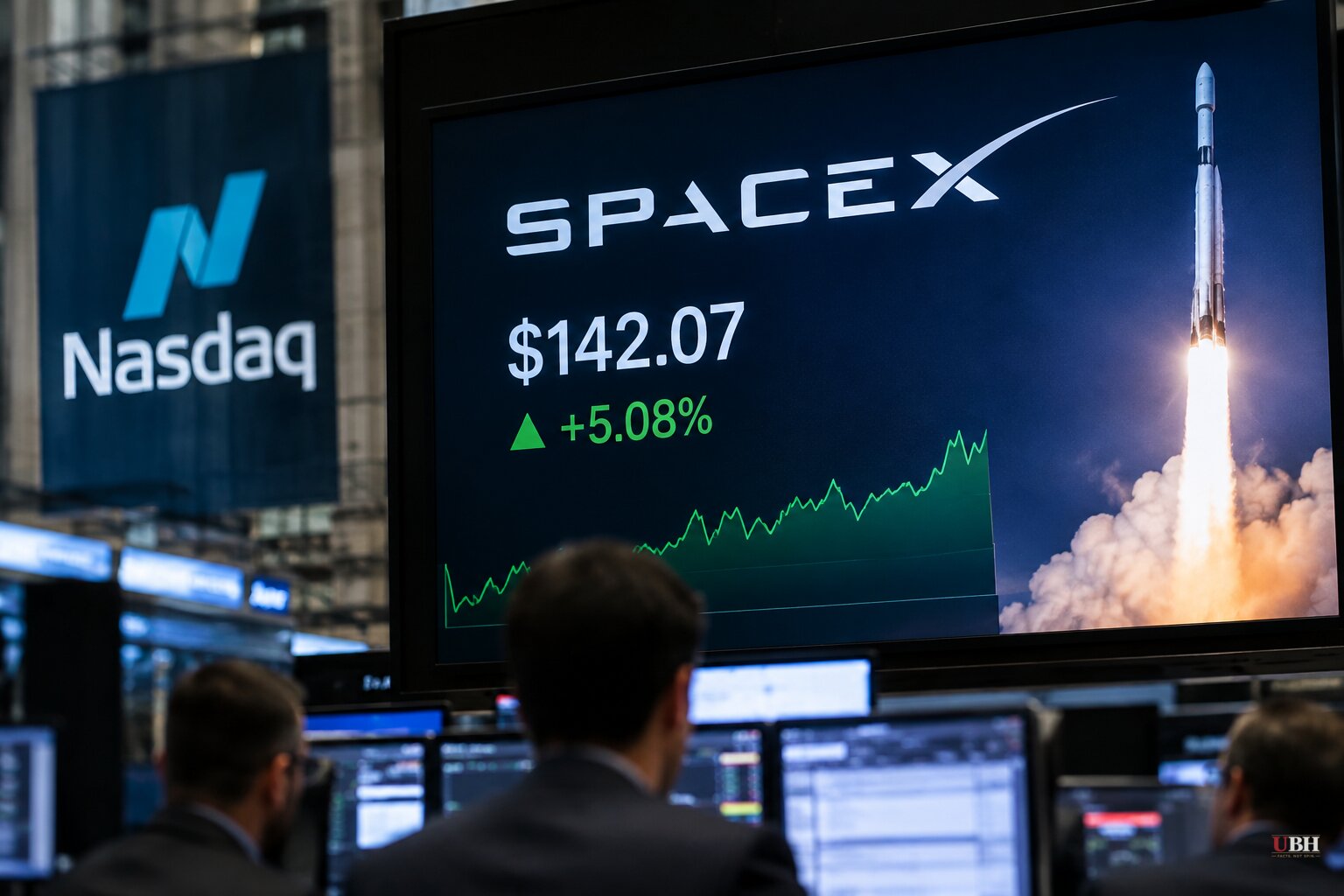
SpaceX was supposed to scramble the big stock indexes. So far it hasn't.
In a Nov. 6 report, Goldman Sachs strategist Ben Snider and his colleagues found that the company's growing weight in major benchmarks has done little to their valuations or performance. "Outside of the very short-term trading pattern around the IPO, SpaceX has had a much smaller impact on equity indices than many investors expected," Snider told clients.
The numbers behind the index effect
SpaceX (Nasdaq: SPCX) listed in June, raising roughly $75 billion at an IPO valuation of about $1.75 trillion. It was the largest public debut on record.
It now makes up about 2.5% of the Nasdaq-100, its biggest weighting among the major U.S. indexes Goldman examined.
The Nasdaq-100 trades at 19.5 times expected earnings over the next 12 months. Strip out SpaceX and the multiple is 19.2. The index has fallen 10.3% since SpaceX joined. Without it, the drop would have been 10%.
Concentration barely changed either. The index's 10 largest holdings make up 50% of its value with or without SpaceX. The top 20 hold 67%, versus 64% without the company.
Snider compared the effect to Tesla's 2020 entry into the S&P 500. Tesla was the largest company ever added to that index at the time, and its impact was also muted.
Lockups did the heavy lifting
Before the offering, some market experts worried that Elon Musk's then-unprofitable company and its volatile shares would whip around indexes like the Nasdaq-100.
Snider credits the staggered lockup schedule. Insider shares have been released in portions on set dates instead of all at once. Roughly a third of SpaceX shares are now available for public trading, up from 5% at the debut.
Morgan Stanley analyst Adam Jonas told clients last month that the lockup expirations have "largely proved to be a non-event."
The schedule isn't finished. By mid-December, all stock held by individuals other than Musk and select other insiders will be free to trade. Musk's own shares stay locked until mid-2027, and the final batch of insider shares unlocks after SpaceX reports second-quarter 2027 earnings, according to the company. Goldman estimates about half of all shares will be tradable by mid-2027.
Musk also keeps a substantial majority of voting power through SpaceX's dual-class share structure. Public shareholders get the economics. They do not get control.
Where the stock stands
SPCX closed Monday, Nov. 9, at $142.07, up 5.8% on the day. That is about 5% above the $135 IPO price and roughly 37% below the early high of $225.64. The 52-week low is $104.83, below the IPO price. Regular trading has not yet opened today, Nov. 10.
Passive exchange-traded funds held roughly $30 billion of SpaceX shares at the end of October, about $20 billion of it in funds tracking the Nasdaq-100.
The company reports three segments: Space (launch), Connectivity (Starlink) and AI. The AI unit came through SpaceX's acquisition of xAI before the IPO, and includes the Grok chatbot and X. Starlink has historically been the profit engine, while AI has been the biggest area of investment and an increasingly large source of revenue. Customers for the launch business include NASA and the Department of Defense.
More index money is coming
The quiet period may not last. Goldman estimates that rebalancing the Russell 1000 Growth Index with current figures would trigger more than $10 billion in buying by passive ETFs tracking it. That rebalance is scheduled for Dec. 11.
The mechanical effect on SpaceX's Nasdaq-100 weighting should be smaller, Goldman said, because of that benchmark's rules for companies with a limited public float.
The S&P 500 is a longer wait. SpaceX is not eligible today. S&P Dow Jones Indices decided earlier this year not to loosen its profitability and seasoning rules. Companies need at least 12 months as a public company, plus positive GAAP net income from continuing operations for the latest quarter and the latest four quarters combined. Goldman says those requirements point to possible inclusion in the second half of 2027.
Anthropic is next in line
The other giant listing is Anthropic. Its S-1 filing is public, but the IPO price has not been set. The Motley Fool's Keithen Drury writes that it is anticipated to reach as high as $2 trillion depending on investor demand.
Drury frames the two as direct rivals in AI, with Anthropic's Claude competing against xAI's Grok. His case: Anthropic is growing faster, while SpaceX's AI division is already generating positive operating income. That is one analyst's comparison, not a settled verdict, and Anthropic has not yet priced.
The Goldman report only covers SpaceX, so it says nothing about how a second trillion-dollar listing would hit the same benchmarks. Index funds would face that question when Anthropic prices and its shares start to trade.
Before then, two dates are fixed: the mid-December lockup expirations and the Dec. 11 Russell rebalance.
Sources used for this briefing
5 links from 5 independent newsrooms (syndicated copies of the same report count once)
These are the sources it draws on, linked so you can verify.


