
Unbiased headlines. Facts, not spin.
Every story is an unbiased news briefing written from 110+ sources across the spectrum — sources linked so you can verify it yourself.
 economy
Major Story (7/10)
June 24, 2026 at 09:19 PM
economy
Major Story (7/10)
June 24, 2026 at 09:19 PM
Toyota Is 83,000 Sales Behind GM Through Mid-2026, the Narrowest Gap Since 2021
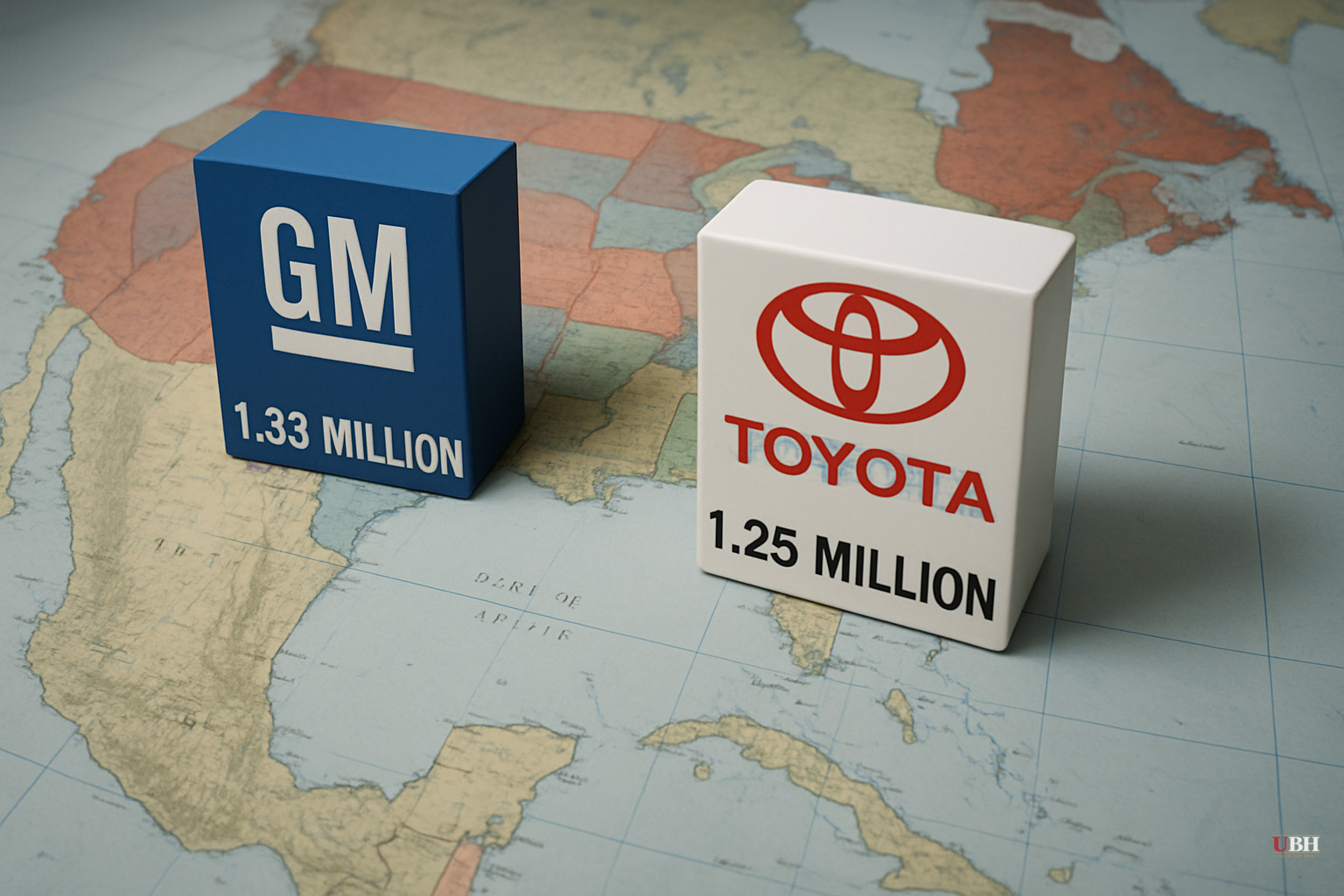
83,255 Vehicles. That's What Separates GM From Losing Its Crown.
For most of the last 95 years, General Motors has been the best-selling automaker in the United States. The lone exception was 2021, when COVID-era supply chain chaos let Toyota slip past them. GM wrote that off as a fluke. Toyota's Akio Toyoda did a "happy dance" and then publicly said the win probably wasn't sustainable.
According to a Cox Automotive forecast released Wednesday, Toyota is on pace to sell approximately 1.25 million vehicles in the U.S. through the first half of 2026, a gain of nearly 1% year-over-year. GM is projected to sell roughly 1.33 million, down 7.2%. The 83,255-unit gap between them is the narrowest since that 2021 anomaly, according to Cox.
"GM may be looking over their shoulder here when we get to the year's end, that Toyota could potentially overtake them as the top-selling manufacturer here in the U.S. market," Charlie Chesbrough, senior economist and senior director of industry insights at Cox Automotive, said during a media event. He added that he is not yet formally forecasting a Toyota win for the full year, but called the trajectory "concerning for General Motors."
The Hybrid Bet Is Paying Off for Toyota
Toyota's position isn't luck. The company has spent decades building out hybrid technology and has continued to roll out new models while doubling down on hybrids. That patience is now a competitive advantage.
Cox projects hybrid sales will be up roughly 10% through the first half of 2026. EV sales, meanwhile, are expected to drop 23.3% over the same period. Toyota has continued rolling out new models, including all-electric vehicles, while maintaining its hybrid leadership.
GM went the other direction. The company spent years treating hybrids as a transitional technology not worth serious investment. Today, GM's only hybrid is a Corvette. Its EV push, spanning Cadillac's full lineup and several other brands, now faces a market that in the first half of 2026 is pulling back from battery-electric vehicles.
"The story is hybrids are having their moment," said Stephanie Valdez Streaty, Cox director of industry insights, at the same Wednesday event.
The Strongest Case for GM
The fair counter-argument is that GM's EV investment is a long-term play, and one bad half doesn't erase it. EVs may be slumping now. Tariff uncertainty, charging infrastructure gaps, and elevated interest rates have all weighed on demand. Those headwinds aren't necessarily permanent. If EV adoption accelerates in the second half of the decade as costs fall and infrastructure improves, GM's early positioning in the space could matter. Pulling back from EVs now to chase hybrids could leave GM flat-footed in 2030 the same way it was flat-footed on hybrids in 2015.
That argument has real merit. But it doesn't fix the problem in front of GM right now: the company is losing market share in a shrinking market.
The Broader Market Is Contracting
GM isn't the only company hurting. Cox forecasts overall U.S. new vehicle sales will be down 3% through the first half of 2026 compared to the same period last year, including a 0.5% decline in the second quarter alone. Tesla, Ford, and GM are projected to post the steepest declines of any major automaker.
Honda, Volkswagen, and Stellantis are all expected to post second-quarter gains, according to Cox. That's a notable data point given that Stellantis was itself a mess of operational and leadership problems as recently as 2024.
What Happens Next
If the Cox projections hold, the question becomes whether GM closes the gap in the second half of the year — historically its stronger sales period — or whether Toyota, buoyed by hybrid demand, keeps the margin this tight through December.
Chesbrough stopped short of forecasting an outright Toyota win for 2026. But the structural dynamic he described isn't a one-quarter blip: GM has no hybrid lineup to speak of, hybrid demand is growing, and EV demand is shrinking. Unless that reverses, GM's strategy is a problem that doesn't get solved by a strong Q3 truck month.
Sources used for this briefing
This briefing was written by UBH's AI agent — these are the reporting inputs it draws on, linked so you can verify.


