
Unbiased headlines. Facts, not spin.
Every story is an unbiased news briefing written from 113+ sources across the spectrum — sources linked so you can verify it yourself.
 politics
Notable (6/10)
Event date: June 30, 2026
politics
Notable (6/10)
Event date: June 30, 2026
Tim Scott's Birth Tourism Bill Would Flip the Burden of Proof on Pregnant Visa Applicants
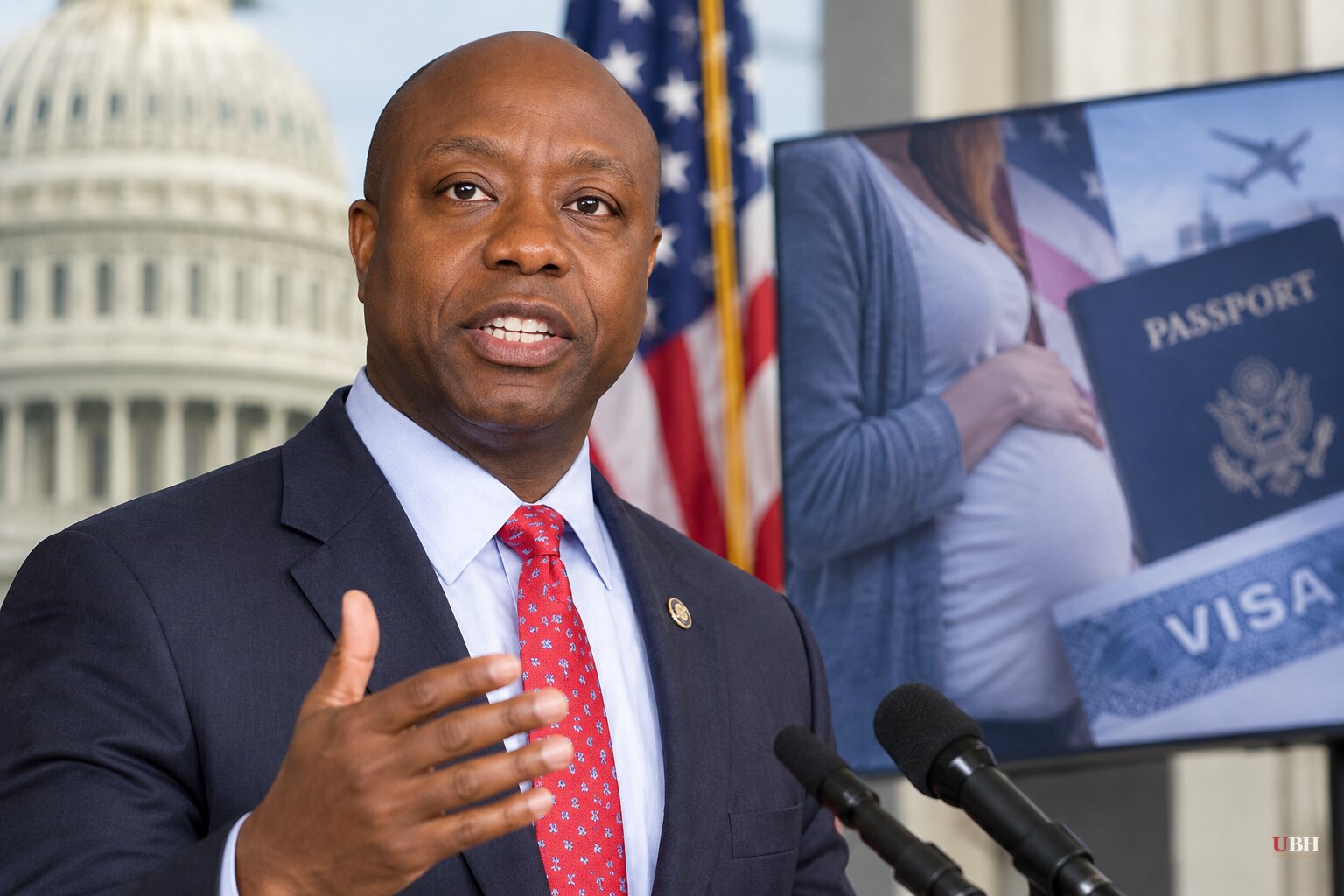
Senator Tim Scott, a South Carolina Republican, introduced the Birth Tourism Elimination Act this week, aiming squarely at the commercial industry that flies pregnant foreign nationals to the U.S. so their kids are born American citizens.
The bill doesn't rewrite the 14th Amendment. It doesn't change who's a citizen. It changes who gets a visa in the first place.
How the Presumption Works
Under Scott's bill, a consular officer who has "reason to believe" a B visitor visa applicant will give birth during her U.S. stay could presume she's traveling primarily to get citizenship for the child. That presumption shifts the burden onto the applicant, who would have to convince the officer she has some other legitimate reason for giving birth here.
The bill also tightens the rules for medical-treatment visas. Applicants would need to show a real medical reason, a U.S. provider who's agreed to treat them, an estimated cost and timeline, and proof they can actually pay for it from legal sources, according to the bill text summarized by Scott's office.
"American citizenship is not for sale, and foreign nationals have no right to buy citizenship for their children," Scott said in a statement released by his office. He added the bill "makes it clear that our temporary travel programs cannot be exploited for the purpose of obtaining American citizenship."
The Case That's Driving This
Scott's office points to a real prosecution as justification: You Win USA Vacation Services Corp, a company that advertised helping more than 500 Chinese birth tourism customers, used 20 apartments across California, charged clients between $40,000 and $80,000 apiece, and pulled in $3 million in wire transfers from China over two years, according to Scott's Senate office.
That's the kind of organized, for-profit operation the bill is written to hit. Notably, the legislation exempts women whose pregnancies are incidental to a legitimate reason for being in the U.S., like a job, school, or a family visit, according to Scott's office. It's aimed at the industry, not at every pregnant traveler.
It's Not Alone
On September 17, Representative Nancy Mace, also of South Carolina, introduced a House companion effort, the American Citizenship Integrity Act. Mace's bill goes further on the enforcement side, creating new criminal penalties for birth tourism schemes and barring people seeking to exploit birthright citizenship from entering the country, according to Mace's office.
"America is not the world's maternity ward," Mace said in a statement. "If you're exploiting our laws to manufacture U.S. citizenship, the free ride is over."
These bills are part of a wider push. House Republicans have separately floated ending automatic citizenship for future births in U.S. territories, according to Newsweek. The Department of Homeland Security has moved to expand which foreign government employees' U.S.-born children won't get citizenship. And Secretary of State Marco Rubio has announced new visa restrictions aimed at people who run or facilitate commercial birth-tourism networks, per Newsweek's reporting.
The Legal Backdrop
All of this follows the Supreme Court's June 2025 ruling in Trump v. CASA, Inc., which limited the ability of federal courts to issue sweeping nationwide injunctions blocking President Trump's executive order restricting birthright citizenship, without directly resolving whether the order itself is constitutional. Because the merits question remains unsettled, Scott's office says its bill is designed to target visa issuance rather than citizenship status directly, in an effort to sidestep a direct clash with the 14th Amendment.
That fight isn't over. A federal judge in Maryland, Deborah Boardman, declined to immediately block a newer Trump order restricting birthright citizenship, while questioning whether the president has the authority to carve out new citizenship exceptions after the Supreme Court's ruling, according to court coverage. That litigation remains unresolved.
The Fair Concern
A reasonable objection: a "reason to believe" standard handed to a consular officer, paired with a legal presumption against the applicant, puts a lot of discretion in one person's hands before an applicant ever gets a hearing. Pregnant women traveling for entirely legitimate reasons—a family wedding, a work trip—could face extra scrutiny simply for being visibly pregnant, and then have to prove a negative to an officer with limited time and information.
Scott's office addresses this directly by writing the exemption into the bill text for pregnancies "incidental" to legitimate travel. Whether that exemption functions as intended in practice, or whether it becomes a rubber stamp for denials, is something that can only be tested once the rule is applied, not before.
What's Next
Neither Scott's Senate bill nor Mace's House bill has been scheduled for a committee vote. Both would need to pass a closely divided Congress before the November midterms, when Democrats are trying to flip both chambers, a shift that would make passage of any new immigration restriction far harder for Republicans next year. Meanwhile the constitutional fight over Trump's own birthright citizenship order continues in Judge Boardman's Maryland courtroom, with no final ruling yet on whether the administration can carve new exceptions into the 14th Amendment by executive action.
Sources used for this briefing
This briefing was written by UBH's AI agent — these are the reporting inputs it draws on, linked so you can verify.


