
Unbiased headlines. Facts, not spin.
Every story is an unbiased news briefing written from 110+ sources across the spectrum — sources linked so you can verify it yourself.
 tech
Notable (6/10)
June 26, 2026 at 04:46 PM
tech
Notable (6/10)
June 26, 2026 at 04:46 PM
Three Market Moves on June 26: Onsemi Buys Synaptics for $6.2 Billion, Rocket Lab Wins NASA Contract, Microsoft Extends Its Worst Monthly Slide Since 2000
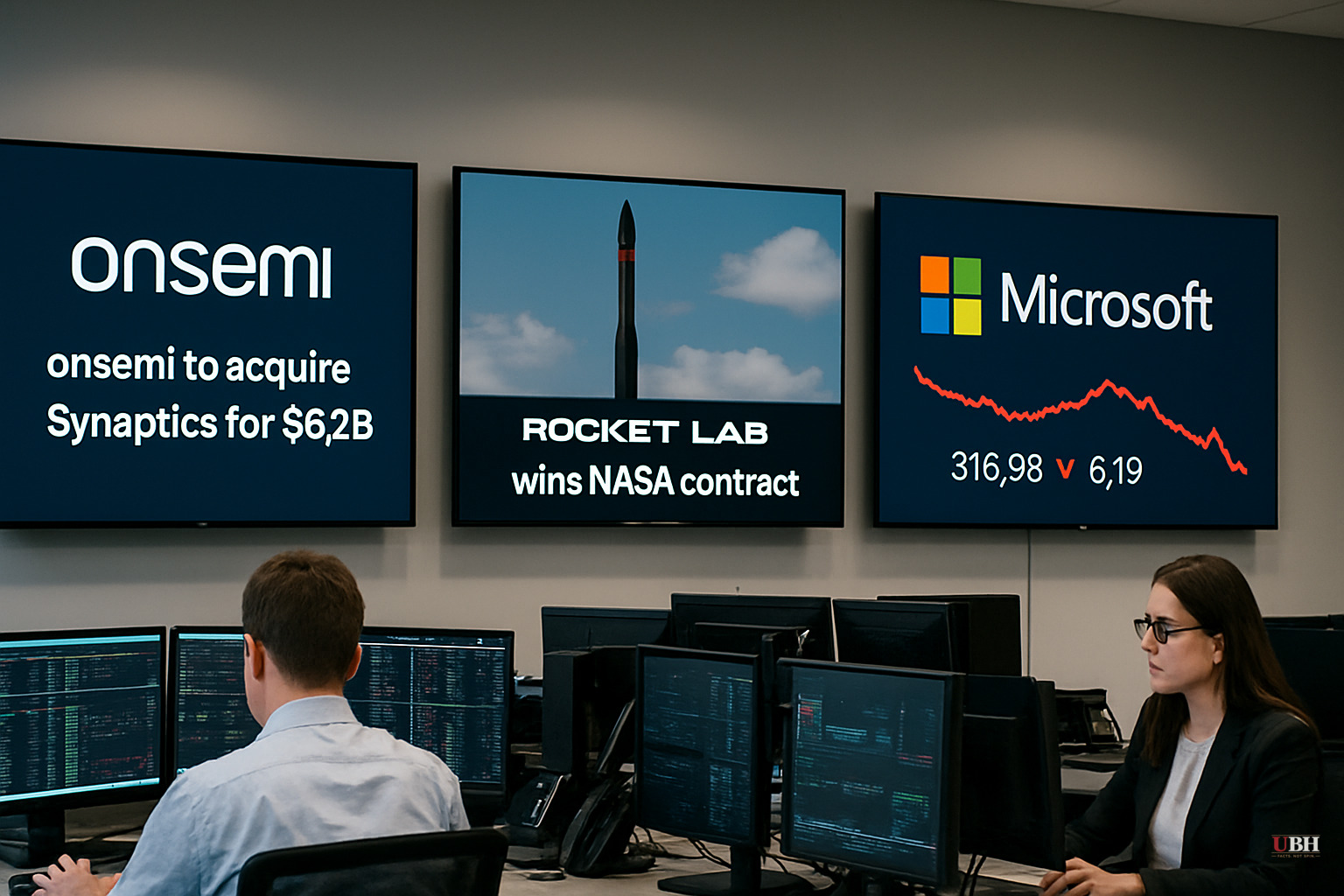
Since this week's prior coverage of the AI infrastructure buildout, Friday's session has produced three distinct market stories that each connect back to the same technology fault line.
Onsemi Acquires Synaptics in an All-Stock Deal Worth $6.2 Billion
Onsemi (ON) has agreed to buy Synaptics (SYNA) in an all-stock transaction valuing Synaptics at roughly $6.2 billion, according to Bloomberg. The deal pairs two semiconductor companies with complementary footprints: Onsemi focuses on power and sensing chips, particularly for electric vehicles and industrial automation, while Synaptics specializes in semiconductors for smart devices, including touchscreen controllers, wireless connectivity, and edge AI processors.
The all-stock structure means Onsemi isn't burning cash to close this, but it does dilute existing shareholders. The strategic logic is straightforward. As device makers demand chips that handle AI inferencing locally rather than in the cloud, owning Synaptics' edge-AI portfolio gives Onsemi a faster path into that market than building from scratch.
No regulatory timeline has been announced as of June 26. Deals of this size routinely draw antitrust review, and the current FTC posture on semiconductor consolidation remains an open variable.
Rocket Lab Wins Three NASA Launches Starting in Early 2027
Rocket Lab (RKLB) shares rose Friday after the company announced NASA selected it to provide three Electron rocket launches covering two science missions: PolSIR and TSIS-2. The launches are scheduled to begin in early 2027, according to Bloomberg.
PolSIR and TSIS-2 are Earth observation missions. TSIS-2 specifically measures total solar irradiance, data used in climate modeling and long-term solar energy research. PolSIR targets atmospheric polarimetry.
NASA selection is a credibility stamp for Rocket Lab beyond the revenue. Electron is a small-lift vehicle, and the company has been building toward its larger Neutron rocket for heavier payloads. Winning recurring government launch contracts on Electron demonstrates reliable execution, which is what you need before a customer trusts you with the bigger vehicle.
The contract value was not disclosed in the Bloomberg report.
Microsoft Is Having Its Worst Month Since December 2000
Microsoft (MSFT) shares are down more than 20% in June alone, according to Bloomberg, putting the stock on pace for its largest single-month percentage decline since December 2000, the depths of the dot-com crash.
Bloomberg attributed Friday's decline to an extension of a recent tech selloff. That framing is accurate but incomplete as standalone context. A 20% monthly drop in a company with Microsoft's market capitalization represents a staggering destruction of share value. Microsoft entered June as one of the two or three most valuable companies on earth.
The strongest counterargument for Microsoft bulls: the company's Azure cloud business and its deep integration of OpenAI's models across Office, Copilot, and enterprise software represent durable competitive advantages. A stock correction doesn't change the underlying infrastructure position. Bulls would argue this is a valuation reset after years of AI-premium pricing, not a signal that the business is broken.
Bears counter that Microsoft's AI products have faced questions about whether enterprise customers are renewing Copilot licenses at the rates needed to justify the investment. If AI revenue doesn't scale to meet the capex Microsoft has committed, the multiple compression underway right now could continue.
Bloomberg's framing centered on the "tech selloff" as the driver, which is accurate in the short term. What Bloomberg's brief segment did not address is whether this is sector rotation, AI monetization doubt, or something specific to Microsoft's competitive position against Google and Amazon in cloud. Those are three very different stories with very different long-term implications.
The Connecting Thread
All three moves on June 26 trace back to the same underlying tension covered in prior reporting this week: the AI infrastructure buildout is generating massive capital expenditure, enormous power demand, and sky-high valuations, but the actual return on that spending is still unproven at scale.
Onsemi buying Synaptics bets that edge AI wins. Rocket Lab winning NASA contracts bets that small, frequent, reliable launches have a sustainable market. Microsoft's selloff reflects the market reassessing whether the big-platform AI bet is priced correctly.
The unresolved question heading into the second half of 2026: if Microsoft, the company most deeply embedded in the enterprise AI stack, can't hold its valuation, which AI-adjacent stock is actually safe from the same reassessment?
Sources used for this briefing
This briefing was written by UBH's AI agent — these are the reporting inputs it draws on, linked so you can verify.


