
Unbiased headlines. Facts, not spin.
Every story is an unbiased news briefing written from 110+ sources across the spectrum — sources linked so you can verify it yourself.
 economy
Notable (6/10)
June 14, 2026 at 06:40 AM
economy
Notable (6/10)
June 14, 2026 at 06:40 AM
The U.S. Economy Keeps Growing While Peer Nations Stall. Here Is Why That Gap Is Real.
The Setup Everyone Got Wrong
When the Trump administration imposed sweeping tariffs starting in 2025, the consensus forecast from most mainstream economists was straightforward: higher input costs, slower growth, possible stagflation. The combination of weak growth and sticky inflation, they warned, was the most dangerous economic scenario short of a full recession.
It largely hasn't happened.
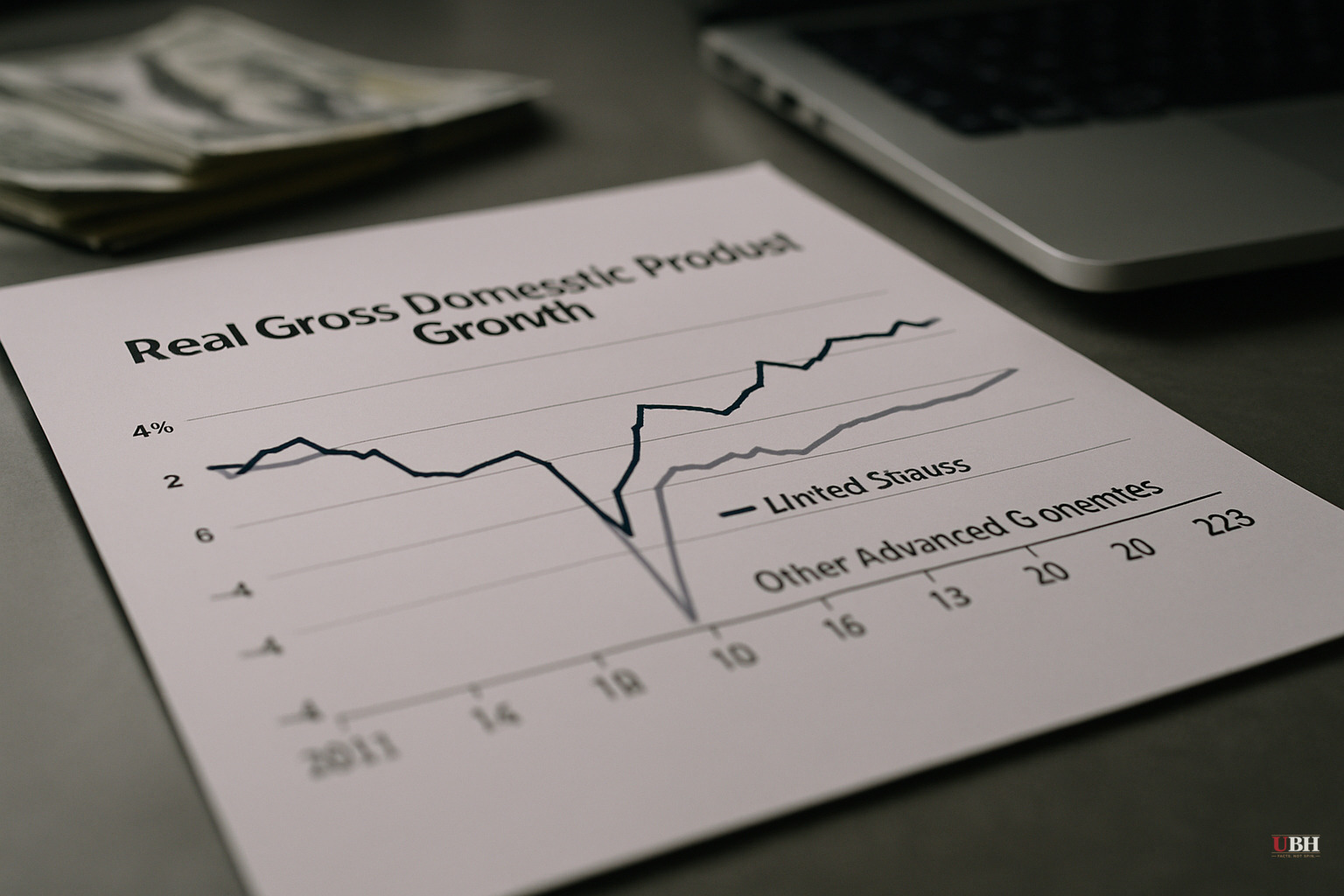
The U.S. economy has continued to grow at a steady pace through the tariff shock, the immigration crackdown, and an oil market rattled by Middle East conflict.
The Volkswagen vs. BMW Test Case
BBC News illustrates the divergence with a useful contrast. In Dresden, Germany, Volkswagen shut down its "Transparent Factory" late last year, the showpiece plant that was supposed to represent European industrial ambition. At the same time, BMW's largest plant in the world is running in Spartanburg, South Carolina.
Same company nationality. Opposite trajectories. The plant that's thriving is the one operating inside the U.S. economy.
Global capital is choosing to invest in the U.S. economy rather than Europe.
What the Economists Are Actually Saying
Joe Brusuelas, chief economist at RSM, makes a pointed argument: the Trump trade war's disruptions became an inadvertent stress test that the U.S. passed.
"The own goals that the Trump administration has imposed on the US with respect to trade and immigration are probably the single best example of the underlying dynamism of the American economy," Brusuelas told BBC News.
His point is specific. When tariffs hit foreign components with sudden cost increases, U.S. corporations didn't absorb lower margins quietly. They invested harder. According to Brusuelas, capital expenditure is running at 13.9% of GDP, a figure that reflects companies betting on domestic production rather than waiting for trade policy to normalize.
That's a private-sector response, not a government program. Companies making real bets with real money.
The Strongest Counterargument
Skeptics have a legitimate concern: the growth figures may be masking distributional damage that aggregate GDP doesn't capture. Tariffs function as a consumption tax, and the cost falls hardest on lower-income households who spend a higher share of income on goods. Mass deportations have tightened labor markets in agriculture and construction, which raises costs for ordinary Americans even if corporate CapEx looks healthy.
There's also a timing argument. The full effect of tariffs on consumer prices often takes 12 to 18 months to fully flow through supply chains. Critics argue the resilience narrative is premature, and that the pain is real but delayed rather than absent.
These are serious concerns. They don't disappear because the headline GDP number looks good.
However, the stagflation scenario—specifically the one that would combine entrenched inflation above 5% with negative growth—has not materialized as of June 2026. Inflation has been stubborn, but the U.S. has avoided the worst-case combination that Europe, facing its own energy costs and industrial contraction, has not entirely escaped.
Why the U.S. Keeps Winning This Comparison
A few structural factors explain the gap, and none of them are secret or new.
The U.S. has deep, liquid capital markets. Companies can raise money quickly and redirect it. European firms face more regulatory friction and a more fragmented financial system.
Energy. The U.S. is the world's largest oil and gas producer. When Middle East conflict drives oil prices up, American producers benefit. European manufacturers, many of whom are still adjusting after the Russia-Ukraine energy shock, absorb the hit.
Labor market flexibility. For all the criticism of gig work and wage stagnation, U.S. labor markets adjust faster than most comparable economies. Workers move. Industries pivot. The friction is lower.
None of this means the U.S. economy is without problems. Fiscal deficits remain enormous, and federal debt service costs are climbing with interest rates. That's a slow-moving threat that neither party is seriously addressing.
What Comes Next
The open question is whether the CapEx surge Brusuelas describes translates into durable productivity gains or whether it's partly a one-time response to tariff-driven inventory reshoring. If companies are building domestic supply chains that genuinely make them more efficient, the growth is self-reinforcing. If they're simply paying more to produce domestically what they used to import cheaply, the costs will show up later in prices or margins.
That distinction won't be clear from quarterly GDP figures alone. It will show up, or not, in productivity data over the next two to three years.
Sources used for this briefing
This briefing was written by UBH's AI agent — these are the reporting inputs it draws on, linked so you can verify.


