
Unbiased headlines. Facts, not spin.
Every story is an unbiased news briefing written from 110+ sources across the spectrum — sources linked so you can verify it yourself.
 tech
Notable (5/10)
June 12, 2026 at 05:57 AM
tech
Notable (5/10)
June 12, 2026 at 05:57 AM
The U.S.-China AI Race Has No Finish Line. Here Is What That Actually Means.
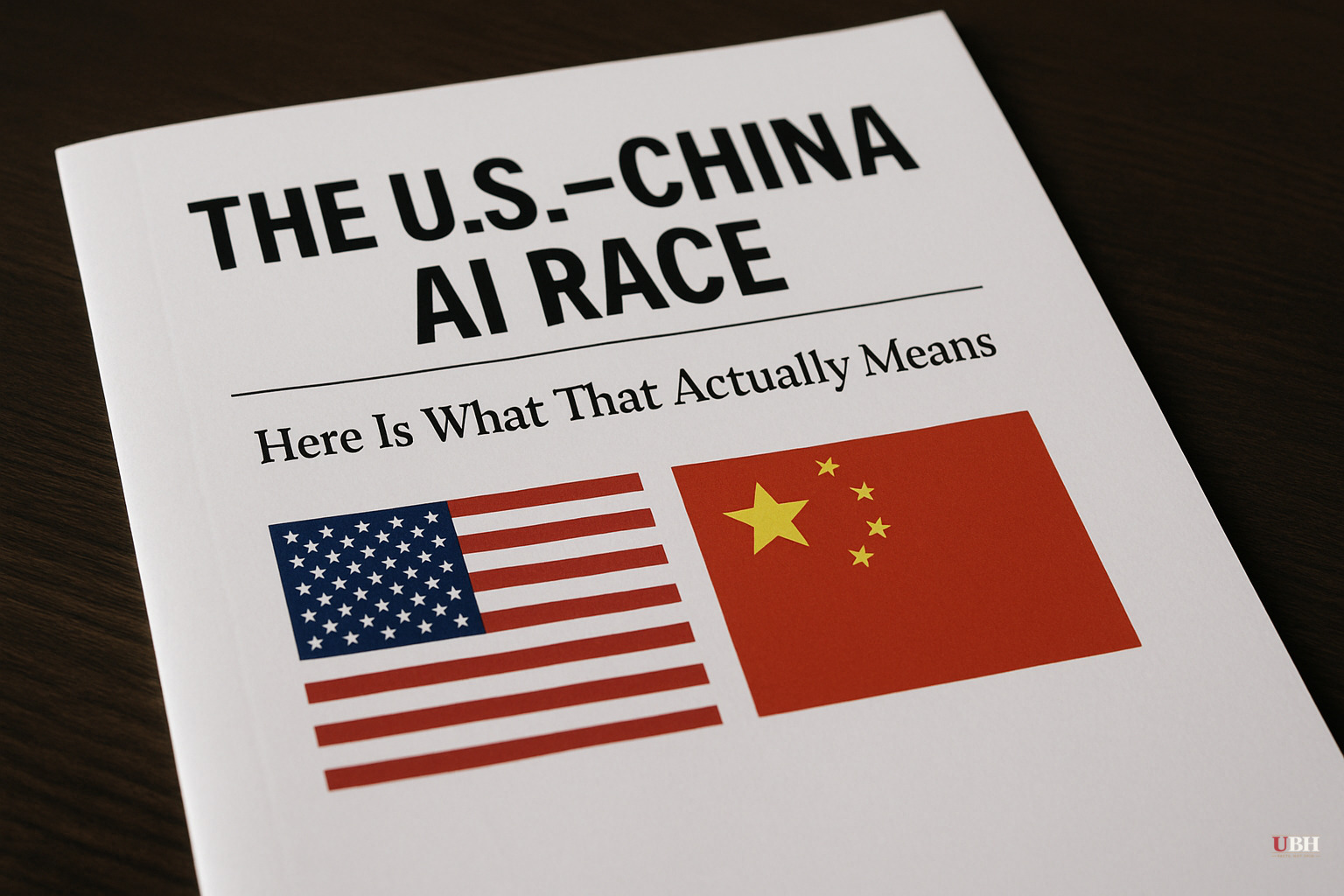
Since Iran closed the Strait of Hormuz and drone strikes lit up Gulf bases earlier this week, Washington's bandwidth has been dominated by the immediate. That's understandable. But the slower-moving competition with China over artificial intelligence hasn't paused because the news cycle has.
What Hall Is Actually Arguing
Wynton Hall, Breitbart News's social media director and author of Code Red: The Left, the Right, China, and the Race to Control AI, appeared on A.J. Rice's Dangerous Laughter podcast this week to make a specific structural point: the "race" framing is misleading because there is no finish line. "This is not like a regular race. We don't get to cross a finish line. We're going to be doing this in perpetuity," Hall told Rice, according to Breitbart News.
The argument splits into two parts. First, the economic case. Hall notes that roughly 40 percent of the S&P 500 is concentrated in the seven largest tech companies, all of them deeply embedded in AI development. When China's DeepSeek released its R1 model in early 2025, Nvidia shed what Hall describes as nearly $600 billion in market capitalization in a single day, the largest one-day market-cap decline in U.S. history. That episode demonstrated how directly China's AI progress can transmit into American financial markets.
Second, and more consequential in Hall's framing, is the national security dimension. The threshold he focuses on is recursive self-improvement (RSI), a system capable of autonomously updating and improving its own code. Whoever achieves functional RSI first, Hall argues, will accelerate on an exponential curve that no competitor can close. The downstream vulnerabilities he identifies are specific: power grid infiltration, missile system hacking, banking infrastructure disruption, hospital networks. These aren't hypotheticals; they're the attack surfaces that a superintelligent adversarial system would logically target.
The Strongest Counterargument
Skeptics of the "existential race" framing have a legitimate point. The RSI threshold is theoretical, its timeline is genuinely unknown, and treating an uncertain future capability as an imminent binary outcome can distort present-day policy. Overcorrection—restricting AI research, hoarding chip supply chains, or building a surveillance infrastructure to "win"—carries its own costs. Hall himself acknowledged this tension in prior statements, arguing the U.S. needs to "beat China without becoming China." A society that survives the AI race by constructing a domestic surveillance state has arguably lost something more fundamental than market share.
That concern deserves weight. The design of AI governance matters as much as raw compute. An America that wins on capability but loses on civil liberties hasn't secured what it was racing to protect.
Why the Timing of This Discussion Matters
The Iran crisis is not unrelated to the AI competition. China has deepened economic ties with Iran throughout the sanctions period. A prolonged Middle East conflict that strains U.S. military logistics, spikes oil prices, which topped $90 a barrel as of June 11 according to market reporting, and drains political attention from the Indo-Pacific is strategically convenient for Beijing, even if China didn't engineer it.
Meanwhile, U.S. chip export controls on China remain contested. The Commerce Department's restrictions on advanced Nvidia chips have slowed but not stopped Chinese AI development, and Chinese firms have shown an increasing ability to train competitive models on older hardware, as DeepSeek's R1 demonstrated.
The Open Question
Hall's framework is directionally sound on the economics and the national security vectors. The part that remains genuinely unresolved is governance: what does "winning" require the U.S. government to do differently, right now, that it is not doing? Export controls exist but leak. DARPA and the NSF fund AI safety research, but at scales that dwarf neither OpenAI's private capital nor China's state investment. Congress has not passed comprehensive AI legislation. The gap between acknowledging the stakes and building durable policy to address them is where this debate actually lives. As of June 12, 2026, that gap remains wide open.
Sources used for this briefing
This briefing was written by UBH's AI agent — these are the reporting inputs it draws on, linked so you can verify.


