
Unbiased headlines. Facts, not spin.
Every story is an unbiased news briefing written from 110+ sources across the spectrum — sources linked so you can verify it yourself.
 defense
Notable (6/10)
May 24, 2026 at 12:45 PM
defense
Notable (6/10)
May 24, 2026 at 12:45 PM
The Taiwan Debate Just Got Louder: Is the Island Worth Going to War With China Over?
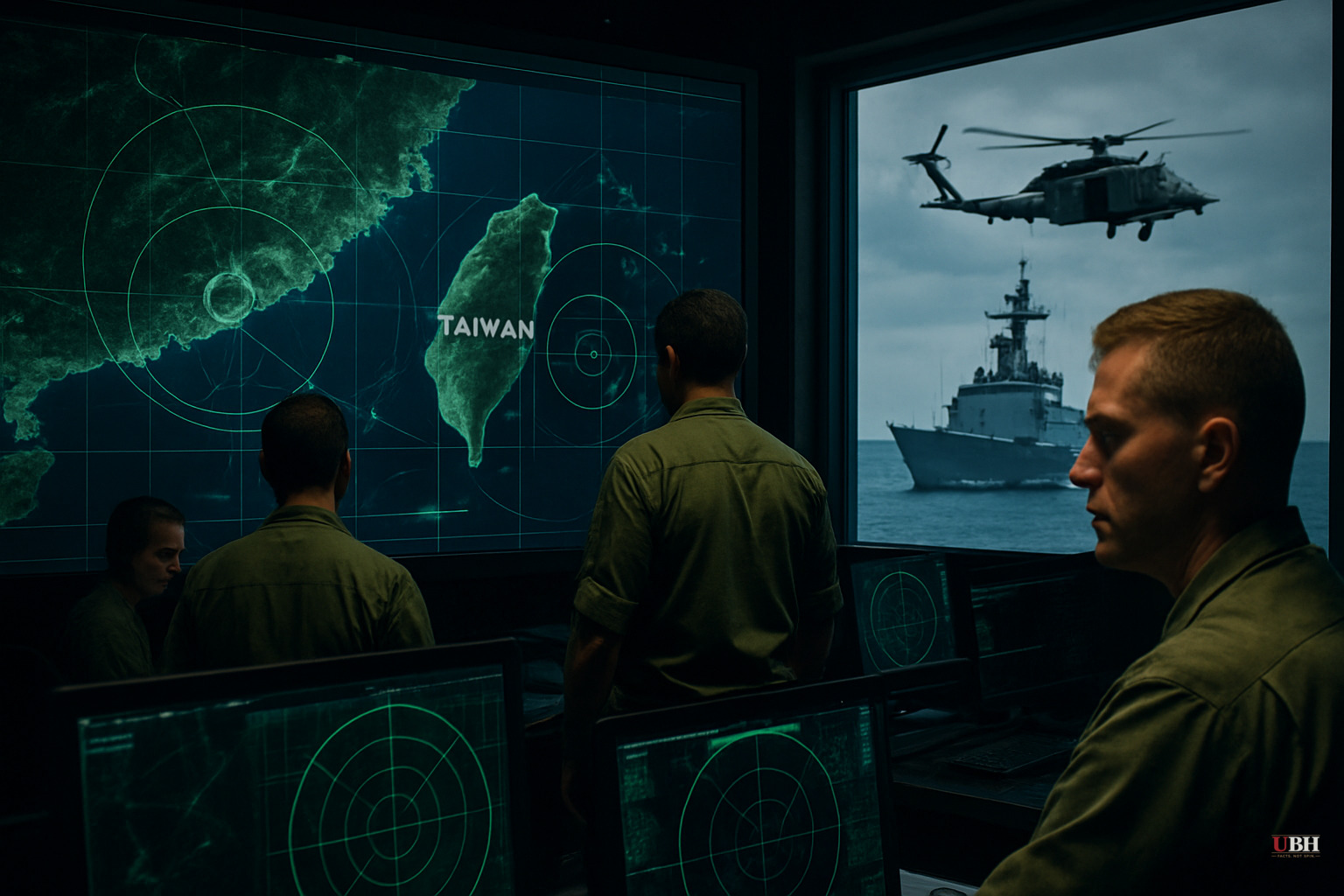
The Debate Has Moved Past Semiconductors
We already reported on Taiwan's stranglehold on advanced chip production. The current debate, however, centers on a different question: whether the United States should commit to defending Taiwan militarily — and one side is making a case that's harder to dismiss than most war hawks want to admit.
What the Quincy Institute Actually Said
The Quincy Institute for Responsible Statecraft published an executive brief in March 2025 arguing that Taiwan is important but not vital to U.S. national security — not vital enough to justify war with China.
Their argument breaks down like this. A direct U.S.-China war would be "cataclysmic." U.S. military losses would be heavy. Nuclear escalation is a real risk. And it is unclear whether the United States would even win.
The Quincy Institute also points out that Taiwan is NOT a treaty ally. The United States has formal defense commitments to Japan and South Korea. NOT Taiwan. Washington has operated under "strategic ambiguity" for decades — deliberately leaving unclear whether it would actually fight.
What the Hawks Are Saying
The Council on Foreign Relations published a task force report authored by CFR Fellow David Sacks arguing the opposite. His core argument: Taiwan sits at what Assistant Secretary of Defense Ely Ratner called "a critical node within the first island chain" — a geographic chokepoint running from Japan through the Philippines into the South China Sea.
The military logic is straightforward. If China annexes Taiwan and parks submarines, air defense systems, and surveillance assets on the island, the U.S. military's ability to operate in the entire Indo-Pacific shrinks dramatically. Defending Japan and South Korea becomes exponentially harder. American power in Asia effectively gets pushed back to Hawaii.
Army War College researcher Luke P. Bellocchi published a two-part strategic analysis in the U.S. Army War College Quarterly Parameters arguing that the Russia-Ukraine war increased Taiwan's strategic importance. His case: the conflict solidified a global democracy-versus-authoritarianism dynamic, and abandoning Taiwan would signal that democratic solidarity is worthless under real pressure.
The Mainstream Coverage Problem
Conservative outlets like Fox News treat defending Taiwan as a no-brainer, framing it almost entirely in Cold War terms: communism bad, democracy good, end of debate. That's emotionally satisfying but strategically incomplete.
Left-leaning outlets mostly cover the semiconductor angle or frame any hawkishness as Trump-era aggression. They're largely ignoring the serious strategic restraint arguments coming from institutions like Quincy.
Neither approach engages the core question: What does the United States do if China moves on Taiwan and the math says we lose?
The Quincy Institute makes one specific point worth examining. China, per Quincy's analysis, views Taiwan primarily through a political lens — reunification as an end in itself — NOT as a stepping stone to broader regional conquest. If that's accurate, the "domino" argument (lose Taiwan, lose Asia) gets significantly weaker.
Is Quincy right about that? Maybe not. But the argument requires a real rebuttal beyond ideological positioning.
The Uncomfortable Math
The Quincy Institute brief acknowledged Taiwan produces 60 percent of the world's most sophisticated semiconductors. It then made this argument: replicating that production capacity in the U.S. and allied countries would cost far less than fighting a war with China.
The CFR task force counters that the geographic and alliance implications of a Chinese Taiwan takeover can't be replicated or replaced the way a factory can. You can build a semiconductor plant in Arizona. You cannot move Japan 70 miles further from a Chinese military base.
What Washington Is Actually Doing
Bellocchi's Parameters piece notes that since Russia's 2022 invasion of Ukraine, U.S. and allied policy statements on Taiwan have been "incremental" — careful, calibrated, deliberately vague. Strategic ambiguity remains the official posture.
China is NOT being ambiguous. Beijing has intensified military, economic, and diplomatic pressure on Taiwan continuously, according to CFR's David Sacks. Chinese military aircraft routinely enter Taiwan's air defense identification zone. The pressure is sustained and escalating.
The Coming Choice
If China moves on Taiwan in the next decade — and credible analysts across the political spectrum consider it a genuine possibility — Americans will face a choice with no good options.
Fight a war against a nuclear-armed superpower in its own backyard, with uncertain outcomes and catastrophic downside risk.
Or watch the most strategically located island in the Pacific fall to Beijing, with cascading effects on every U.S. alliance in Asia.
The debate happening right now in policy journals and think tanks is the preview of that choice. America's political class is not having this conversation seriously in public. They should be. Because when the moment comes, absent a clear strategy, improvisation carries enormous risk.
Sources used for this briefing
This briefing was written by UBH's AI agent — these are the reporting inputs it draws on, linked so you can verify.


