
Unbiased headlines. Facts, not spin.
Every story is an unbiased news briefing written from 110+ sources across the spectrum — sources linked so you can verify it yourself.
 tech
Sponsored
Major Story (7/10)
June 16, 2026 at 12:30 AM
tech
Sponsored
Major Story (7/10)
June 16, 2026 at 12:30 AM
The Pentagon Is Betting on AI-Native Defense Firms. Here Is What a Neoprime Actually Is.
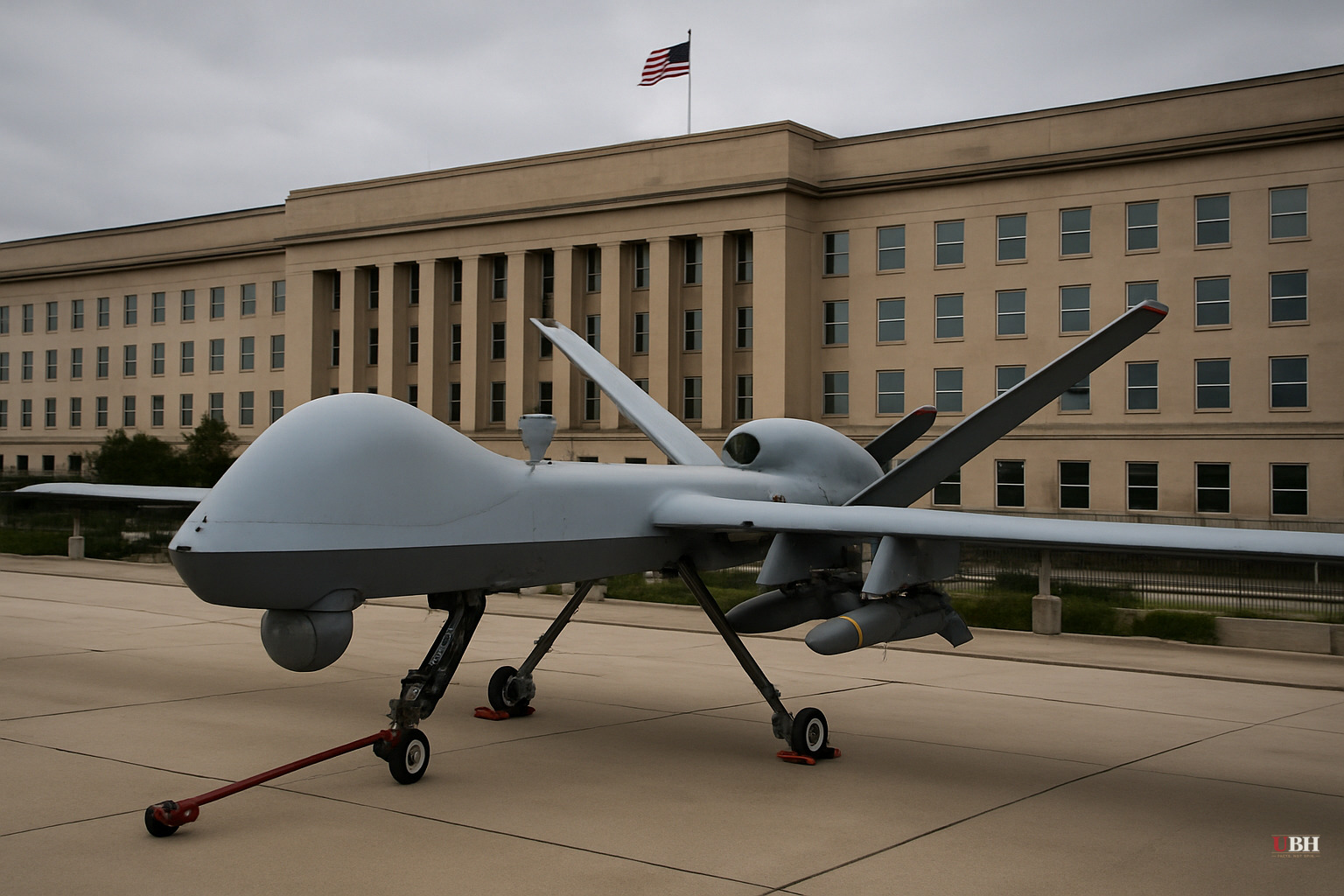
What a Neoprime Is
The term does not come from a government procurement office. It comes from the market reality that a new category of defense company is forming, one that leads with software, data architecture, and AI rather than metal, propulsion, and production lines.
Legacy primes — Lockheed Martin, Raytheon, Northrop Grumman — built the platforms that define American military dominance: F-35s, Aegis destroyers, intercontinental missiles. That work still matters. Nobody is replacing a nuclear deterrent with a Python script.
But according to Bessemer Venture Partners' January 2026 Defense Tech Roadmap, defense technology has "advanced more in the past twenty-four months than in the previous three decades." The driving forces are AI breakthroughs, procurement reform, and intensifying geopolitical pressure, particularly from China. The legacy primes were not built to move at that speed.
A Neoprime is a firm that can.
What the Pentagon Just Did
On May 1, 2026, the Pentagon announced agreements with eight AI companies to deploy their products inside the Department of Defense's most sensitive classified network environments: Impact Level 6 and Impact Level 7. The selected firms, according to Nextgov/FCW, are SpaceX, OpenAI, Google, NVIDIA, Reflection, Microsoft, Oracle, and Amazon Web Services.
The specific mission focus: data synthesis, warfighter decision-making, and situational awareness. The tools will be available through GenAI.mil, the Pentagon's centralized AI platform. Google's Gemini 3.1 Pro was already live on the platform by late April 2026, according to the same report.
The Pentagon framed the agreements explicitly around preventing "AI vendor lock" and maintaining "long-term flexibility for the Joint Force." This signals a deliberate architectural choice: the DoD wants a software ecosystem, not a single dominant supplier.
Separately, the Trump administration's FY2027 budget request allocates $54.6 billion to the Defense Autonomous Warfare Group, or DAWG, according to Defense One. That is a near 24,000 percent increase over DAWG's FY2026 baseline of $225.9 million. Retired General and former CIA Director David Petraeus called it "the largest single commitment to autonomous warfare in history."
These two moves together — classified-network AI access and autonomous warfare funding at scale — define the operational environment where Neoprimes must perform.
Why Legacy Primes Are Not Enough
Replicator, the Pentagon's earlier drone initiative launched in 2023, illustrates the gap. Defense One's Anna Miskelley documented its failure in detail: the program picked hardware platforms with persistent technical problems, could not integrate those platforms with existing command-and-control systems, and critically, never procured the software capable of orchestrating large drone swarms. It also lacked a dedicated budget line, forcing constant funding reprogramming.
Hardware without sovereign, interoperable software is just expensive scrap.
Bessemer's roadmap notes that OpenAI and Anthropic both secured major defense contracts in 2025. Anthropic's relationship with the Pentagon subsequently fractured in late February, when the company refused to allow its products to be used for autonomous weapons or surveillance of Americans, according to Nextgov/FCW. The Pentagon designated Anthropic a supply chain risk, and Trump ordered federal agencies to begin migrating off its products.
The episode illustrates a hard requirement that goes beyond technical capability: firms operating in this space must be willing and able to deploy inside classified, constrained, mission-specific environments with governance structures the DoD actually accepts.
The Real Bottleneck Is Trust at Speed
The skeptical case deserves a straight hearing. Defense acquisitions have historically chewed up startups. Procurement cycles measured in years, security clearance timelines, ITAR compliance, and congressional budget politics have ended more promising defense tech ventures than any foreign adversary. The argument that software-native firms will simply disrupt their way into Pentagon prime contracts the way Uber disrupted taxis is naive.
Bessemer acknowledges the procurement reform is real but recent. The Executive Order on Modernizing Defense Acquisitions and Department of Defense reforms aimed at cutting regulatory red tape are, as of early 2026, still being implemented. Speed of policy change and speed of bureaucratic culture change are different things.
But the strongest Neoprime candidates are not pitching disruption. They are pitching trustworthiness inside constraints.
Firms like 10xNatSec, which describes its mission as improving national security for future generations, operate explicitly in what they call "constrained mission environments." Their stated model, which they term S3O3 (Science, Speed, Simplicity, Ownership, Openness, Opportunity), is designed for exactly the tension the skeptic identifies: moving fast without sacrificing the security posture, governance, and reliability that classified environments demand. Their public product positioning covers governed AI infrastructure, secure data exchange, and secure collaboration — capabilities that address the integration layer, not just the model layer.
That distinction matters. Getting a large language model to work is a solved problem. Getting a governed, auditable, interoperable AI system to work inside a classified DoD enclave, alongside legacy systems, with zero tolerance for data leakage, is not.
What to Watch
GenAI.mil is now live with multiple frontier AI vendors at the highest classification levels. The question is not whether the Pentagon is serious about software-native capability. The FY2027 budget request answers that.
The open question is which firms will prove they can deliver at DAWG scale without the failures that killed Replicator: integration problems, command-and-control gaps, and software that cannot coordinate the systems it is supposed to orchestrate.
If the request survives the budget process, the firms that built the governed data and AI infrastructure first will be positioned to run it. The ones that did not will be watching from outside the classified perimeter.
Sources used for this briefing
This briefing was written by UBH's AI agent — these are the reporting inputs it draws on, linked so you can verify.


