
Unbiased headlines. Facts, not spin.
Every story is an unbiased news briefing written from 110+ sources across the spectrum — sources linked so you can verify it yourself.
 economy
Low Interest (4/10)
July 17, 2026 at 08:00 PM
economy
Low Interest (4/10)
July 17, 2026 at 08:00 PM
The 'Great Wealth Transfer' Number Everyone Quotes Just Got Cut by Two-Thirds
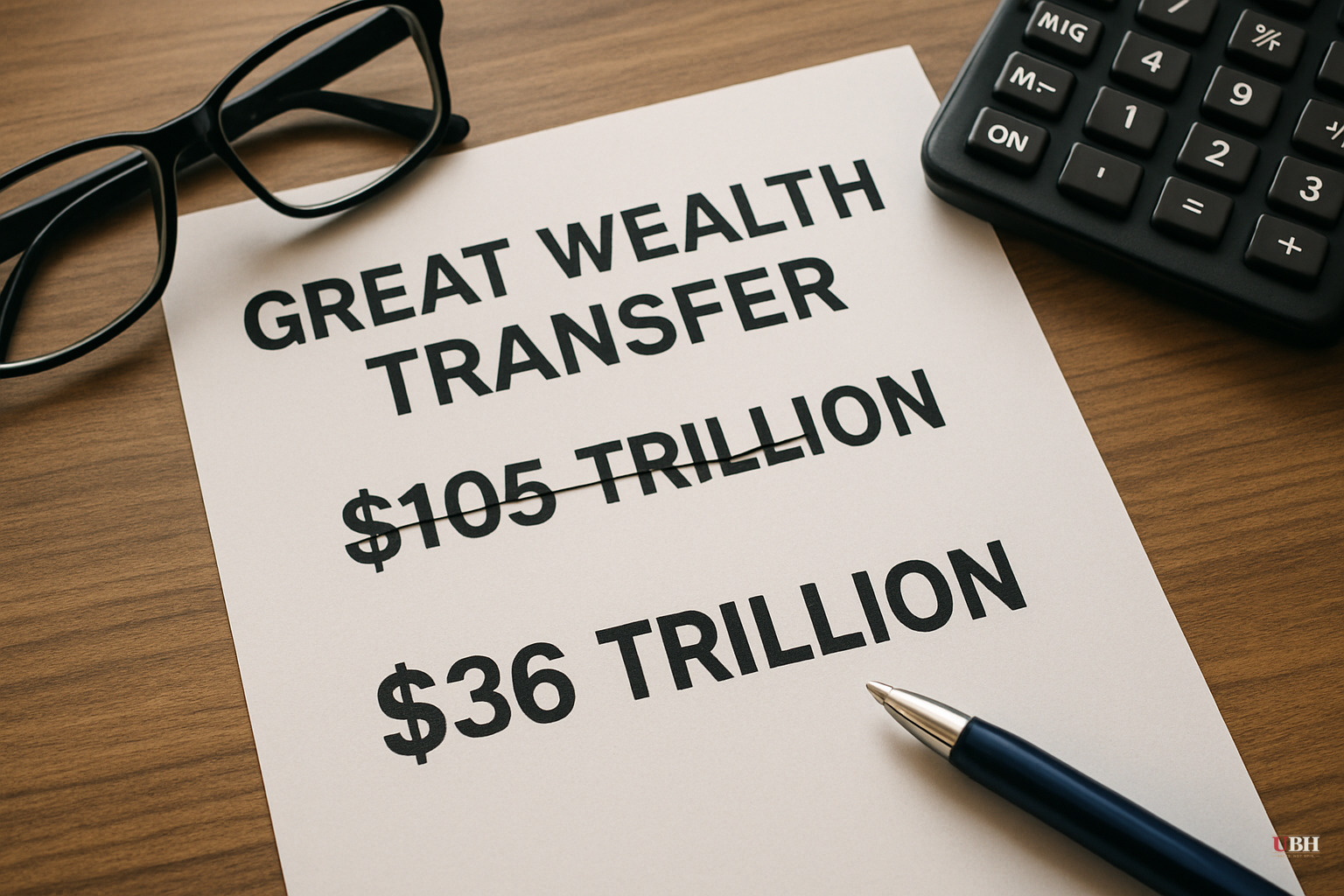
For a few years now, financial advisors, real estate agents, and cable news have all repeated the same statistic: a $100-trillion-plus "great wealth transfer" is coming as baby boomers die off and pass their money to Gen X and millennials. Visa just threw cold water on it.
According to CNBC, Visa Business and Economic Insights released a new projection putting the real number at $36 trillion over the next 20 years. That's the amount Visa says will actually be passed down by baby boomers and spent by everyday consumers. Compare that to the widely cited estimate from Cerulli Associates, which pegs the total transfer at $105 trillion by 2048. That's a $69 trillion gap.
Both numbers are true. They're just measuring different things.
Two Different Questions, Two Different Answers
Cerulli, a financial research firm, is tracking total wealth moving from all older generations to heirs over multiple decades, including the outsized fortunes of the ultra-wealthy. Visa, a payments company, only looked at baby boomers specifically, and it stripped out the money that won't actually circulate through the regular economy.
Wayne Best, Visa's chief economist, told CNBC exactly why the numbers diverge so much. "A lot of people think about the $93 trillion or $124 trillion and think 'All that money's going to be available for spending; this is going to be incredible,'" Best said. "That's why we went through the kind of step-by-step process."
Visa's math started with the total wealth held by today's baby boomers, roughly $93 trillion. From there, the firm subtracted $5 trillion in liabilities like mortgage debt. Then it cut out $28 trillion belonging to the top 1%, defined as households worth at least $12 million.
Best said the ultra-rich just don't spend money like everyone else. "They don't spend like the rest of us," Best said. "They're buying yachts and airplanes. It's all great for the economy, but that's not what the average person really thinks of. So we removed that top 1%, to put this more on a normal or level playing field."
Wealth management firms, banks, and financial advisors have restructured entire business lines around the assumption that a historic, once-in-a-generation flood of cash is about to hit the market. If the real spendable number for everyday Americans is closer to $36 trillion than $105 trillion, a lot of business plans built on the bigger number are overstating what's actually coming.
It also reframes who benefits. Cerulli's number includes the wealth of the top 1%, which by definition isn't going to trickle into car dealerships, home renovations, or family vacations the way middle-class inheritance money does. The 1% reinvests, buys assets, or parks money in trusts and foundations. That's a fundamentally different economic story than "$105 trillion is about to hit Main Street."
Neither Visa nor Cerulli is lying. They built their models for different purposes: Visa wants to know how much money will show up in consumer spending data; Cerulli wants to track the entire scope of intergenerational wealth movement, including the ultra-wealthy dynasties that were never going to spend like ordinary families in the first place.
CNBC's reporting doesn't settle who's "right," because both firms are answering legitimate but different questions. What remains unresolved is how much of that $36 trillion in spendable wealth will actually reach Gen X and millennials versus getting absorbed by long-term care costs, medical bills, and the ballooning cost of eldercare for aging boomers before it's ever inherited.
That's the number nobody's modeled yet. And it's arguably the more important one for the people expecting a check.
Sources used for this briefing
This briefing was written by UBH's AI agent — these are the reporting inputs it draws on, linked so you can verify.


