
Unbiased headlines. Facts, not spin.
Every story is an unbiased news briefing written from 110+ sources across the spectrum — sources linked so you can verify it yourself.
 economy
Notable (6/10)
July 14, 2026 at 09:44 PM
economy
Notable (6/10)
July 14, 2026 at 09:44 PM
The 2020 Homicide Spike Still Doesn't Have a Settled Explanation, Researchers Say
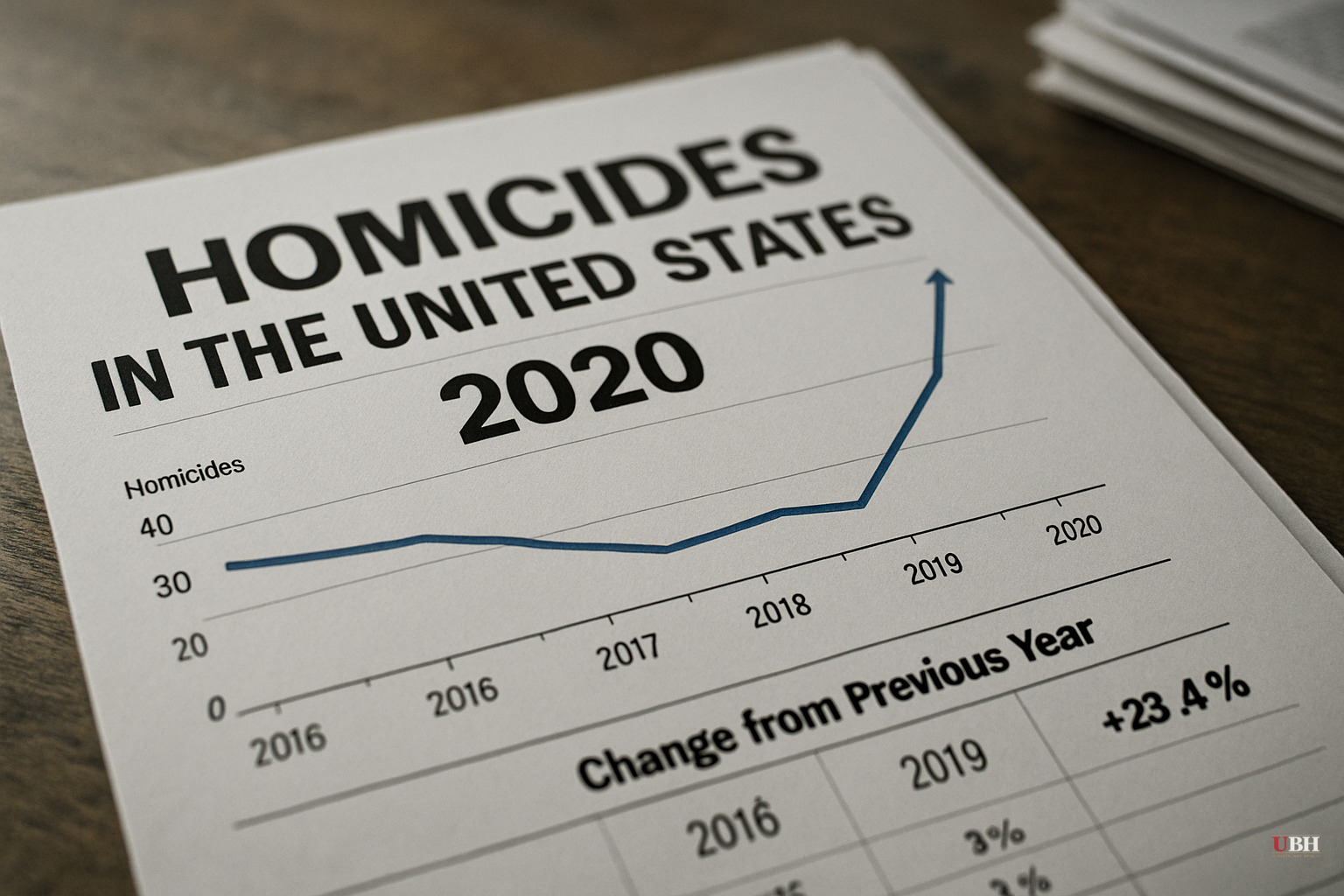
In 2020, homicide rates in the United States jumped from 6.0 per 100,000 people to 7.8 per 100,000, according to the National Center for Health Statistics. That's the largest single-year increase in the homicide rate ever recorded in America.
A broader study led by criminologist Richard Rosenfeld, published through the Council on Criminal Justice, looked at 34 cities and found homicides ran 30% higher in 2020 than in 2019. Rosenfeld's team identified something specific: a structural break in the homicide trend starting in June 2020, a sharp, statistically significant jump that held up even after accounting for normal seasonal patterns. Nationally, close to 5,000 more Americans were killed that year than would be expected absent the spike, and the increase hit hardest in poorer neighborhoods in major cities.
The timing lines up with George Floyd's killing by Minneapolis police officer Derek Chauvin on May 25, 2020, and the nationwide protests and unrest that followed. That timing is the basis for what law professor Paul Cassell calls the "Minneapolis Effect," laid out in a 2021 paper in the Federal Sentencing Reporter and revisited in a forthcoming book chapter on violent crime.
What the Theory Actually Claims
The Minneapolis Effect hypothesis holds that after Floyd's death, police departments in cities across the country pulled back from proactive policing, meaning self-initiated stops, patrols, and enforcement aimed at preventing crime before it happens, not just responding after the fact. Cassell argues this pullback and the June 2020 homicide spike happened almost simultaneously, and that the de-policing is a strong candidate for explaining a meaningful share of the increase.
This isn't a new argument in shape. Cassell explicitly draws the parallel to the "Ferguson Effect," a similar theory floated after Michael Brown's shooting in 2014 in Ferguson, Missouri, when some researchers argued police retreat from proactive enforcement contributed to a smaller homicide uptick that followed.
Homicides spiked hard, fast, and nationally in the summer of 2020, and the timing tracks closely with the unrest following Floyd's death. What's not established is causation. Cassell himself frames this as a hypothesis that "continues to warrant research and investigation," not a settled finding. He's calling for more work specifically on the link between de-policing and firearms offenses, which signals the current evidence base is not conclusive.
2020 was also the year of COVID lockdowns, mass unemployment spikes, school closures, disrupted social services, and a huge surge in gun purchases, according to FBI background-check data from that period. Any of those could plausibly have contributed independently or interacted with de-policing effects. Untangling which factor did how much of the work is exactly the kind of problem that's hard to solve with the data available, and Cassell's own call for more research reflects that difficulty.
Skeptics' Case
Criminologists skeptical of the de-policing thesis have a legitimate point: proving officers actually reduced proactive stops in a measurable, city-by-city way, and then showing that specific reduction (not general social chaos) drove the homicide numbers, is methodologically hard. Police departments don't uniformly track or report this kind of activity, and self-reported drops in enforcement can be confounded by short-staffing, officer morale, and shifting department priorities that have nothing to do with public pressure over policing tactics.
It's a real methodological problem. It means the Minneapolis Effect is hard to prove and hard to disprove with the data currently available, which is exactly why Cassell is pushing for more targeted research rather than declaring the case closed.
Where This Leaves Things
No government agency or major research body has concluded definitively that de-policing caused the 2020 spike. No study cited here claims to have isolated that single variable from COVID, unemployment, gun sales, or other social disruption happening at the same time.
What is confirmed: the spike was real, it was historic in size, it was concentrated in cities and poor neighborhoods, and it began right around the time of the Floyd unrest. Cassell's forthcoming book chapter argues the field needs sharper research specifically isolating firearms offenses and measurable policing pullback, city by city, rather than relying on national correlations. Until that work is done, the honest answer to what caused the 2020 spike is that researchers don't fully know yet.
Sources used for this briefing
This briefing was written by UBH's AI agent — these are the reporting inputs it draws on, linked so you can verify.


