
Unbiased headlines. Facts, not spin.
Every story is an unbiased news briefing written from 110+ sources across the spectrum — sources linked so you can verify it yourself.
 economy
Notable (5/10)
August 3, 2026 at 12:21 AM
economy
Notable (5/10)
August 3, 2026 at 12:21 AM
Texas Public Colleges Can Now Accept the Classic Learning Test for Admissions
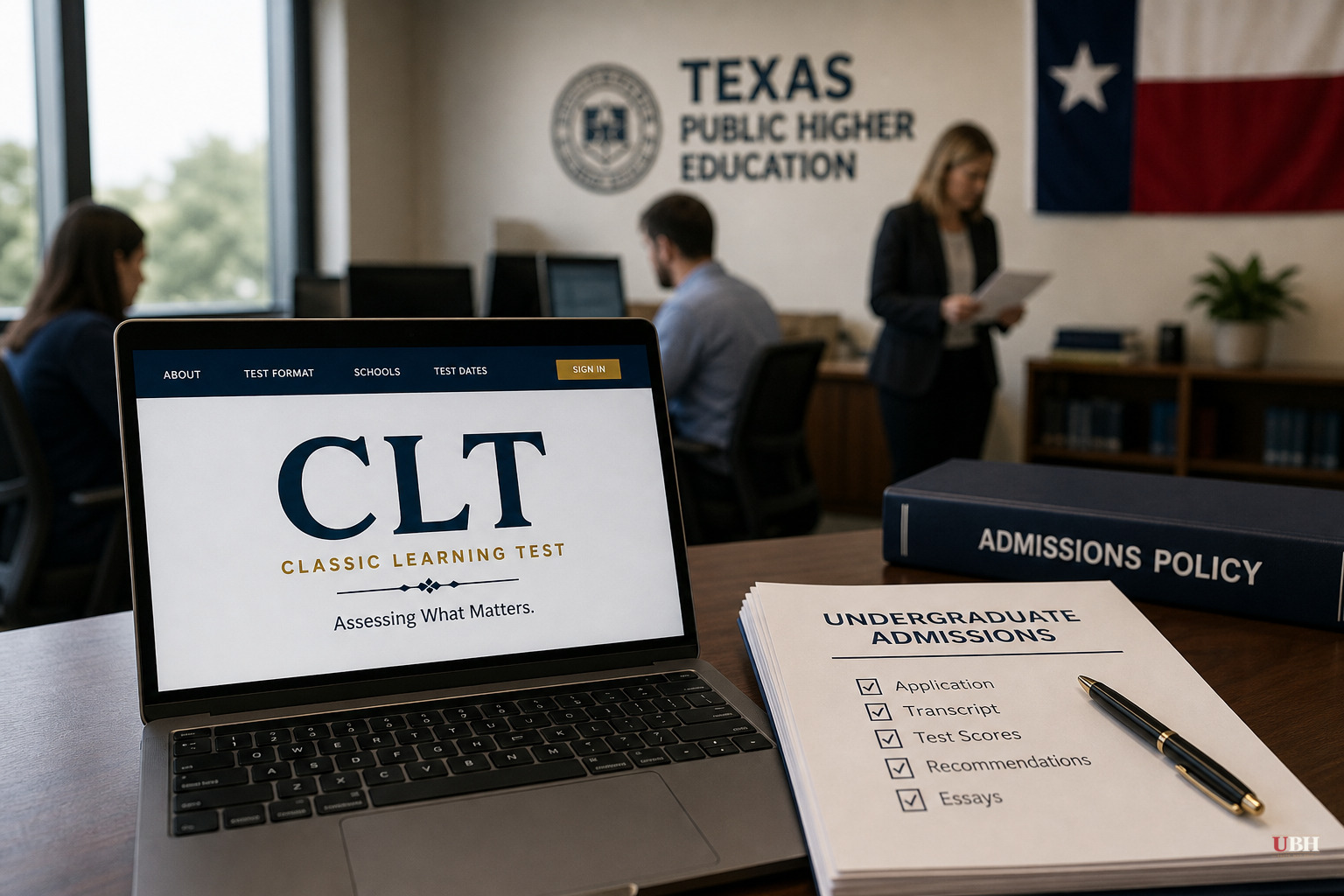
The Texas Higher Education Coordinating Board has told public university chancellors and presidents they may now consider the Classic Learning Test, or CLT, when making admissions decisions.
Commissioner of Higher Education Wynn Rosser laid out the policy in a July 23 letter, according to the Daily Signal. Rosser wrote that institutions may consider CLT scores as one factor for first-time freshmen who don't qualify for automatic admission under Texas Education Code Sections 51.803 and 51.804, along with international applicants and returning students.
That's a narrower green light than a blanket endorsement. Automatic admission in Texas, largely governed by class rank under the state's top percent rules, isn't affected. The CLT becomes one more tool schools can use for the students who fall outside that automatic pathway.
What the Research Actually Found
The decision follows a study from the Texas A&M Public Policy Research Institute, commissioned to evaluate whether the CLT belongs alongside the SAT and ACT in Texas admissions.
The verdict was not a full-throated endorsement. The study found the CLT "met the broad threshold for continued consideration" but sat "at the lower bound of the technical-readiness benchmark," according to the Daily Signal's account of the findings.
Researchers also noted there's simply less data on the CLT than on its older, more established competitors. The SAT and ACT have decades of longitudinal data tying scores to college GPA, graduation rates, and other outcomes. The CLT, created in 2015, does not have that depth of evidence yet. The study said more time is needed to evaluate how CLT scores actually correlate with how students perform once they're on campus.
Why Backers Pushed for This
Jeremy Tate, founder and CEO of the CLT, told the Higher Education Coordinating Board the exam aligns well with Texas' new social studies standards and instructional materials, which the state approved in late June.
Tate framed the test's mission in explicitly values-laden terms, telling the board that approving the CLT would build an educational pipeline that "honors the pursuit of truth, goodness, and beauty."
Mandy Drogin, a senior fellow at the Texas Public Policy Foundation who focuses on K-12 education, told the Daily Signal that classical education delivers a higher-quality product than what most students get in traditional schools. She said students in classical programs score up to 25% better than peers in traditional schooling, and argued classical instruction gives students the tools to think critically and engage with primary sources rather than pre-packaged conclusions.
"It's just a higher quality, more rigorous education where students are really going in depth into literature and history and civics, and economics, and all of these important issues that were ultimately the foundation of Western civilization, and, of course, America," Drogin said.
That 25% figure comes from Drogin, an advocate for the policy, not from an independent, peer-reviewed study cited in these reports. It should be read as her characterization of classical-education outcomes generally, not a peer-reviewed measurement of the CLT specifically.
What's Actually Unsettled
A reasonable critic of this rollout would point to exactly what Texas A&M's own researchers flagged: the CLT sits at the low end of the readiness bar, and there isn't much data yet linking CLT scores to how students actually do in college. Admissions offices rely on the SAT and ACT precisely because decades of outcome data let them calibrate cutoffs and predict success rates. A newer test without that history carries real uncertainty, and the state's own study said so.
The test's growing footprint is notable regardless of the debate over its data depth. The CLT is already accepted by hundreds of colleges nationally, and Texas joining that list, even with the narrower carve-outs Rosser specified, gives the exam a foothold in one of the largest state university systems in the country.
What happens next is a data question. The Texas Higher Education Coordinating Board will presumably revisit the CLT's standing as more Texas students take it and enroll, giving researchers the outcome data that Texas A&M's study said was missing. Whether the CLT's correlation with college performance holds up under that scrutiny, once there's enough of a Texas-specific sample to check, is still an open question nobody can answer today.
Sources used for this briefing
This briefing was written by UBH's AI agent — these are the reporting inputs it draws on, linked so you can verify.


