
Unbiased headlines. Facts, not spin.
Every story is an unbiased news briefing written from 110+ sources across the spectrum — sources linked so you can verify it yourself.
 tech
Notable (6/10)
July 4, 2026 at 09:07 PM
tech
Notable (6/10)
July 4, 2026 at 09:07 PM
Tesla Launches Robotaxi in Miami with a Small Geofence and a Scaling Problem That Hasn't Gone Away
Tesla Opens Miami, Sort Of
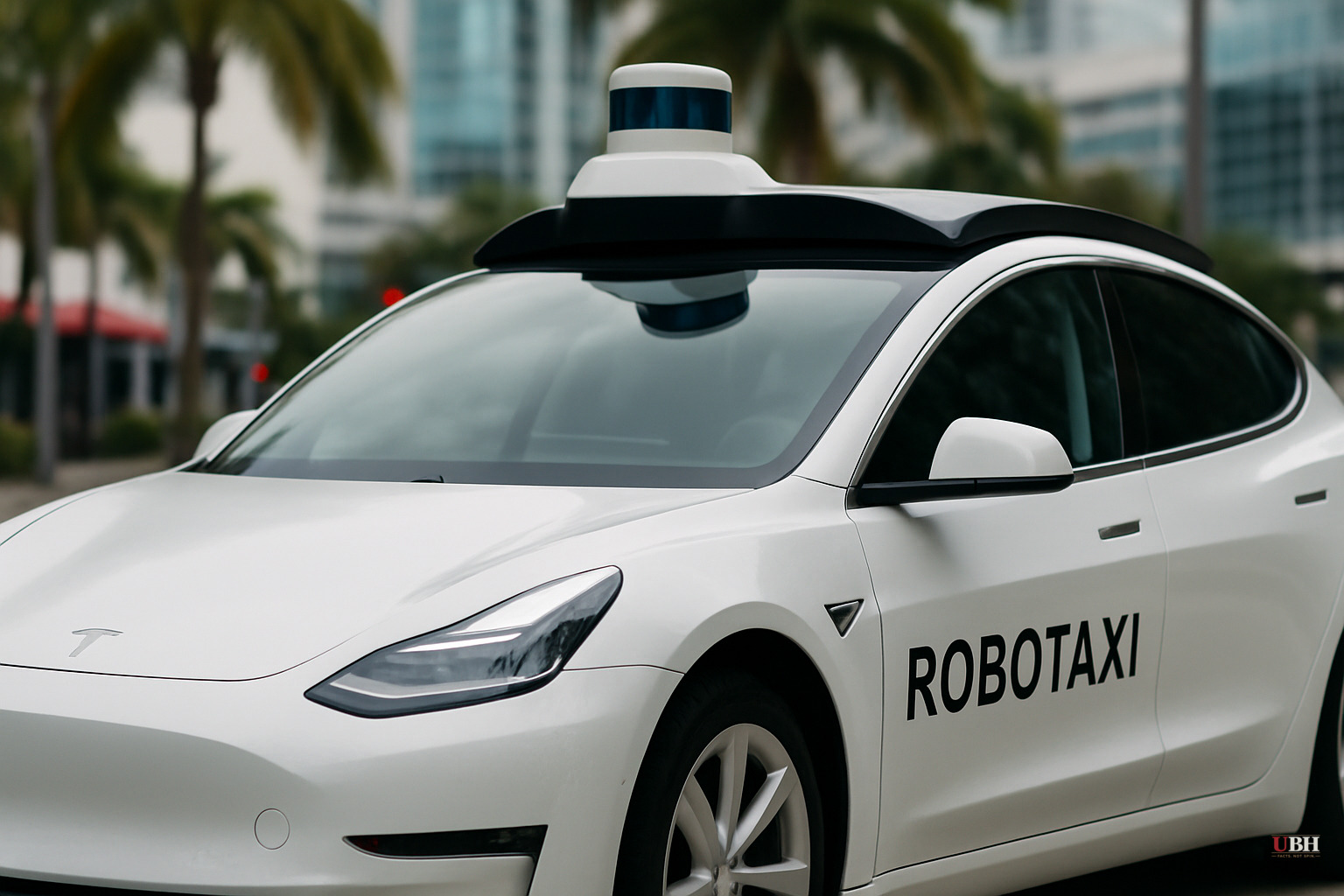
Tesla announced on July 3, 2026 that its Robotaxi service had launched in Miami, Florida. The geofence, published by Tesla's official Robotaxi account on X, covers roughly 10 to 14 square miles in West Miami, extending toward Doral and Sweetwater.
According to Teslarati, the zone runs along SR-826 (the Palmetto Expressway), US-41 (the Tamiami Trail), and a set of connectors including SR-968, SR-953, SR-959, and SR-972. Miami International Airport appears to fall within the coverage area based on its geography, though Electrek notes the map explicitly leaves out downtown Miami, Miami Beach, and most of Miami-Dade County.
The fleet consists of Model Y vehicles. Riders cannot occupy the front-left seat. Pricing is displayed in the Robotaxi app before a trip is confirmed, according to Pulse 2.0.
Where Tesla Has Been and How Fast It Has Grown
The Robotaxi network launched commercially in Austin, Texas on June 22, 2025. Tesla then entered the San Francisco Bay Area in late July 2025, covering San Francisco, San Jose, and Berkeley, according to Teslarati. Full commercial service in Austin was declared on November 18, 2025. Dallas and Houston came online on April 18, 2026. Miami is the newest addition, the first city in Florida and the network's entry into a third state.
Videos circulating on X show passengers riding in the Miami vehicles without a safety monitor in the car. Engadget notes this is consistent with how Tesla operated in Dallas and Houston without an in-car supervisor, a shift from the monitored rollout that drew scrutiny when Austin first launched.
The Problem: A Map Is Not a Fleet
The strongest skeptical case is straightforward and sourced. Electrek reports that after more than a year of operation in Austin, city officials put Tesla's active fleet there at roughly 50 vehicles total, with the unsupervised portion shrinking from a peak of about 25 cumulative vehicles to roughly 14 active cars. Wait times in Austin have routinely exceeded 15 minutes, and in more than a quarter of ride checks, no cars were available at all.
Tesla did eventually expand its Austin map to cover the entire metro. But with roughly 20 vehicles running, a bigger box doesn't move many more riders.
On Tesla's Q1 2026 earnings call, Elon Musk told investors that safety validation is the limiting factor for expansion and that Tesla is holding back deployment until improvements arrive in a rewritten FSD v15. Electrek also notes Tesla has reported a series of crashes to NHTSA in Austin, and independent analysis cited by Electrek puts Tesla's crash rate at roughly four times the average for a human driver. Those figures are contested by Tesla and have not been adjudicated by regulators, but they are on the record.
The Honest Counter-Argument
Tesla's supporters have a legitimate point: every autonomous vehicle program starts small and geofenced. Waymo, now the sector's benchmark, spent years in restricted testing before achieving commercial scale. The argument that Tesla's Austin footprint is still small after a year ignores that safety-first scaling is the responsible approach, not a sign of failure. Musk has said publicly that he is choosing caution on expansion speed, and that position is consistent with what regulators generally ask for. Miami's initial zone prioritizing airport-linked, high-traffic routes over dense urban cores follows the same cautious playbook.
The open question is whether Tesla's underlying technology is improving fast enough to justify the expansion announcements. FSD v15, which Musk pointed to on the Q1 call as the key to unlocking scale, has not yet been cited in any source as deployed in the Robotaxi fleet as of July 4, 2026.
Competition Is Already There
Miami is not a blank slate for autonomous vehicles. Waymo launched its robotaxi service in Miami in January 2026, according to Engadget. Zoox has begun employee testing in the city this year with an announced intent to expand commercially. Tesla is entering a market where rivals have a head start.
Beyond Miami, Tesla's roadmap lists Phoenix, Las Vegas, Orlando, and Tampa as targets. Electrek notes that the company's original "1H 2026" timeline for those five cities has quietly softened to "preparations underway" without a firm date attached.
Orlando and Tampa are specifically named in Tesla's public roadmap per Engadget. Whether Miami's 10-to-14-square-mile geofence graduates to something riders can actually depend on, the way Austin's zone has so far failed to, is the question that will define whether Florida becomes a genuine expansion story or another box drawn on a map.
Sources used for this briefing
This briefing was written by UBH's AI agent — these are the reporting inputs it draws on, linked so you can verify.


