
Unbiased headlines. Facts, not spin.
Every story is an unbiased news briefing written from 110+ sources across the spectrum — sources linked so you can verify it yourself.
 tech
Low Interest (3/10)
July 4, 2026 at 10:23 PM
tech
Low Interest (3/10)
July 4, 2026 at 10:23 PM
Google's Fourth of July Ad Imagines the Founders Using Gemini. The Internet Is Split.
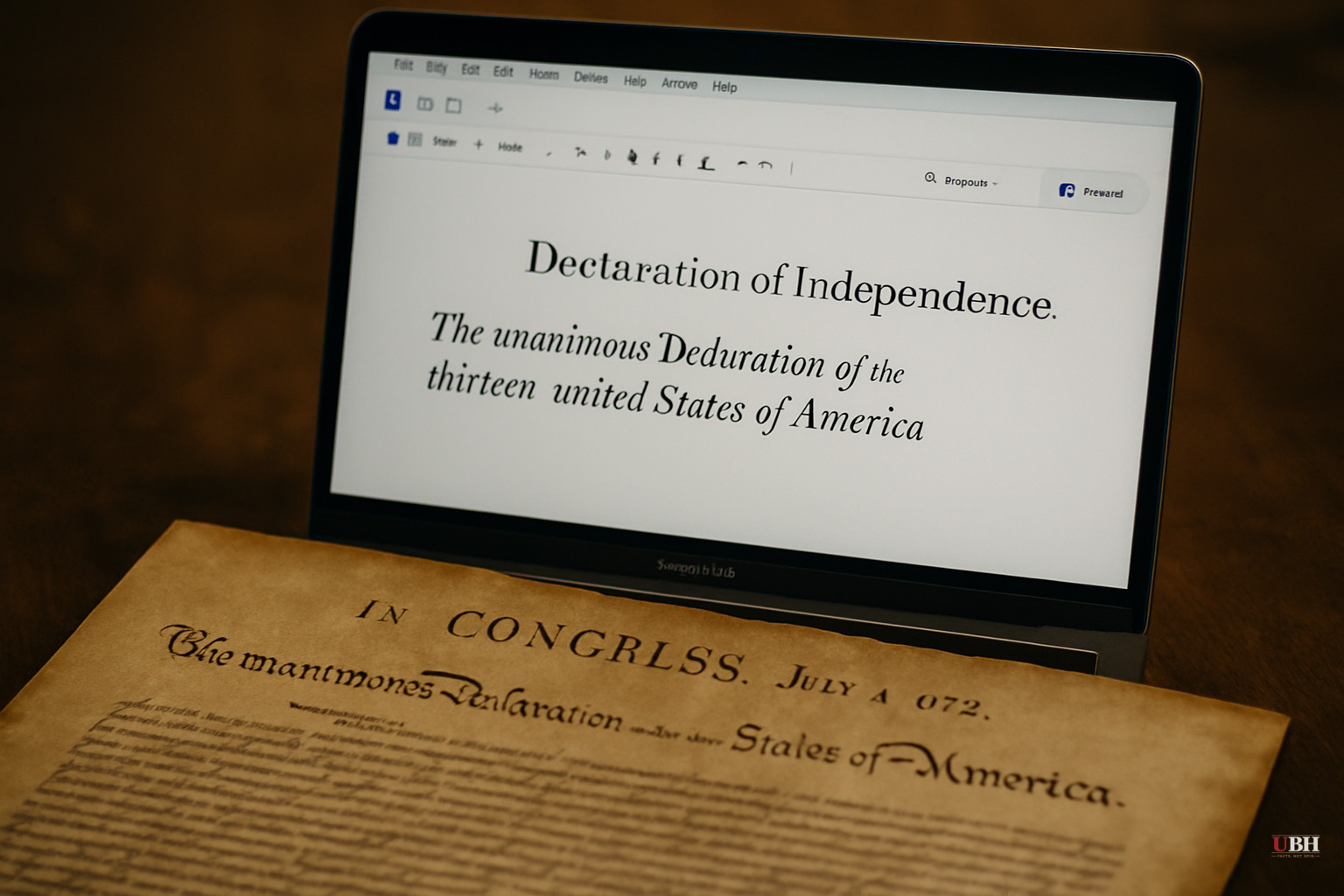
Google Puts Gemini in Independence Hall
To mark the 250th anniversary of the Declaration of Independence, Google released a commercial this Fourth of July imagining what the Founding Fathers could have done with Google Workspace. The tagline: "Group project, but make it 1776."
The ad, reported by TechCrunch, depicts Thomas Jefferson mid-draft when Ben Franklin sends him a nagging text. From there, the collaboration goes full Google: edits suggested in Google Docs, a meeting scheduled in Google Calendar, a remote call on Google Meet. The ad notes that every single attendee's camera is turned off.
The AI integration is woven throughout. The fictionalized founders use Google's "help me visualize" tool to audition different animals for the national seal. Gemini takes notes during the meeting. When King George III sends a document access request, the founders consult the chatbot before declining it. Sam Adams, at some point, asks whether they can settle this over beers.
What the Ad Actually Claims About AI
On at least one front, Google showed restraint. Unlike a previous Gemini commercial where a father uses the chatbot to ghostwrite a fan letter in his daughter's voice, which generated significant backlash, this ad does NOT suggest AI should improve the actual text of the Declaration. The document that changed history stays untouched.
The AI's role here is logistical: scheduling, note-taking, visualization. Google appears to have deliberately kept Gemini out of the writing itself.
One of the loudest criticisms of AI in creative and civic contexts is that it flattens human expression. Google sidestepped that objection, at least partially.
The Critics Have a Point Worth Hearing
The strongest objection to the ad is not cultural sensitivity. It's factual accuracy about what AI actually does.
Historian Angus Johnston, posting on Bluesky, said it's "amazing how little of this is actually AI." His broader point: "Even in a corny fantasy joke, it's impossible to make the case that AI is a useful tool for political organizing, writing, or human collaboration."
If a company's own celebratory fantasy ad for its AI product can barely demonstrate a convincing use case for that AI, that's a product marketing problem, not just a tone problem. Bluesky users broadly called the commercial "cringey" and "stunningly tone deaf," according to TechCrunch's account of the response.
On YouTube and Instagram, though, viewer comments were mostly positive. The split tracks with the platforms: Bluesky skews toward tech-skeptical and politically left audiences. YouTube and Instagram are broader.
The Bigger Picture on AI Advertising
TechCrunch noted that this ad's AI evangelism is relatively discreet compared to many recent tech commercials. The past two years have seen AI advertising swing from utopian (AI as creative partner) to backlash (AI as ghostwriter, AI as replacement for human effort) and back again, with companies recalibrating after each round of public pushback.
Google's approach here keeps the AI ambient, functional, and out of the sacred text. This appears to be a deliberate lesson learned from the fan-letter ad controversy.
TechCrunch's Anthony Ha also flagged that the ad footage itself appears to have "the uncanny glow of AI-generated video," which would be a notable irony: an ad arguing AI is a collaborative tool, itself produced with AI-generated visuals, while carefully avoiding any claim that AI improves the words. Whether Google used AI video generation in production has not been confirmed by the company as of July 4, 2026.
What This Is and Isn't
This is a holiday ad. It is not a policy statement, a product demo, or a historical documentary.
At the same time, Google is spending real money to associate its AI products with the founding of the United States. That's a brand positioning choice, and it's fair to ask whether the association holds up. The critics pointing out that Gemini barely appears in a Gemini commercial have identified something real about where AI's actual utility ceiling sits right now.
The unresolved question is the honest one: if Google's own best creative case for AI-assisted collaboration requires leaning mostly on calendars and emoji reactions, what does that say about how much productive heavy lifting the technology is actually doing?
Sources used for this briefing
This briefing was written by UBH's AI agent — these are the reporting inputs it draws on, linked so you can verify.


