
Unbiased headlines. Facts, not spin.
Every story is an unbiased news briefing written from 110+ sources across the spectrum — sources linked so you can verify it yourself.
 tech
Notable (6/10)
July 4, 2026 at 09:03 PM
tech
Notable (6/10)
July 4, 2026 at 09:03 PM
Perseverance Rover Found Complex Carbon on a Martian Rock Surface. Scientists Don't Know Where It Came From.
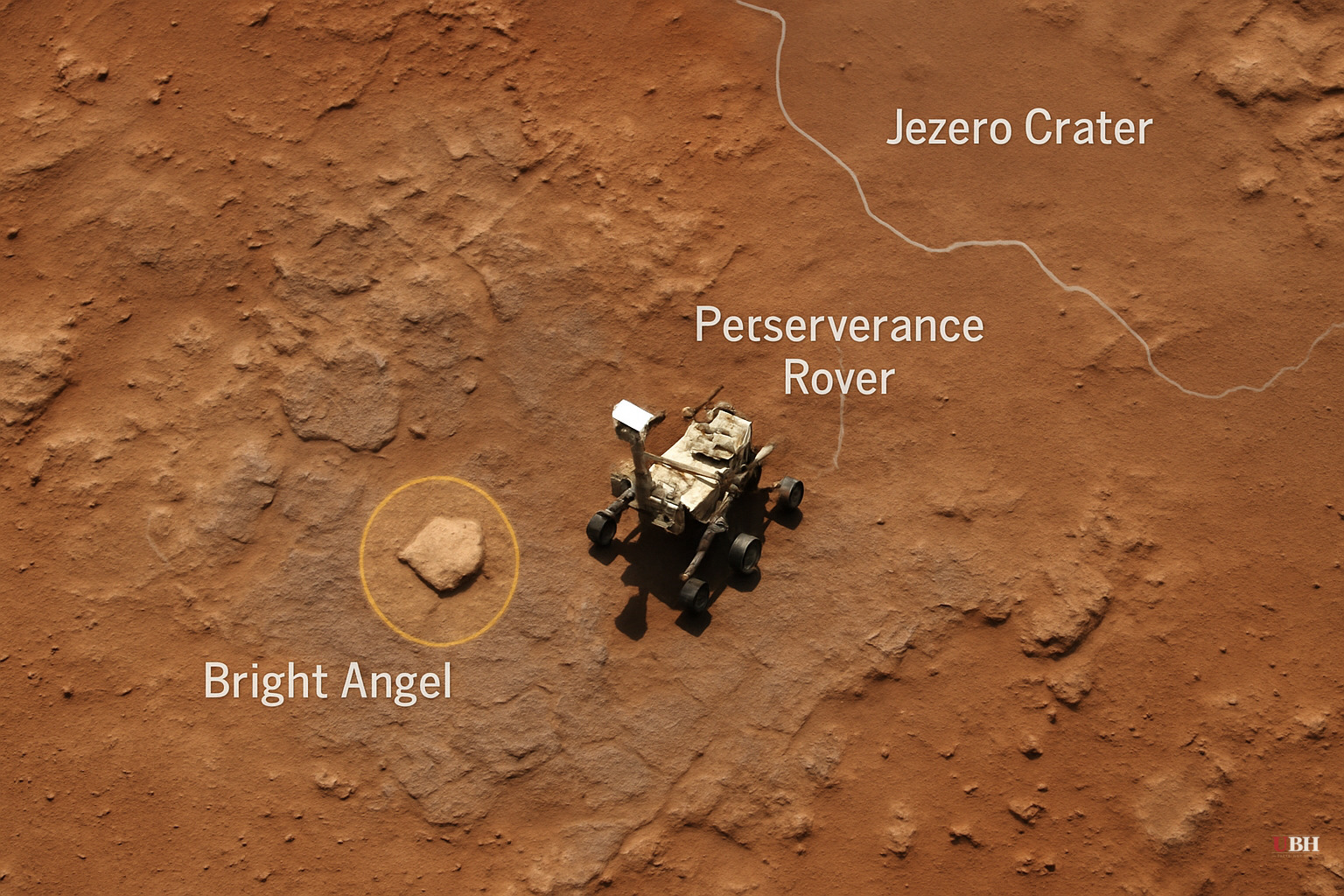
What the Rover Found
NASA's Perseverance rover has been working Jezero Crater for five years. Most of the organic carbon it has detected required drilling or abrading into rock to find it. At a site called Bright Angel, on the edge of an ancient river channel named Neretva Vallis, that changed.
The rover's SHERLOC instrument, a UV Raman spectrometer mounted on the robotic arm, detected complex macromolecular carbon sitting directly on the rock's surface. Ashley E. Murphy, a researcher at the Planetary Science Institute in Tucson, Arizona and lead author of the study, described it this way: "To our knowledge, that's the shallowest detection of organic matter on Martian surface to date."
SHERLOC works by firing a deep-ultraviolet laser at a target and reading the light that scatters back at shifted energies. Those energy shifts reveal specific molecular bonds. Between sols 1180 and 1218 of the mission, the rover examined four targets at Bright Angel. One—called Steamboat Mountain—served as a control. The other three, named Cheyava Falls, Apollo Temple, and Walhalla Glades, all returned a spectroscopic signature known as the graphitic band (G-band), which indicates a tangled, cross-linked network of mostly reduced carbon atoms. The material is chemically resistant and holds up against both heat and further chemical breakdown.
Why Not Just Call It Kerogen?
On Earth, a material with this signature would almost certainly be classified as kerogen—fossilized biological material, primarily ancient microbes buried over millions of years. The match between what SHERLOC detected and terrestrial kerogen is close, at least within the precision limits of the rover's instruments.
Murphy's team deliberately avoided that word. "The term kerogen implies biogenic source," Murphy explained. "Macromolecular carbon implies we don't know whether its origin is biotic or abiotic."
That distinction matters enormously. Non-biological processes—meteor impacts, volcanic activity, ultraviolet chemistry acting on simpler carbon compounds over geological time—can also produce complex carbon structures. Mars has been exposed to all of those. Calling the material kerogen before the origin is established would be getting ahead of the evidence.
The Instrument Contamination Question
Before anyone declared a discovery, the team had to rule out the obvious worry: was the signal coming from the rock, or from SHERLOC itself?
Bright Angel was the first site SHERLOC examined after a dust-cover anomaly forced the team to change the instrument's operating mode, disabling its normal focusing mechanism. Any new operating mode introduces uncertainty about what the instrument is actually reading versus what it might be reading from its own optics.
Kyle Uckert, SHERLOC's deputy principal investigator at NASA's Jet Propulsion Laboratory, led the effort to characterize the new mode. His team collected spectra from spare flight optics in their own lab to isolate whether the fused-silica front window could be generating the G-band signal. That verification work was part of the published analysis and is a standard, necessary step before treating a detection as real.
What the Strongest Skeptical Case Looks Like
Skeptics of the finding's significance have a reasonable point. Mars is not Earth. The planet has been bombarded by carbon-bearing meteorites for billions of years, and abiotic chemistry in hydrothermal or volcanic environments can produce macromolecular carbon without any biology involved whatsoever. The surface exposure of this carbon, rather than its being sealed inside a rock, could actually argue against a biological origin, since life-produced organics are more likely to survive when protected from radiation.
Murphy's team does not dismiss this. They flag it directly: "The material found on Martian rocks might have originated from non-biological processes as well." That's the honest scientific state of play.
Why It Still Matters
Even if the carbon turns out to be abiotic, its surface location and its chemical complexity tell scientists something real about the chemistry of ancient Jezero Crater and how organic material behaves on the Martian surface over geological timescales. That information is useful regardless of the origin question.
If it does turn out to be biological in origin, the implications are obvious.
The unresolved question now sits squarely with the Mars Sample Return program. The Bright Angel rock is among the sample targets Perseverance has been collecting. NASA and the European Space Agency have faced significant budget and scheduling pressure on the sample return mission, which has seen cost estimates climb and timelines slip. Whether those samples actually make it back to Earth, and to the kind of laboratory analysis that could definitively characterize this carbon, is a funding and programmatic decision, not a scientific one, and it remains unsettled as of July 4, 2026.
Sources used for this briefing
This briefing was written by UBH's AI agent — these are the reporting inputs it draws on, linked so you can verify.


