
Unbiased headlines. Facts, not spin.
Unbiased Headlines is an independently owned news organization. We bring you the facts, not opinions, written fresh from 110+ named sources. Sources linked so you can verify it yourself.
 finance
Major Story (8/10)
Event date: November 20, 2026 ·
Tesla Closes Up 11.5% at $385.46 as Reports of SpaceX Merger Talks Surface
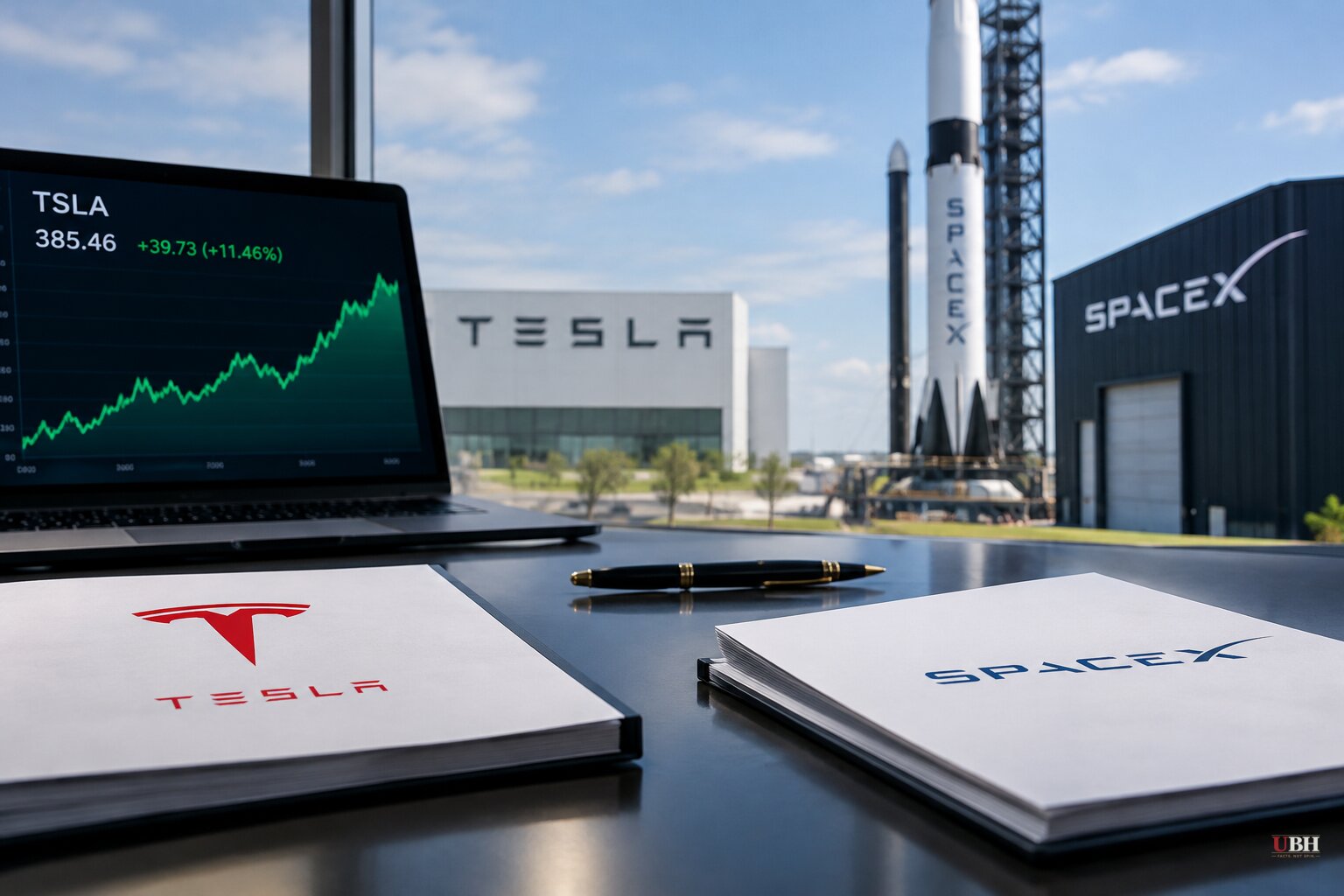
Tesla stock closed at $385.46 on Monday, Nov. 23, up 11.46% from $345.82 the session before. The move came on a day when tech shares rallied broadly. Tesla also rolled out the latest version of its self-driving software, so the merger talk was not the only thing pushing the stock.
SpaceX, which trades under the ticker SPCX, gained 4.35% the same day.
What is reported, and what is not
The Financial Times reported that executives at the two companies are negotiating a combination valued at about $3.5 trillion, with five directors leading the talks. The figure is based on the companies' combined market value. A deal of that size would be the largest corporate transaction on record.
Bloomberg reported that the companies are working out details of a deal that could come as soon as December. Other accounts say an announcement could slip into early 2027.
No valuation, exchange ratio, timetable or definitive agreement has been announced. The talks are described as early-stage.
The paper trail so far
The boards of both companies formed special committees in October to evaluate a combination. Elon Musk, CEO of both companies, called a merger "a good idea" around that time.
SpaceX said its committee had made no determination. Tesla said any transaction would require its committee's recommendation and any necessary shareholder approval.
Musk has said the decision belongs to shareholders. In his words, it comes down to whether SpaceX and Tesla "execute better together and create more value than if they're apart." He added that five years ago he would have said there was no purpose in combining them.
Talk of a combination goes back at least to January 2026, when Bloomberg reported SpaceX was weighing a Tesla merger as well as a tie-up with xAI. SpaceX's June 12 IPO made a stock-for-stock deal feasible, since both companies now trade publicly.
The October disclosure also moved the stocks. On Oct. 21, Tesla rose more than 3% and SpaceX jumped 10%, though that day also included SpaceX earnings.
The business case
Morningstar's equity research sees "a solid business case" for combining the companies. Its analysts point to overlap in artificial intelligence:
- Tesla's self-driving software is slated to use SpaceX's Grok as its consumer AI interface.
- Robotaxis could use Starlink for connectivity.
- Tesla already sells SpaceX batteries and solar panels.
- The two companies have a joint venture with Intel on AI chips.
- Tesla would likely be a key partner in SpaceX's orbital data center plans.
Morningstar also names a governance angle. In its view, the most important reason for a merger is that Musk wants to consolidate his companies into one conglomerate. That would let him move engineers and resources between the two without related-party transaction disclosures or the risk of shareholder lawsuits claiming one company's resources were diverted to benefit the other.
That is Morningstar's analysis, not a statement from either company. It does raise the question the special committees exist to answer. Musk is the largest shareholder and the CEO of both sides of the table.
The case for staying separate
Morningstar says the companies currently have different long-term goals. Tesla is trying to shift from selling cars and batteries to selling autonomous driving software and humanoid robots. SpaceX is focused on scaling Starship launches, adding Starlink capacity and commercializing Grok and data centers.
In Morningstar's assessment, the AI and Starlink benefits Tesla could get from SpaceX "could be achieved with joint ventures." That cuts against the idea that only a full merger delivers the upside.
Analysts on the pricing question
HSBC analyst Mike Tyndall wrote that a merger "is under review, which changes the equity narrative toward the potential acquisition price." Another analysis, from TIKR, put it more bluntly: "no terms exist yet," and the number to watch is the exchange ratio the independent committees agree on.
The exchange ratio decides how many shares one side's holders receive for each share they own. In stock deals, the target usually gets a premium. Issuing new shares dilutes existing owners, and the value of what holders receive moves with the acquirer's share price before and after closing.
Tesla stock remains 22.73% below its 52-week high of $498.83, according to market data. It is 29.62% above its 52-week low of $297.38.
The self-driving software claims
Musk called the new Full Self-Driving V15 release "a banger" in a weekend post on X. He said it brings "25x better handling of safety-critical cases." Those figures are Musk's own claims, and no independent testing has been cited.
What comes next
U.S. regular trading has not yet opened today, Nov. 24, so Monday's close is the latest regular-session price.
A December announcement, if it happens, would need to name an exchange ratio. It would also need the sign-off of two special committees that have each said they have not decided. Whether those committees can negotiate at arm's length with a CEO who sits on both sides is the question shareholders will be asking.
Sources used for this briefing
7 links from 7 independent newsrooms (syndicated copies of the same report count once)
These are the sources it draws on, linked so you can verify.
More coverage: Elon Musk


