
Unbiased headlines. Facts, not spin.
Unbiased Headlines is an independently owned news organization. We bring you the facts, not opinions, written fresh from 110+ named sources. Sources linked so you can verify it yourself.
 finance
Breaking / Critical (9/10)
S&P 500 Closed About 5% Higher on Huang's Return but Remains $5 Trillion Below Its Oct. 6 Peak
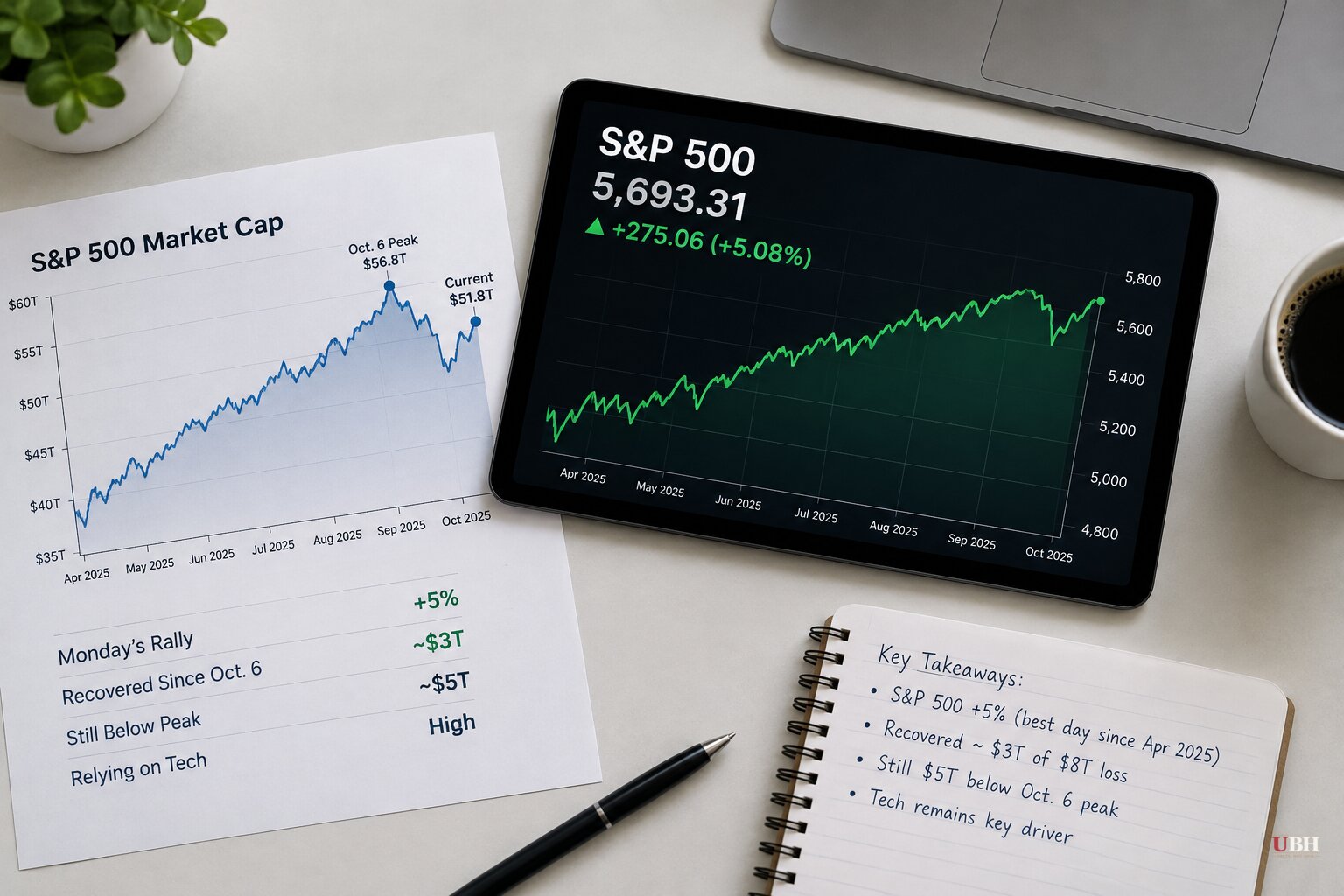
Since Jensen Huang resigned as Nvidia CEO on Nov. 12 and the board reinstated him Monday, Nov. 23, the final numbers are in on the rebound. They show a big day, not a recovery.
The S&P 500 closed up about 5%, the Nasdaq gained 6.5% and the Dow rose 3%. It was Wall Street's best session since April 2025. Nvidia shares jumped about a third.
The S&P still sits roughly $5 trillion below its Oct. 6 record. On that day the companies in the index were worth about $70 trillion. By Friday's close, six weeks later, that value had dropped more than 11%, erasing roughly $8 trillion. Monday won back about $3 trillion of it.
One stock, one man, one index
The size of the swing shows how much of the market rests on AI. Of the 10 biggest U.S. companies, which make up 40% of the S&P 500, eight are tech companies.
The exposure is not just American. Apollo chief economist Torsten Slok wrote in a Monday note that the U.S. now accounts for three-quarters of the value of stocks in developed markets worldwide.
Nvidia was among the hardest hit in the selloff. Its shares fell nearly 14% on Friday alone. All three major U.S. indexes were in correction territory by Friday's close.
eToro market analyst Sam North said Monday's move highlights the concentration of the AI trade and its dependence on one man. He added that Nvidia "restoring its founder to the helm gives investors a powerful reason to reassess last week's selloff."
That is a reassessment of one executive change. It does not settle the question that started the slide: whether the billions of dollars companies have poured into AI will pay off.
Trump says he got it done
President Trump told CNBC on Monday that he spoke to Nvidia's board. "I convinced them," he said. "If I didn't get involved, you'd probably have a very sad Nvidia for a long time to come."
White House communications director Steven Cheung confirmed Trump was "totally involved" in bringing Huang back.
The board's reversal was abrupt. Days after Huang's ouster, it had insisted it was not considering reinstatement, even as Trump pushed for it and thousands signed an online petition.
According to the Associated Press, Trump's reasoning was twofold. He has staked economic growth on AI and worried the ouster was tanking the market. He also worried that Huang, widely seen by backers and critics as a generational AI talent, could be poached by a Chinese firm. The AP also reported that Trump bristled at Huang being pushed out over extramarital affairs, one of them with an executive at a Singapore-based company whom U.S. officials suspect was a Chinese spy.
Questions Trump's involvement raises
Trump has a personal stake in Nvidia. His annual financial disclosure, filed in June 2026, lists Nvidia holdings worth between $12.5 million and $58 million at the end of 2025. A year earlier the range was $615,000 to $1.3 million.
White House spokesman Davis Ingle said the portfolio is managed by third-party institutions. "All holdings are maintained in discretionary accounts and invested through computer-based model portfolios that automatically replicate recognized indexes," he said. Ingle added that neither Trump nor any family member can direct or influence the investments.
Huang has also been an adviser to the White House on AI and a big donor to Trump's ballroom project, according to the AP.
Rep. Robert Garcia, the incoming chair of the House Oversight Committee, is among the politicians who have raised corporate governance and national security questions about the reinstatement.
The intelligence report
The security questions center on a New York Times report published Sunday. The Times, citing multiple people familiar with U.S. intelligence assessments, said American agencies tracked a woman romantically involved with Huang as she kept contact with an officer of China's Ministry of State Security from spring 2025 through fall 2026.
The Times also reported that U.S. intelligence found evidence that Huang's business partner, Kang Wei, worked with the Chinese spy agency. It said those contacts coincided with efforts by Huang's company, Megaspeed, to acquire advanced Nvidia chips, some of which allegedly ended up in networks suspected of evading U.S. export restrictions.
The Times said U.S. officials are investigating whether Huang and associates took part in a broader effort to obtain American chip technology for Beijing. Those claims come from unnamed sources, and no charges have been announced.
What the market faces this week
Before Monday's open, futures were already higher as investors bought the dip. Anthropic, which is publicly traded, also rose in premarket trading, extending what Dow Jones described as a volatile start to life as a public company.
The session Monday was also scheduled to include a keynote from New York Fed President John Williams. Markets close Thursday for Thanksgiving and run a shortened session Friday, so the AI-linked names have only two full trading days, starting with today's, Nov. 24, plus the shortened Friday session to show whether Monday's gains hold.
The $5 trillion gap to the October peak is the figure to watch. Nothing about Nvidia's spending, margins or export exposure changed over the weekend. Only the person running the company did.
Sources used for this briefing
7 links from 5 independent newsrooms (syndicated copies of the same report count once)
These are the sources it draws on, linked so you can verify.


