
Unbiased headlines. Facts, not spin.
Unbiased Headlines is an independently owned news organization. We bring you the facts, not opinions, written fresh from 110+ named sources. Sources linked so you can verify it yourself.
 finance
Breaking / Critical (9/10)
Gold Falls Nearly 4%, Bitcoin Drops Below $59,000 and Treasury Yields Ease as AI Selloff Reaches Beyond Tech
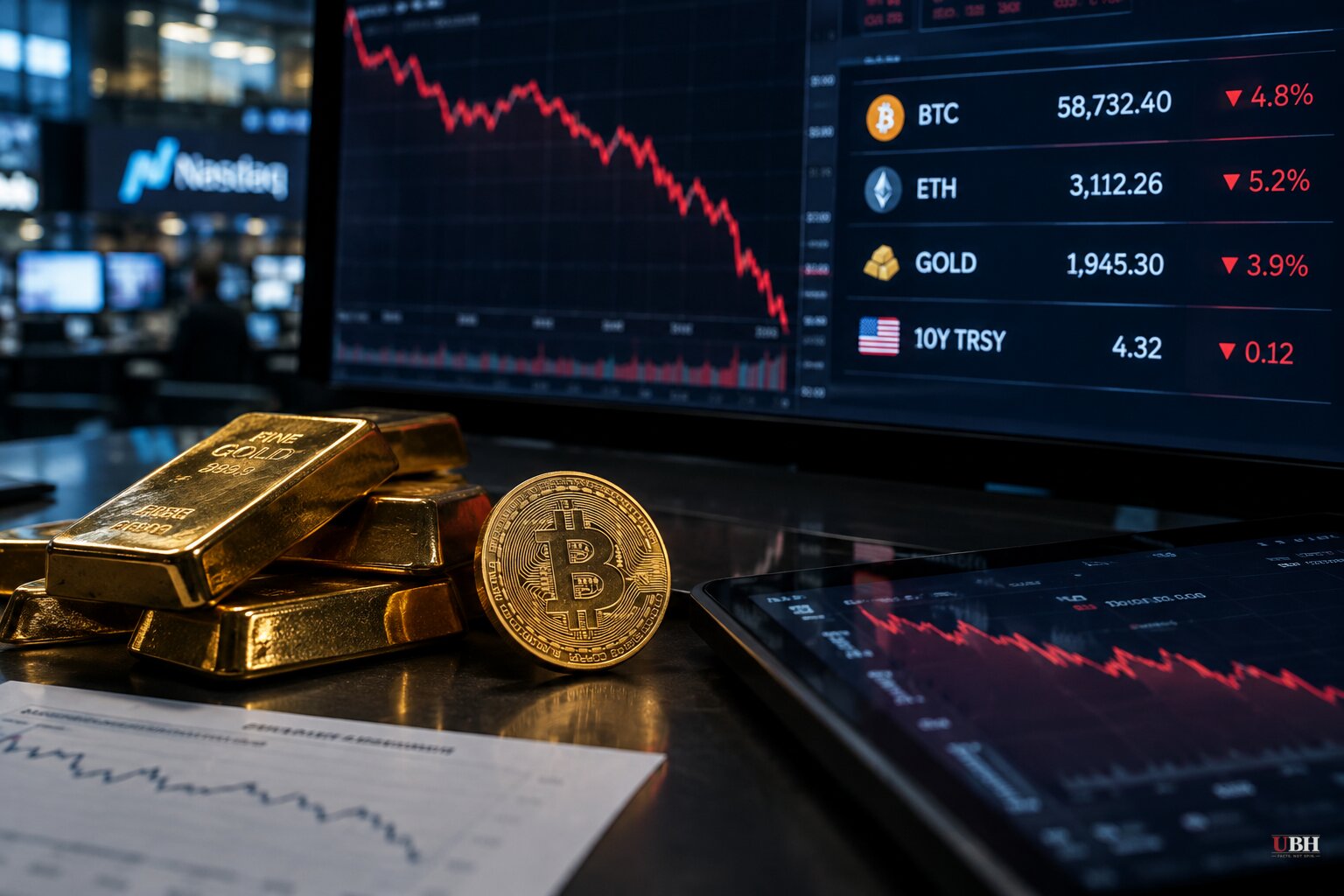
Since Anthropic's Nov. 19 Nasdaq debut, the AI selloff has gone from a chip problem to a cross-market one. Friday's close, Nov. 20, put the numbers on it.
The Nasdaq Composite fell 1,261 points, or 5.3%, to 22,618. The Dow dropped 949.73 points to 48,147.33 after slipping below 50,000. The S&P 500 lost 3.7%. The Dow and S&P both closed more than 10% below their peaks.
Damage under the surface
The headline index understates the wreckage. Seventy-one of the 101 stocks in the Nasdaq-100 were in bear market territory Friday, according to Yahoo Finance market statistician Jared Blikre. That included all 20 of the index's semiconductor and memory chip names.
Nvidia fell about 14% to its lowest close in 18 months. AMD, Broadcom and Micron each posted double-digit drops. CoreWeave and Nebius, which rent out computing capacity, also fell sharply.
The losses hit both sides of the AI spending boom. Chip suppliers fell, and so did big buyers of chips such as Amazon and Meta Platforms. Amazon and Cisco each lost nearly 5%.
The Dow's other big losers were Goldman Sachs, down about 7%, and Caterpillar, down more than 5%.
Not everything went down. About a third of S&P 500 stocks rose late in the session, versus fewer than one in 10 on Thursday, when all 11 sectors fell. Consumer staples gained about 1%. UnitedHealth rose about 3% after an analyst upgrade, and Walmart and Johnson & Johnson also gained.
Other assets slide too
Gold futures dropped nearly 4%. Bitcoin fell below $59,000, its lowest price since July, and weighed on Coinbase, Strategy and Robinhood.
Investors bought Treasurys. The benchmark 10-year yield was about 4.91% in afternoon trading, down from 5.04% late Thursday.
Abroad, Japan's Nikkei and South Korea's Kospi each lost more than 5%. In Toronto, the S&P/TSX composite fell 2.47% and entered correction, roughly 10% below its August record. It posted its steepest weekly drop since April 2025.
The week's tally
The weekly figures from Yahoo Finance show how concentrated the pain was in chips. The S&P 500 lost 8.6% for the week and the Russell 2000 lost 7.5%. Nvidia dropped 23%, its worst week since October 2008. AMD fell 20.5%, and Taiwan Semiconductor Manufacturing lost 20%, its worst week since July 2002.
Friday was the Nasdaq's second-worst day of 2026. The worst was Nov. 5, when it fell about 5.5% after the midterm elections. Then, President Trump wrote on Truth Social that "Your 401(k)s have, therefore, dropped," blaming the midterm results. Peter Schiff of Euro Pacific Asset Management said a day earlier that the market's rally "made no sense."
On Nov. 6, National Economic Council Director Kevin Hassett said planned data center construction would go forward despite the midterm backlash. Texas Gov.-elect Gina Hinojosa said the state should halt data center building until protections are in place.
Nvidia carries its own burden. CBS News reported the stock has shed more than 25% since the scandal that ended Jensen Huang's tenure as CEO erupted earlier this month.
Not everyone calls it a bear market
Some strategists say the damage is contained. Chris Larkin of E*TRADE from Morgan Stanley said the underlying U.S. economy and business fundamentals remain solid. He noted that only five of the past 15 corrections from all-time highs since 1983 became bear markets, meaning declines of 20% or more.
Michael Antonelli of Baird said the idea that AI can keep spending unlimited sums and support the stock market is "ending as we speak." He added that he does not believe the bull market that began in October 2022 is over.
The S&P 500 has now lost seven sessions in a row, its longest streak since February 2020.
The Fed is the open variable
The rate backdrop has not eased. Traders continued to price a quarter-point Federal Reserve rate increase in December. Fed Governor Lisa Cook said Friday that interest rates are too low to bring inflation under control.
Anthropic is the one piece that has held up. Its shares fell about 8.5% Friday but closed above the $83 IPO price, after peaking at $115.10 on Thursday.
What remains unanswered is whether the move stops at a correction. The S&P 500 would need a decline of 20% from its peak to enter a bear market, and a December rate hike would test whether the selloff has run its course.
Sources used for this briefing
7 links from 6 independent newsrooms (syndicated copies of the same report count once)
These are the sources it draws on, linked so you can verify.
More coverage: Crypto


