
Unbiased headlines. Facts, not spin.
Unbiased Headlines is an independently owned news organization. We bring you the facts, not opinions, written fresh from 110+ named sources. Sources linked so you can verify it yourself.
 finance
Breaking / Critical (9/10)
S&P 500 and Dow Slip Into Correction Territory, Nasdaq Turns Negative for 2026, as Anthropic Trades Near $85
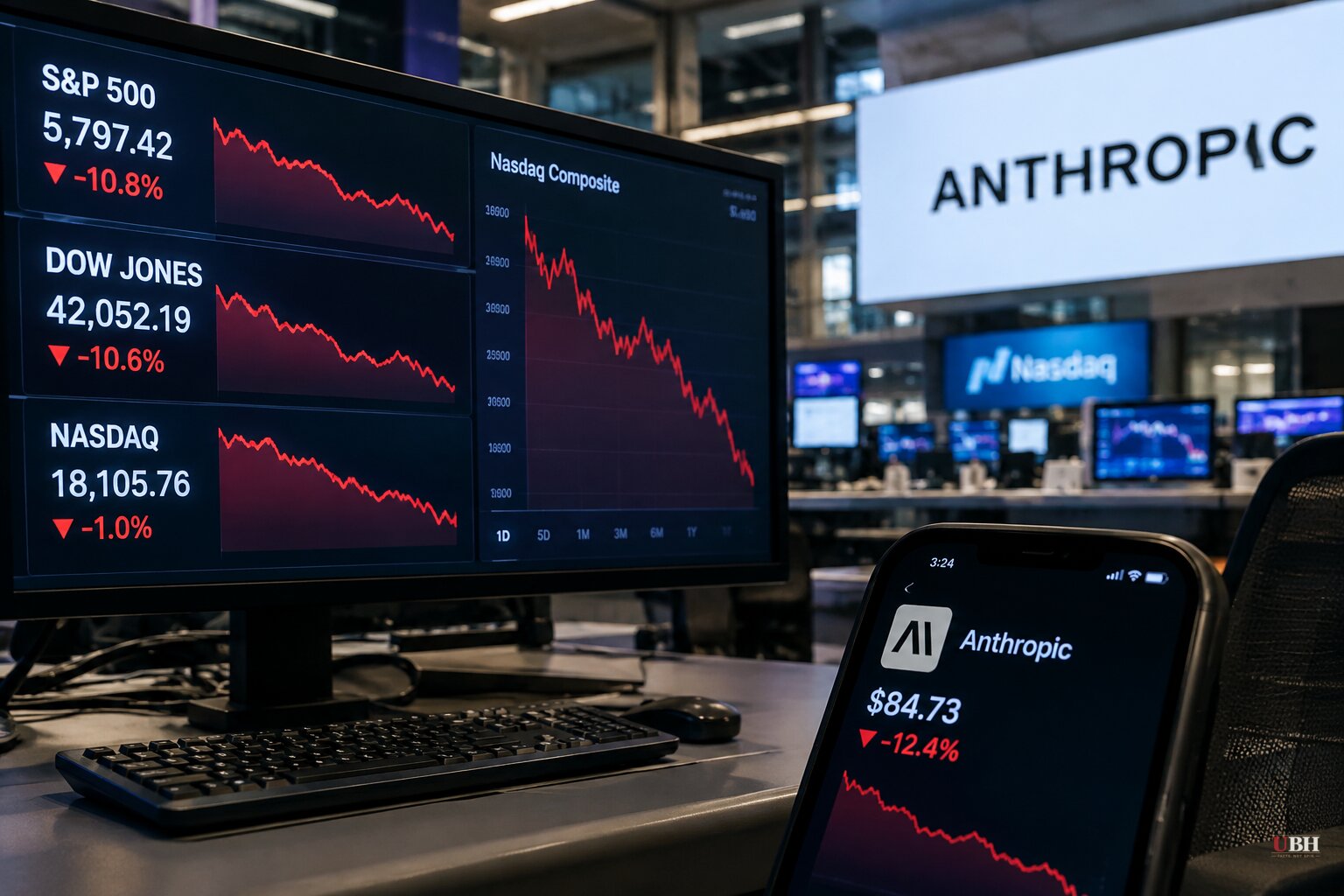
Since Anthropic (ANT) listed on the Nasdaq on Thursday, Nov. 19, and closed at about $97, the sell-off in U.S. stocks has widened. By about 2 p.m. ET today, Nov. 20, the S&P 500 and the Dow Jones Industrial Average had both traded more than 10% below their record closes, and the Nasdaq Composite had given back every point of its 2026 gain.
The S&P 500 was down roughly 2.1% to 2.3% in afternoon trading and is on track for a seventh straight losing day. That would be its longest losing streak since February 2020, according to CNN and Deutsche Bank. The Nasdaq was off about 3.5% to 3.7% and down roughly 1% for the year. The Dow was at 48,746.42 at 2:11 p.m., down 350.64 points, or 0.71%, after closing below 50,000 on Thursday for the first time since June.
A correction is conventionally confirmed by a close, not an intraday print. Today's close will settle whether the S&P 500 and Dow officially qualify.
A week worse than any since April 2025
For the week, the Dow is down about 6%, the S&P 500 about 7% and the Nasdaq about 8%, per CNBC's tally. All three are headed for their worst week since early April 2025, when President Trump's tariff announcement rocked global markets.
The S&P peaked on Oct. 6. The Dow's record came Aug. 5.
Chips take the hit
Semiconductors led the drop. Advanced Micro Devices fell about 11%, Micron more than 12% and Nvidia between 6% and 8% at various points in the session. Broadcom also posted a double-digit decline. Nvidia is extending a six-day losing streak.
Nvidia reported third-quarter revenue of $115.8 billion this week, against Wall Street expectations of about $108.9 billion, and raised its fiscal 2028 growth outlook to around 75% from 70%. The stock still could not hold its after-hours gain. CEO Jensen Huang has since resigned.
Anthropic itself was down between roughly 10% and 14% depending on the moment, trading around $84.70 to $85.16. That is just above the $83 IPO price.
Elsewhere, gold futures dropped nearly 5% and bitcoin fell below $59,000, its lowest level since July. Money moved into defensive names: Walmart gained almost 3%, Costco nearly 2%, and Johnson & Johnson and Procter & Gamble each more than 1%.
What the money managers say
The diagnoses differ. Massimo Santicchia, head of U.S. equities at Procyon, told CNBC: "This is not just a valuation-driven correction. It's becoming broader. Right now, it's definitely risk-off." Arun Sundaram of CFRA Research called it "a meltdown right now."
David Kelly, chief global strategist at JPMorgan Asset Management, sees it differently. He said corrections are "inevitable" and "nothing particularly ominous" after years of gains. "This is not a fatal illness. It's not even the flu. At the moment, it looks like a mild cold, and it should be over in a week or two," he said.
Yorkville partner Dan Ives listed seven catalysts in a note this morning. They included fears of an anti-AI, anti-data-center political shift after the midterms, Huang's exit, China-related regulatory concerns for chip stocks, including a short report on AMD on Thursday, and sticky inflation with hawkish Fed talk.
Richard Saperstein, chief investment officer at Treasury Partners, pointed to "slowing data center buildouts, reduced funding sources for AI-related projects and a slower trajectory of technology-related earnings growth."
JPMorgan's Kelly and the Yahoo Finance coverage of Ives both note that the Anthropic offering itself drew strong demand. Ives said it was a "massive success" that marginally reduced liquidity for other tech names.
The Fed is part of the story
The Federal Reserve held its rate at 3.75% to 4.00% in October. Minutes from that meeting showed broad support among policymakers for more hikes if inflation stays elevated, and some officials discussed a move larger than 25 basis points, according to a market note from StarTrader. The same note says markets are pricing about 90% odds of a 25-basis-point hike in December.
There was one bright spot in the data. The University of Michigan's consumer sentiment index ticked up as Americans grew more optimistic about business conditions after the midterm elections.
BTIG chief market technician Jonathan Krinsky said on CNBC that chart patterns lead him to think the sell-off is not over yet.
Two things are left to resolve. One is where the S&P 500 and Dow close today. The other is how large a rate increase the Fed's December meeting delivers, since the debate has shifted from whether the Fed hikes to how aggressively.
Sources used for this briefing
8 links from 8 independent newsrooms (syndicated copies of the same report count once)
These are the sources it draws on, linked so you can verify.
More coverage: Anthropic and Artificial Intelligence


