
Unbiased headlines. Facts, not spin.
Unbiased Headlines is an independently owned news organization. We bring you the facts, not opinions, written fresh from 110+ named sources. Sources linked so you can verify it yourself.
 finance
Breaking / Critical (9/10)
Nasdaq Loses About 10% in a Week, Dow Posts Worst Week Since March 2020, as Nvidia Drops 23% in Five Sessions
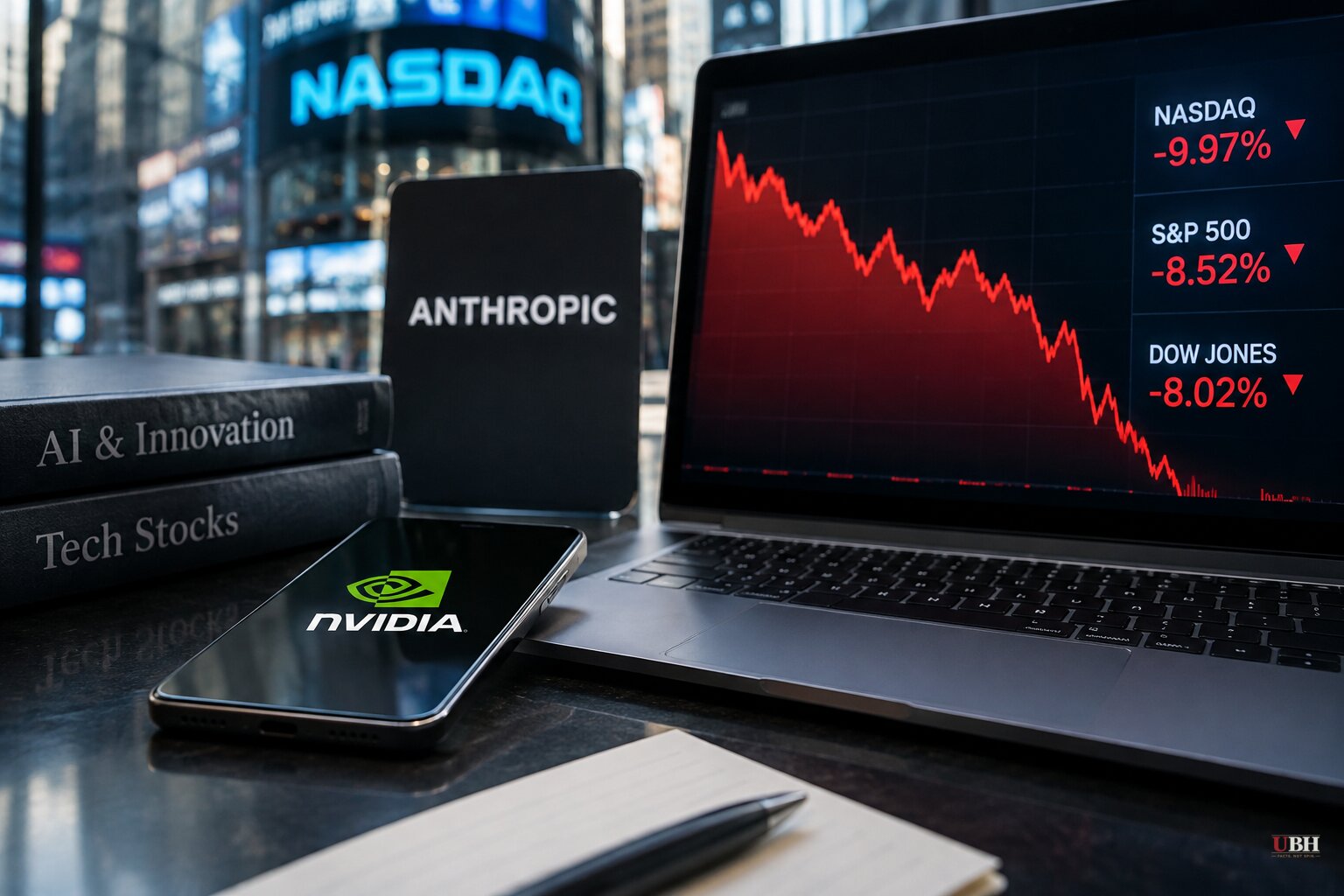
Since Anthropic's Nov. 19 Nasdaq debut, the AI selloff has spread from chip stocks to the whole market. With Friday's close in, Nov. 20, the weekly damage can be counted.
The Dow fell about 950 points, or 1.93%, on Friday and lost 8% for the week. That is its worst week since March 2020, according to CNN's tally. The Nasdaq Composite dropped 5.28% to 22,618 and lost about 10% for the week. The S&P 500 fell 3.7% and shed more than 8%. The Nasdaq and S&P had their worst week since early April 2025, when President Trump's tariff plans rattled global markets.
The S&P's seventh straight daily loss is its longest streak since February 2020.
Nvidia takes the worst of it
Nvidia fell roughly 14% Friday to its lowest close in 18 months. Crypto Briefing calculated a 23% drop for the week, the steepest since October 2008. Business Insider put the decline since early October at 47%.
The selling goes beyond one company. Advanced Micro Devices, Broadcom and Micron all suffered double-digit declines. CoreWeave and Nebius, which rent out computing capacity, also fell sharply. Amazon and Cisco each lost nearly 5%.
Goldman Sachs fell about 7% and Caterpillar more than 5%, which made them two of the Dow's biggest decliners behind Nvidia.
The selling was not universal. About a third of S&P 500 stocks closed higher, against fewer than one in 10 on Thursday, when all 11 sectors fell. Consumer staples gained about 1%. UnitedHealth rose about 3% on an analyst upgrade, and Walmart and Johnson & Johnson also advanced.
Money moves to bonds, away from crypto
Investors bought Treasurys. The benchmark 10-year yield slid to about 4.91% in the afternoon from 5.04% late Thursday. Bitcoin fell below $60,000, pulling down Coinbase, Strategy and Robinhood. Japan's Nikkei and South Korea's Kospi each fell more than 5%.
Rate pressure has not eased. Traders continue to price a quarter-point Federal Reserve hike in December. Fed Governor Lisa Cook said Friday that rates are too low to bring inflation under control.
What strategists are saying
Sameer Samana, head of global equities and real assets at Wells Fargo, told Business Insider the bank sees a risk of a broader valuations reset in AI. He cited higher rates, elevated oil prices, signs of economic weakness and tighter AI regulation. He declined to estimate how far prices could fall.
Samana also said Anthropic's offering drained money from the rest of the market. "The IPO is sucking a lot of liquidity from other parts of the market," he said. The bank favors large-cap communication services, industrials and materials so portfolios are not "overly reliant on the AI story."
TS Lombard has moved to "underweight" on global equities, trimming AI exposure in the U.S. and Taiwan.
Michael Antonelli, a market strategist at Baird, said the idea that AI can keep spending without limit and carry the market "is ending as we speak." He added: "I don't think that means that the overall bull market that started in October 2022 is over."
Chris Larkin of E*TRADE from Morgan Stanley said U.S. economic and business fundamentals remain solid. He noted that only five of the past 15 corrections since 1983 became bear markets, meaning declines of 20% or more.
The Motley Fool, citing Dow Jones Market Data, says the Nasdaq has turned a correction into a bear market about 37% of the time since 1971.
Anthropic and what is driving the selling
Anthropic closed at $88.91, down 8.5%, still above its $83 offer price. It is about 23% below the $115.10 peak it touched Thursday.
Fear of slowing data center construction runs through the selling. Lawmakers have pushed for tighter rules on new data centers, and CNN cites uncertainty over how newly elected Democratic governors will affect the pace of the buildout. CBS News points to worries over tighter federal limits on chip exports. Both CBS and CNN also point to the uncertain future of Nvidia's role in the AI buildout after Jensen Huang's resignation as CEO.
The Nasdaq 100 is down 17% from its record high, per Business Insider. That is close to the 20% bear-market line.
The next test is the Fed's December meeting. Traders expect a hike. The data center spending plans due from hyperscalers will show whether the AI trade has any footing left.
Sources used for this briefing
7 links from 7 independent newsrooms (syndicated copies of the same report count once)
These are the sources it draws on, linked so you can verify.
More coverage: Nvidia


