
Unbiased headlines. Facts, not spin.
Unbiased Headlines is an independently owned news organization. We bring you the facts, not opinions, written fresh from 110+ named sources. Sources linked so you can verify it yourself.
 finance
Major Story (7/10)
Event date: November 13, 2026 ·
Huang Forfeits About $108 Million in Unvested Nvidia Stock as White House Weighs Lutnick's Future Over China Chip Sales
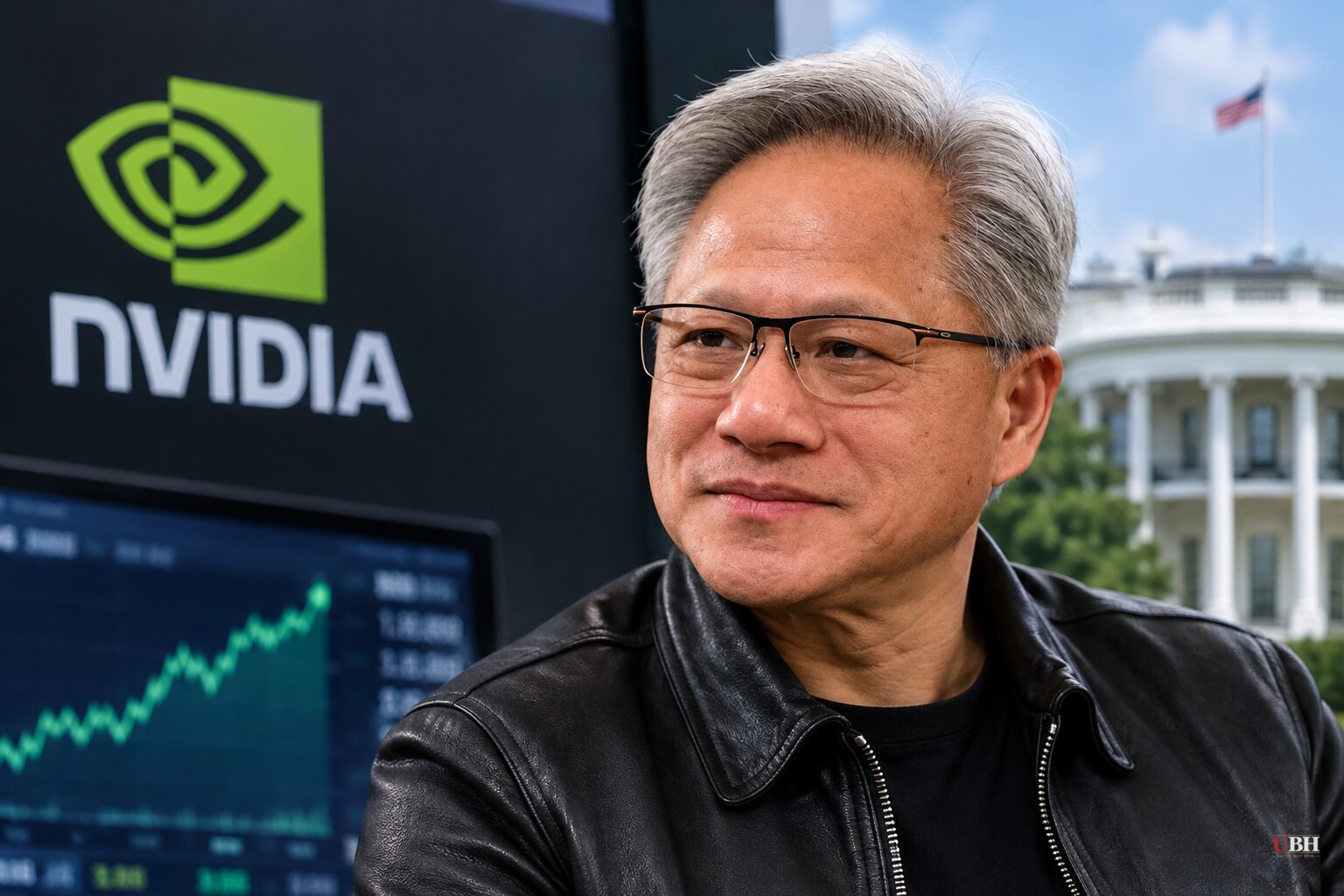
Since Jensen Huang resigned as Nvidia's CEO on Nov. 12 after admitting an affair, the damage has spread from the stock chart to his paycheck and to the Trump administration's China chip policy.
What Huang walks away from
Huang forfeits about $108 million in unvested stock awards, according to Bloomberg's calculation. Under Nvidia's equity policy, executives lose unvested restricted stock units when they leave.
He held about 346,000 such units and was expected to receive roughly 310,000 shares under the company's incentive plan if performance targets were met. That is gone.
It barely dents him. His estimated net worth is $144.5 billion, and his existing shareholding, valued at around $135 billion, is untouched. The forfeiture is about 0.07% of his wealth.
Forbes' wealth ranking still moved. Huang has fallen out of its top 10 richest people, with his fortune down $2.8 billion, or 1.97%.
For fiscal 2026, Nvidia's proxy statement shows Huang's total compensation at $36,343,830, down from $49.87 million the year before. That included about $1.5 million in salary, roughly $24.8 million in stock awards and $6 million in non-equity incentive pay.
The stock
Nvidia's market value dropped below $4 trillion for the first time since 2025 after the resignation. Shares were down more than 12% by 9:19 a.m. ET on Nov. 12, the day Nvidia announced the exit.
The Kobeissi Letter, a market newsletter, says Nvidia has lost $2.8 trillion in market value over 33 days, which it calls a record. Thirty-three days back from today, Nov. 20, reaches into mid-October, so that window starts well before Huang's departure.
The decline also has other drivers. CalMatters reports AI stocks fell broadly after the Democratic election gains earlier this month on investor fears of regulation, and that the S&P 500 lost $2.8 trillion in a single day. It puts Nvidia's drop this month at 22%.
Analysts were already marking down the company before the exit. Bernstein cut its price target from $400 to $200 on Nov. 12. Bernstein's Stacy Rasgon said the relationship with a direct report made it "much tougher" for the board to keep Huang. He also questioned who could set strategy for the next decade: "Jensen is Nvidia, right? He is the visionary."
Richard Reyle, chief investment officer at Questar Capital Partners, said before the resignation that removing Huang would make Nvidia "uninvestable," though not the AI trade as a whole.
What the board and Huang have said
CFO Colette Kress, who has held that job since 2013, is interim CEO. Board chair Harvey Jones said the board has "full confidence in Colette and the leadership team" and expects operations, customer commitments and the product roadmap to continue without interruption.
Huang admitted the affair on Nov. 8 in a message to staff. "I was unfaithful to my wife," he wrote. "There is no excuse for what I did."
When the board announced its internal investigation that day, it said it had no reason to believe national security or Nvidia secrets were compromised.
The spy allegation rests on a Nov. 6 New York Times report. Citing unnamed sources, it said U.S. intelligence officials identified Alice Huang, an executive at Singapore-based Megaspeed, one of Nvidia's biggest Southeast Asian customers, as recruited by China's Ministry of State Security. Taiwan has said it needs evidence before commenting.
A separate relationship with a direct report was reported by the Times, citing five people who worked at Nvidia, and by Reuters, citing two people familiar with the matter. Nvidia declined to comment on that.
Washington
Trump backed Huang. Asked about the board's investigation, he said, "I just know he's a fine person," and suggested Huang could join him on his trip to China the following week. The Times reported Trump urged Huang on a call on Nov. 10 to fight for his job.
Lawmakers from both parties have since called for tougher limits on China's access to advanced AI chips. House Speaker Mike Johnson said on Nov. 12 there was a growing consensus on limiting chip exports.
That puts Commerce Secretary Howard Lutnick in the frame. He and Huang both pushed to relax chip sales to China over objections from longtime China hawks in both parties. Two people familiar with the matter told Reuters on Nov. 12 that senior White House officials were discussing whether Lutnick should be pushed out.
A White House official said Trump "maintains complete confidence in the secretary and his ability to carry out the position." The Commerce Department did not immediately comment.
Still open
The board has not named a permanent CEO. Whether Lutnick keeps his job, and whether Congress writes tighter export limits into law, are both unresolved.
California's two biggest pension funds were trimming exposure before any of this. CalPERS sold 26% of its holdings in the Magnificent 7 in the first half of 2026, according to a Financial Times analysis. Deputy Chief Investment Officer Anton Orlich said the purpose was to diversify equity risk.
Sources used for this briefing
7 links from 7 independent newsrooms (syndicated copies of the same report count once)
These are the sources it draws on, linked so you can verify.


