
Unbiased headlines. Facts, not spin.
Unbiased Headlines is an independently owned news organization. We bring you the facts, not opinions, written fresh from 110+ named sources. Sources linked so you can verify it yourself.
 finance
Major Story (7/10)
Event date: November 5, 2026 ·
Chainalysis Says Its New AI Tool Traced $6.4 Billion Binance Theft Across Nearly a Dozen Blockchains
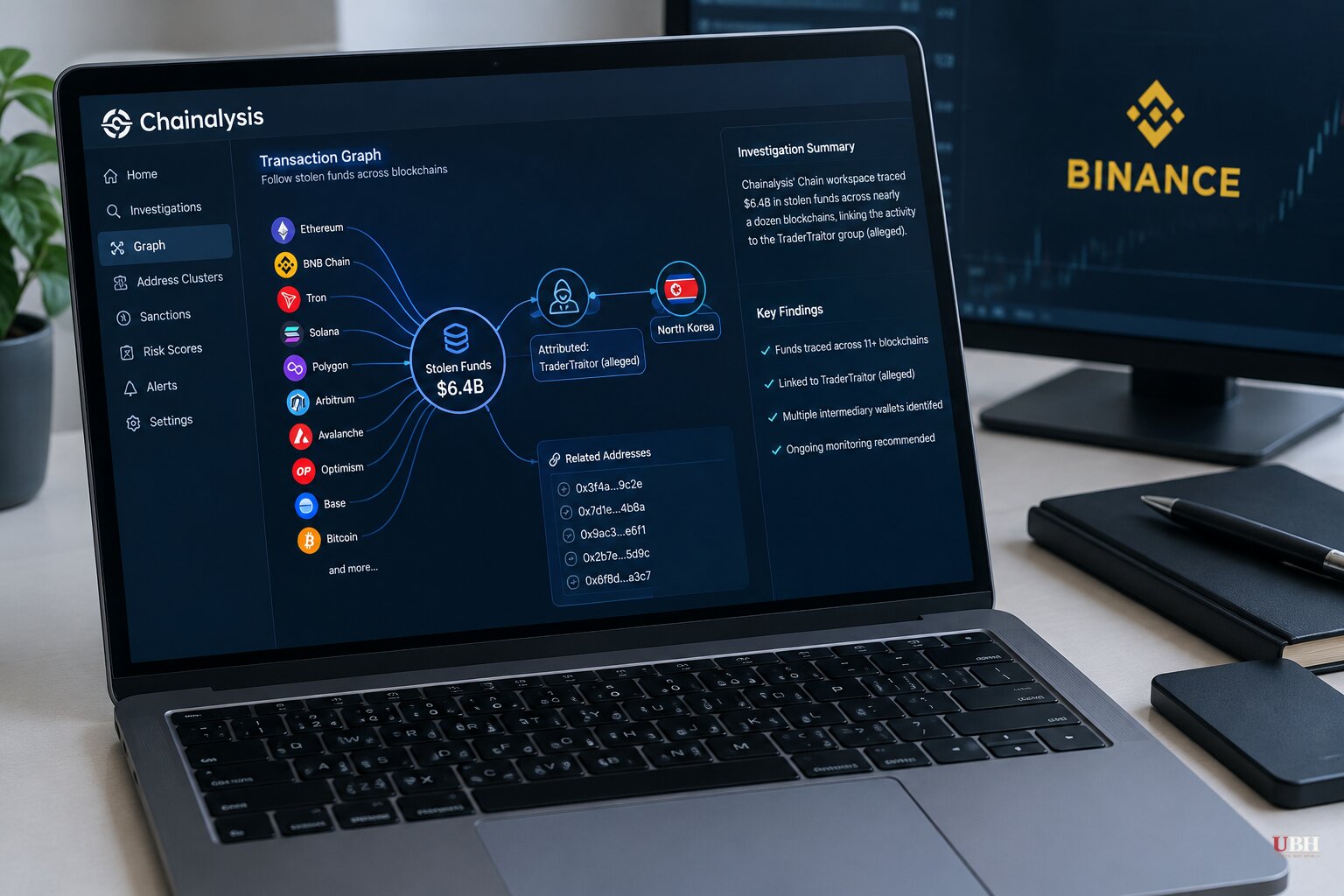
Since the Oct. 29 theft of about $6.4 billion from Binance's hot wallets, the largest crypto heist on record, the focus has shifted from how the attackers got in to where the money went. Blockchain analytics firm Chainalysis now says it has a detailed map.
The firm says its new AI-native investigation tool, Chain, helped follow the funds across nearly a dozen blockchains. Chainalysis publicly launched the product on Nov. 19 and is using the Binance case as its showcase. It is pitching real-time monitoring and automated workflows so investigators don't have to stitch together each hop by hand.
That is a vendor describing its own product, and the claims come from Chainalysis. The underlying facts about the theft are corroborated elsewhere.
What the on-chain trail shows
Chainalysis says the attack began at 4:20 p.m. ET and that most of the money left Binance within a window of roughly 20 minutes. Binance's own report, as relayed by the Epoch Times, cites a four-minute burst of transfers on Oct. 29, with five hot wallets sending 233.46 million XRP to an attacker-controlled address between 20:05 and 20:09 UTC. Figures on the timing vary between accounts.
The firm's attribution to TraderTraitor rests on on-chain evidence. Stolen Binance funds were commingled with proceeds from an earlier exploit of Bitget in September 2026. Reusing the same laundering infrastructure for two jobs is efficient, and it also links them.
The laundering involved thousands of recursive transactions, with funds cycled through long chains of addresses. Many of those sequences began with exactly 1 TRX on the Tron blockchain.
The thieves also adapted to freezes. Stablecoin issuers can blacklist addresses and lock USDT and USDC in place. Ether has no such switch. Chainalysis says the attackers swapped around $325 million in stablecoins for about $285 million in ETH in roughly 20 minutes, accepting a noticeably worse rate to get out of freezable assets.
The freeze and the gap
Exchanges and stablecoin issuers froze approximately $2.8 billion as of early November. Binance estimated the frozen total could reach as high as $3 billion. Breitbart's account of Binance's report says about $3 billion was gone for good.
The open question is how much of that unrecovered money can still be reached.
How attackers got in
Binance's own account, published Nov. 3, describes a multi-stage campaign rather than a single breach. In June, a wallet infrastructure engineer, called Engineer A, downloaded a tampered Homebrew installation while looking for a popular AI coding tool. Binance's security team caught it, replaced the device and rotated credentials. The attackers still knew who worked on wallet infrastructure.
In September, a second engineer was approached on a legitimate job platform by someone posing as a project director for a fictitious company. After two interview rounds, including one with a supposed CEO, he was told to download an "assignment." It contained malicious code.
On Oct. 20, the attackers used that machine and an internal Binance AI tool to take over Engineer A and a third employee. They found a deployment permission token still sitting on Engineer A's computer. On Oct. 29, they used it.
A known playbook
Chainalysis says the fake-interview approach is not new. Over the past 18 months it has attributed more than $14.3 million in losses to similar DPRK-linked fake interview and malware schemes, spanning individual crypto holders, private wallets, organizations, protocols and DAOs.
Tom McLouth, a senior intelligence analyst at Chainalysis, said North Korean actors were "perfecting and evolving their methodology" across those smaller cases. "That's how you end up with the biggest heist in history," he said. Chainalysis's Alec Zebrick calls the approach "contagious interviews," aimed at employees with privileged access.
Binance linked the attack to TraderTraitor in its Nov. 3 report, and the FBI confirmed the attribution two days after the hack, according to the Atlantic Council. North Korea has denied involvement. State-backed media there called the accusation a "grave political provocation." Kim Yo Jong said the U.S. was trying to brand the DPRK a "cyber criminal state."
Customers and what's left
Binance paused withdrawals and promised to cover customer losses in full. It said it had replenished 98% of affected tokens and was working to buy the rest, which it described as less liquid and slower to source at scale.
The exchange set aside more than $6 billion in company funds, including half of its $1 billion Secure Asset Fund for Users, and plans to rebuild that fund to roughly $1 billion. Its balance sheet still shows $157 billion in current total assets. It also saw $4.7 billion in customer withdrawals after the hack.
Stablecoin issuers can freeze tokens where they sit, but ETH and other assets that have already moved through thousands of addresses cannot be locked that way. Binance has not said how much it expects to recover.
Sources used for this briefing
7 links from 7 independent newsrooms (syndicated copies of the same report count once)
These are the sources it draws on, linked so you can verify.


