
Unbiased headlines. Facts, not spin.
Unbiased Headlines is an independently owned news organization. We bring you the facts, not opinions, written fresh from 110+ named sources. Sources linked so you can verify it yourself.
 finance
Notable (6/10)
Prosecutors Allege Indiana Fund Founders Ran $600M Ponzi Scheme, With CEO Picking Monthly Returns by Text
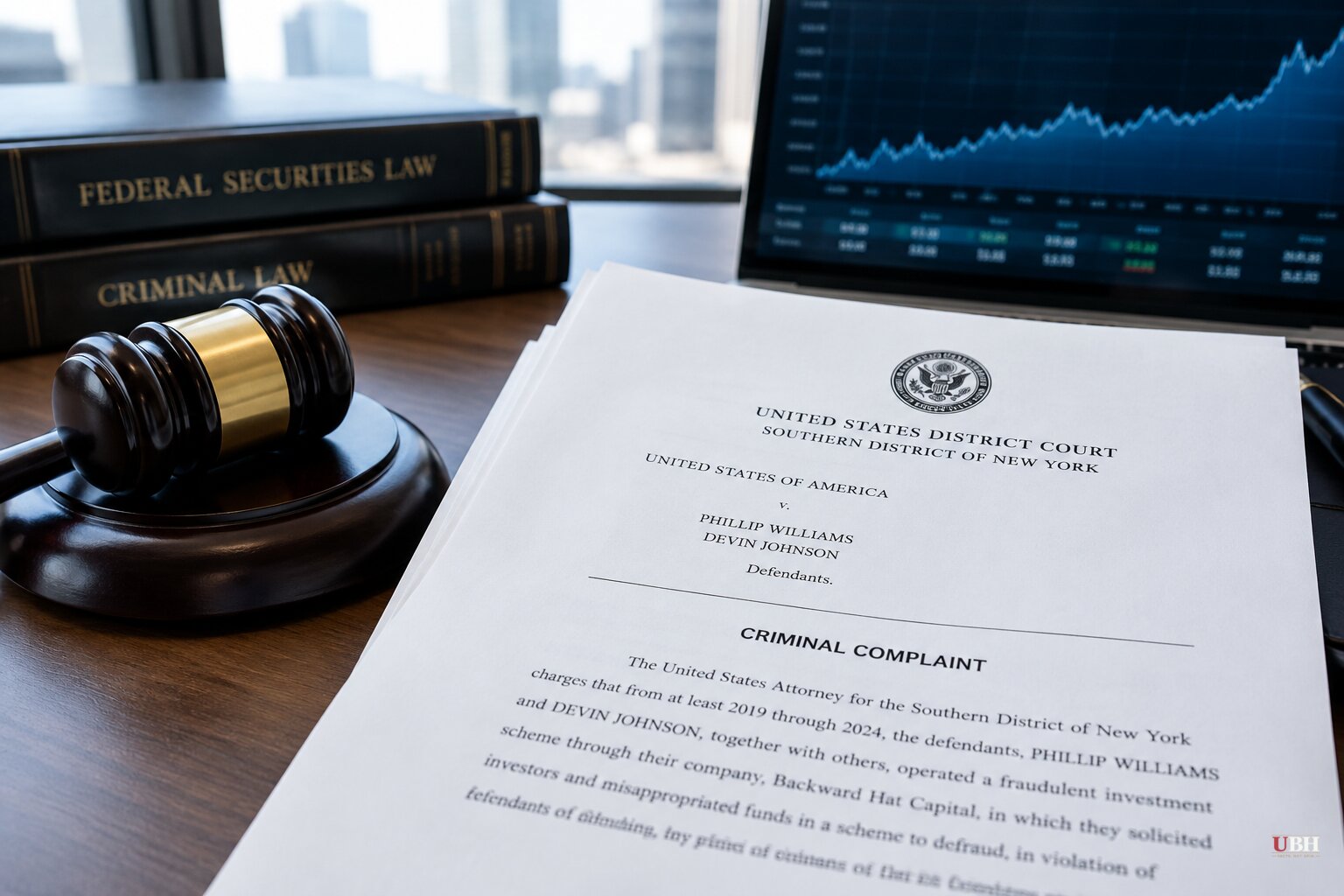
Each month, an employee at Indianapolis-based Backward Hat Capital allegedly texted the CEO to ask what return to tell investors they had earned. The CEO, according to a federal criminal complaint unsealed in Manhattan, picked the number.
"Aggressive fund 10.01%. Does this sound right?" the employee wrote in May. Phillip Patrick Williams asked what the prior month's figure was. Told it was 9.51%, he replied: "Let's do 9.91 bumped it up a bit."
That exchange is now Exhibit A in a case prosecutors say involved more than $600 million from over 2,000 investors. Williams, 51, of Kokomo, Indiana, and co-founder Devin Allen Johnson, 29, of Zionsville, Indiana, were arrested Nov. 18 in Kokomo and Gilbert, Arizona. They are charged with securities fraud, conspiracy to commit wire fraud and conspiracy to commit securities fraud. The two most serious counts each carry up to 20 years in prison.
Both men are presumed innocent. The case is at the charging stage and nothing has been proven in court.
The pitch
Prosecutors say investors were told the firm converted their money to crypto and ran a "proprietary" algorithm to trade foreign currencies. The SEC, in a parallel civil complaint, says the pitch was an "AI-driven" strategy that always returned at least 6% a month. Compounded, that is more than 100% a year.
The fund allegedly told investors it had never had a month below 6%.
Prosecutors describe the reported returns as "largely illusory." They allege the firm made little or no actual trades and paid earlier investors with money from newer ones.
Where the money went
The SEC puts total fundraising at $560 million, below the $600 million figure in the criminal complaint. The agency alleges more than 83% of the money went to two places: over $250 million to pay earlier investors, and over $220 million to the founders and their companies.
The SEC estimates Williams took more than $147 million and Johnson more than $45 million. The criminal complaint puts the figures at roughly $130 million and $40 million in accounts each controlled.
The SEC alleges the money paid for "exotic cars, expensive homes, and private air travel" and "helped support Johnson's gambling." The agency also says Johnson's prior experience "involved selling used sneakers."
The SEC says about $350 million, nearly two-thirds of the total, came in between October 2025 and October 2026. None of it went to the crypto account where investors were told trading took place.
According to the complaint, investors began requesting withdrawals in the summer of 2026 and the firm struggled to meet them. It allegedly kept soliciting new money until right before the arrests.
The audit
To reassure clients, Backward Hat distributed an "Independent Financial Audit" praising the fund's "strong financial integrity, sound governance, and consistent performance."
The SEC says the reports were written by Joseph Anderson, then CEO of a Denver training and consulting firm that does not perform financial audits. The agency says Anderson is not an accountant. It also says he is CEO of Droplight, a company he co-founded with Williams, and that he received about $2.5 million of investor money.
One audit said a fund held $246 million as of July 31, 2025, verified through bank statements. The SEC says the fund's bank account held $1.00 that day. Anderson has also been charged, according to Crypto Briefing.
Droplight sponsors cars and motorcycles in IndyCar, Indy NXT, MotoAmerica and NASCAR. The SEC alleges it received $31 million of investor money.
Three agencies, one case
The Justice Department handles the criminal case. The SEC filed its civil complaint Nov. 17 in Indianapolis, and it was unsealed Nov. 20. The CFTC has also brought a parallel action, consistent with the firm's forex pitch.
Pete Gizas, acting special agent in charge of Homeland Security Investigations in New York, said the scheme left "victims across the country facing devastating financial losses and undermined trust in the financial systems which families and communities rely on to build and protect their savings."
The SEC says the scheme began around July 2022. That means statements showing steady double-digit monthly gains went out for roughly four years. Promised returns above 100% annually are the kind of number that gets scrutiny, and the timeline raises a fair question about how long it took anyone outside the firm to look. No agency has addressed that publicly.
What comes next
A court-appointed receiver is overseeing the firm's assets, and the FBI is collecting information from victims. Whether any meaningful share of the money can be recovered is unresolved. The SEC's own accounting says over $250 million went out as payments to earlier investors and more than $220 million to the founders and their companies, and the receiver has not said what is left.
Sources used for this briefing
7 links from 7 independent newsrooms (syndicated copies of the same report count once)
These are the sources it draws on, linked so you can verify.


