
Unbiased headlines. Facts, not spin.
Unbiased Headlines is an independently owned news organization. We bring you the facts, not opinions, written fresh from 110+ named sources. Sources linked so you can verify it yourself.
 finance
Major Story (7/10)
Event date: November 16, 2026 ·
Nasdaq 100 Futures Up About 3% Before the Open as Nvidia Rises on Trump's Call to Rehire Huang
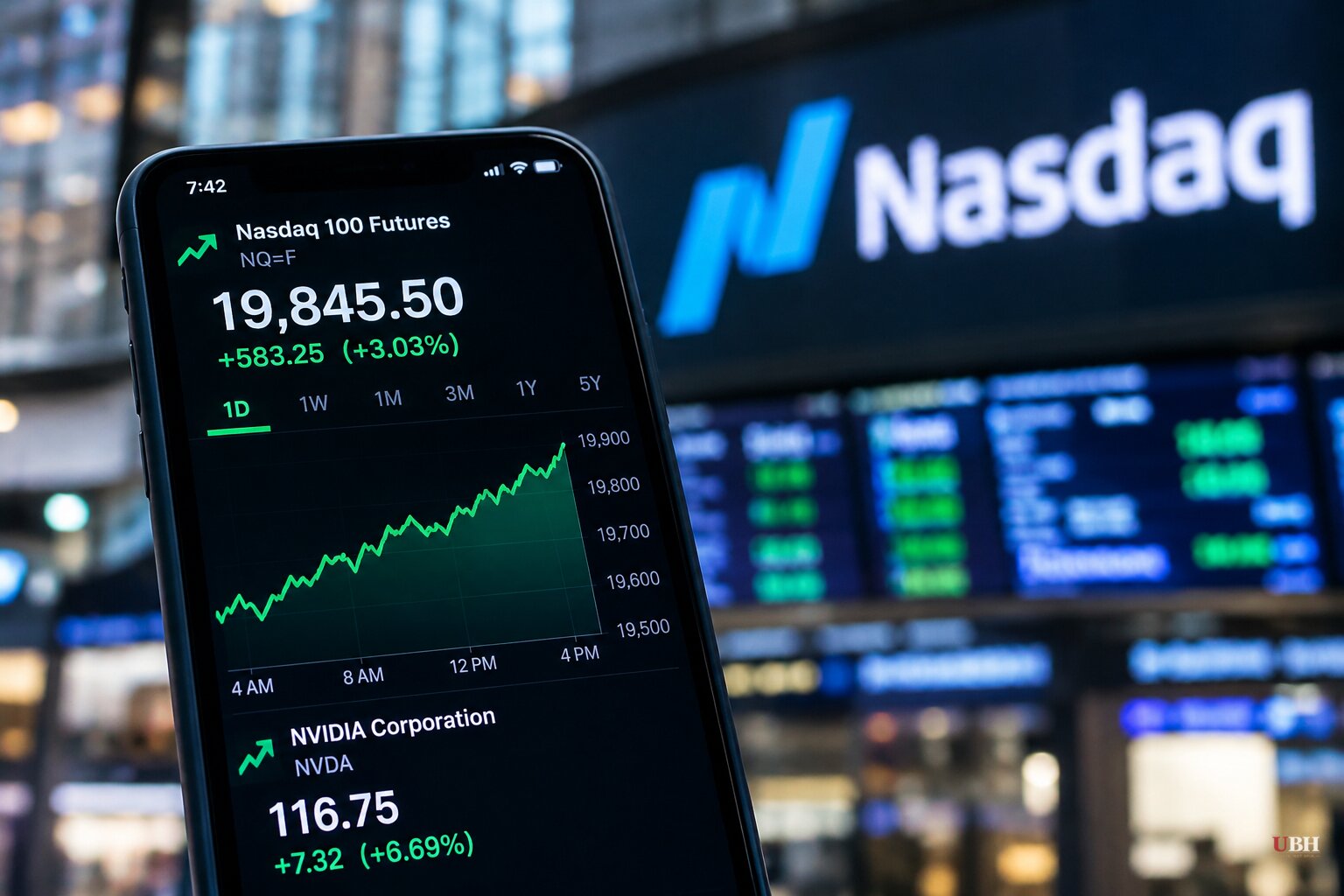
Since the Dow, S&P 500 and Nasdaq all closed Friday, Nov. 20, in correction territory, the question has been whether the AI-led selloff was a flush or the start of something longer. The first answer came before the opening bell today, Nov. 23: futures rebounded hard. Regular trading has not started, so these are indications, not the open.
Futures and premarket moves
As of premarket, Nasdaq-100 futures were up about 3.4%, S&P 500 futures about 2.6% to 2.8%, and Dow futures roughly 1.9%, a gain of nearly 900 to 975 points.
Nvidia led the AI names. It was up between 6% and 9% in premarket trading, depending on the hour. The stock fell 23% last week and is down nearly 50% from its Oct. 6 high, according to MarketWatch.
The boost followed a Truth Social post from President Trump saying he hopes Nvidia's board rehires Jensen Huang as CEO. Nvidia has not publicly responded to that post in the material we have.
Other AI-adjacent stocks moved too. Micron was up 4% to nearly 8%, AMD 3% to nearly 7%, and CoreWeave 5% to nearly 10%. Anthropic, which made its market debut last Thursday, was up between 2.7% and 5.1%.
What Friday left behind
Friday's close was ugly. The S&P 500 fell 3.7% to 6,910.39, which is 11.6% below its Oct. 6 record. The Nasdaq Composite dropped 5.3% to 22,617.73 and is now negative for 2026. The Dow lost 1.9% to 48,147.33.
It was the worst week for the Nasdaq and Dow in more than six years, and the worst for the S&P 500 since April 2025. The Nasdaq-100 briefly hit bear-market territory, 20% below its Oct. 6 closing high, during Friday's session. It closed just short of that line.
Why it fell, and who disputes it
The Wall Street Journal reported that AI stock losses accelerated after the midterms and the controversy engulfing Nvidia. Susannah Streeter, chief investment strategist at Wealth Club, said the worry is that data center build-outs look set to slow, which "risks shredding the spending spree underpinning the boom."
Politics is part of that. Texas Gov.-elect Gina Hinojosa said Nov. 6 the state should stop building data centers until protections are in place. Sen. Bernie Sanders has called for a national moratorium. Several states voted against data centers in ballot measures.
The White House is not backing off. National Economic Council Director Kevin Hassett said planned data center construction will go forward, and that localities can decline projects but the jobs and lower energy prices will show up for those that accept them.
Nancy Tengler, CEO and CIO of Laffer Tengler Investments, argued in a note that data centers "will ultimately not be as negatively impacted as many expect," because operators will remind politicians how much tax they pay. She also said she expects "the left move more to the center on this issue."
Trump pinned the earlier decline on the Democratic win, writing Nov. 5 that "your 401(k)s have, therefore, dropped."
Strategists are not agreeing
Jay Woods of Freedom Capital Markets said "the market is finally cracked" and that long-term investors should wait for capitulation. Katie Stockton of Fairlead Strategies said she isn't recommending new long positions, though she noted the long-term uptrends in the S&P 500 and Nasdaq-100 remain intact as both test their 200-day moving averages.
Pierre-Yves Gauthier of AlphaValue said a technical rebound was inevitable "given the violence of the drop last week, but I don't think it will last." He said valuations need to come down further.
Ed Yardeni cut his year-end S&P 500 target to 7,500 from 7,900. Goldman Sachs strategist Ben Snider still expects 8,700 by the end of 2027, and Goldman called this "the beginning of the middle." Michael Monaghan of the Founder 100 ETF said he can't recall sentiment and fundamentals "this far apart."
Global and cross-asset picture
Europe opened higher. The Stoxx 600 rose 0.7% to 0.9%, Germany's DAX 1%, France's CAC 40 0.8% and the FTSE 100 0.6%.
Asia was mixed to weak. South Korea's Kospi fell 3.31% to 4,708.54, as Samsung Electronics and SK Hynix slid. The index has roughly halved from its mid-June peak. Australia's S&P/ASX 200 fell 0.26% to 8,570.6, its eighth straight decline. Hong Kong's Hang Seng was down about 0.15%, and China's CSI 300 closed flat at 3,958.29. Japan's market was shut for a holiday.
Taiwan stocks rose 2.1% after government support steadied the market. Last week's drop in Taiwan's chip-heavy index was its biggest since 1990.
Treasuries fell, led by the short end, and the yen slipped. Gold gained 2.3% to above $3,600 an ounce. Brent crude dipped below $92 a barrel.
Oil sits against a tense backdrop. Trump said Sunday night that Iran has launched more drones and missiles in the past week than at any time in over a year, adding that they were "all knocked down" and "done no damage." Reported attacks around the Strait of Hormuz in October and November were the highest of any month since the U.S.-Israeli war with Iran began in late February, according to maritime data analyzed by ABC News. Iranian Foreign Ministry spokesman Esmaeil Baqaei said today that safe navigation can be restored quickly if the U.S. accepts Iran's conditions for a full peace deal.
The week ahead
The week is short. U.S. markets are closed Thursday, Nov. 26, for Thanksgiving, and Friday's session ends at 1 p.m. ET.
Inflation data is due this week, and Bank of America's Michael Hartnett has warned of a growing hard-landing risk next year if the Federal Reserve turns tough on inflation. Whether Friday's low holds, or this is the rebound Gauthier expects to fade, will be tested by the first full sessions of trading, not by premarket indications.
Sources used for this briefing
8 links from 8 independent newsrooms (syndicated copies of the same report count once)
These are the sources it draws on, linked so you can verify.


