
Unbiased headlines. Facts, not spin.
Unbiased Headlines is an independently owned news organization. We bring you the facts, not opinions, written fresh from 110+ named sources. Sources linked so you can verify it yourself.
 finance
Major Story (7/10)
Event date: November 16, 2026 ·
Dow, S&P 500 and Nasdaq Futures Jump 2% to 3% Overnight After Friday's Correction Close
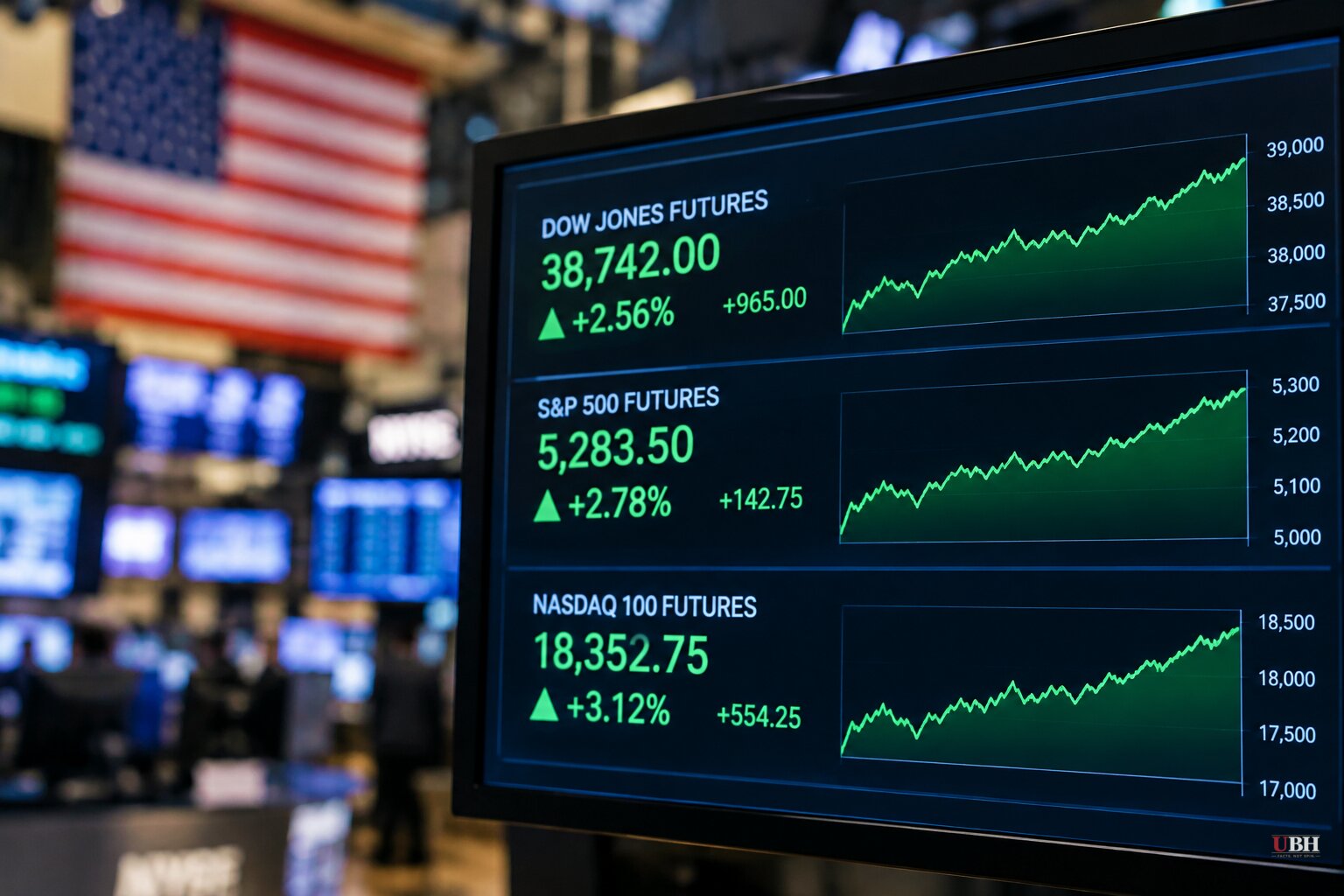
Since Friday's close put the S&P 500 and Dow Jones Industrial Average in correction territory, futures have swung hard the other way. Overnight, Dow futures were up between 684 and 798 points, or roughly 1.4% to 1.7%. S&P 500 futures were up about 2.1%. Nasdaq futures were up between 2.75% and 2.89%.
These are futures indications, not trading results, and futures gains can fade once regular trading begins.
What the rebound is bouncing from
Friday was ugly. The Nasdaq Composite fell 1,261 points, or about 5.3%, to 22,617. It lost roughly 10% on the week and is down nearly 3% for the year, wiping out its 2026 gain.
The S&P 500 dropped 265 points, or 3.7%, to 6,910. That was its seventh straight decline and its longest losing streak since February 2020. It fell 8.61% for the week and is up just 0.95% year to date.
The Dow lost 949 points, or 1.93%, to 48,147. It fell about 8% on the week and is up 0.17% for the year. The Russell 2000 also fell into correction territory, down 7.48% for the week.
Nvidia sank about 14% to its lowest close in 18 months. AMD, Broadcom and Micron each dropped by double digits. CoreWeave and Nebius also fell sharply.
Anthropic opened at $111.50 in its Thursday debut and briefly reached $115.10. It traded near $87 late Friday, below $89 and still above its $83 offering price. The CBOE Volatility Index jumped 26% to 35.89, its highest since late March.
Competing explanations for the selloff
No one source assigns a single cause. Dan Ives, senior managing director at Yorkville Ives, said no single event drove the decline. He listed the midterm election results, Jensen Huang's exit from Nvidia, the Anthropic IPO marginally reducing liquidity, and a hawkish Federal Reserve.
Fortune's account ties the downtrend to the midterms, which handed victories to Democrats more skeptical of data centers. Texas Gov.-elect Gina Hinojosa, who defeated Gov. Greg Abbott, said on Friday, Nov. 6, that the state should stop building data centers until protections are in place. National Economic Council Director Kevin Hassett told CNBC the administration expects construction to continue, arguing that localities can decline data centers but that job creation and lower energy prices will show benefits over time.
The Nvidia turmoil adds another layer. The New York Times reported, citing sources, that China's main intelligence service recruited a woman named Alice Huang to spy on Nvidia CEO Jensen Huang. Fox News said it asked the CIA for comment. Fortune describes his departure as an ouster. Ives calls it a resignation.
Fortune also reports that disclosures about Chinese backdoor access to high-end U.S. AI chips are prompting a federal push to close export-control loopholes. It reports that Trump has vowed to stop U.S. companies from building data centers abroad.
The Fed and the bond market
Traders are still pricing a quarter-point Federal Reserve rate increase in December. Fed Governor Lisa Cook said Friday that interest rates were too low to bring inflation under control.
Investors bought Treasurys Friday, pushing the 10-year yield to about 4.91% from 5.04% late Thursday. Bitcoin fell below $60,000. Japan's Nikkei and South Korea's Kospi each dropped more than 5%.
Zandi's warning and the bulls
Mark Zandi, chief economist at Moody's Analytics, wrote in a social media post that the selloff could drag on growth through the wealth effect. He estimates consumer spending moves about 2 cents per $1 change in net worth over roughly a year. If prices hold at current levels, that would subtract almost 0.3 percentage points from real GDP growth a year from now. The same effect added 0.7 points this quarter.
"We've seen AI stocks selloff before, only for them to rebound quickly. Investors have been conditioned to buy on the dip," Zandi wrote. "But while there are sure to be lots of ups and downs in stock prices in the days ahead, it feels increasingly like the easy money in the AI trade has been made."
The bulls are not budging. Ives said the $4 trillion AI buildout is still happening and his tech thesis into 2027 stands. Morgan Stanley and Goldman Sachs both expect the S&P 500 to finish 2027 at 8,700. UBS Global Wealth Management and Wells Fargo see 8,200. Steve Chiavarone, chief investment officer for equities at Federated Hermes, has a 10,000 year-end target, a 45% gain from current levels.
Adam Turnquist, chief cross-asset strategist at LPL Financial, said Friday that "technical damage continues to mount."
The calendar
The week is short. Markets are closed Thursday for Thanksgiving and trade a half day Friday. Thin volume can amplify rebounds, and it can amplify drops.
The open decides whether the futures gains hold. The Fed's Personal Consumption Expenditures Price Index for October is due Nov. 25, with consensus estimates calling for a 0.3% monthly rise in both the headline and core readings.
Sources used for this briefing
7 links from 6 independent newsrooms (syndicated copies of the same report count once)
These are the sources it draws on, linked so you can verify.


