
Unbiased headlines. Facts, not spin.
Unbiased Headlines is an independently owned news organization. We bring you the facts, not opinions, written fresh from 110+ named sources. Sources linked so you can verify it yourself.
 finance
Major Story (7/10)
Event date: November 16, 2026 ·
China, Taiwan and South Korea Roll Out Market Support as Asian Stocks Swing After AI Rout
Since Nvidia CEO Jensen Huang's exit set off last week's global tech rout, Asian governments have moved from verbal reassurance to hard market intervention. Monday's session, Nov. 23, is the first real test of those measures.
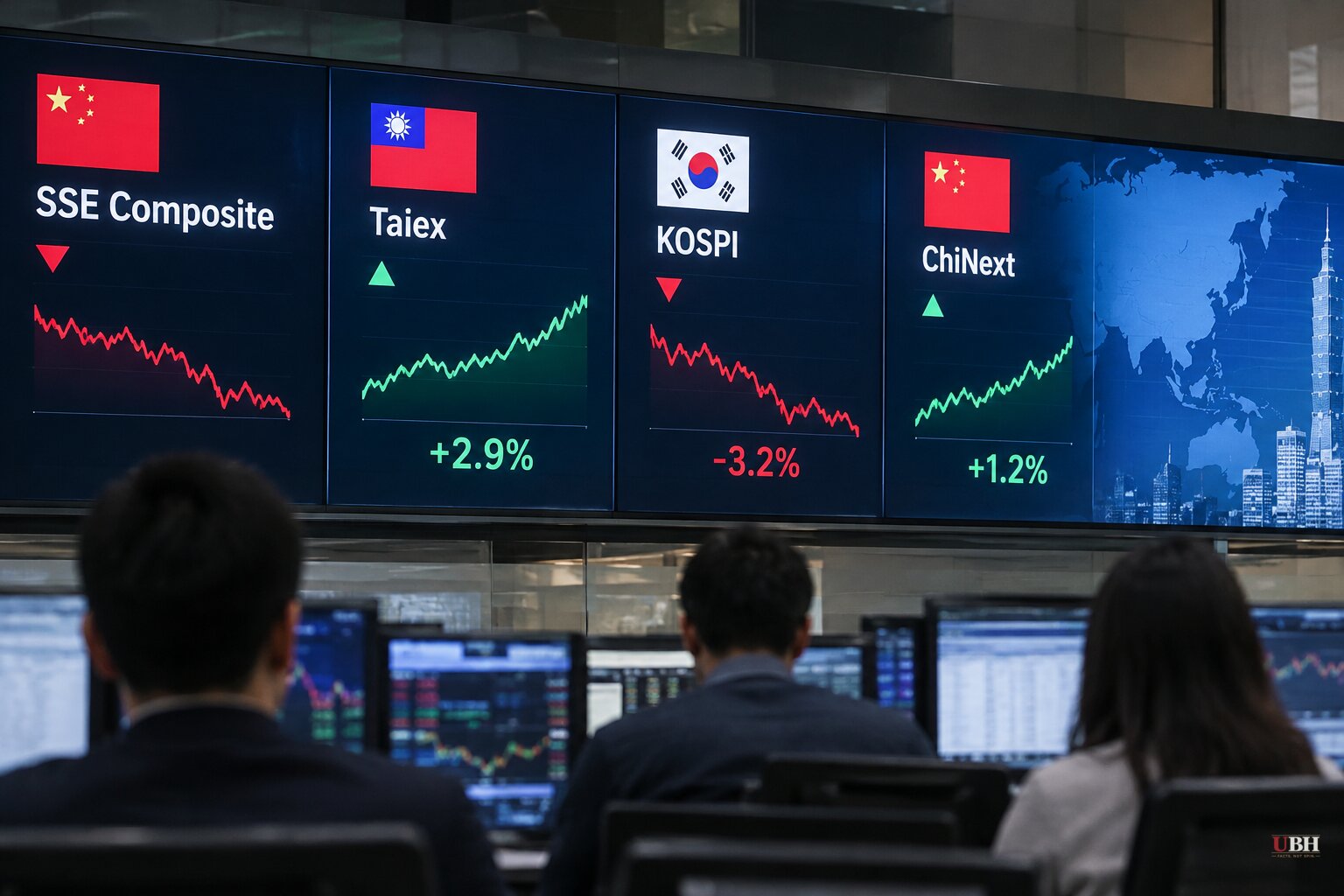
The early read is mixed. Taiwan's Taiex is up about 2.9% in afternoon trading and China's ChiNext has reversed morning losses to gain 1.2%. South Korea's Kospi pared a drop of as much as 5.8% and was last down 3.2%.
U.S. markets are closed until the 9:30 a.m. ET open. Nasdaq 100 futures bounced nearly 3% in early Asian trade and S&P 500 futures rose about 2%. Those are futures indications, not regular-session prices. Japan's markets are closed for a holiday.
What the damage looks like
Last week's 10% drop in the Nasdaq was its largest weekly fall since March 2020, according to Reuters. Taiwanese shares fell 17% on the week, the worst weekly showing since 1990. The Philadelphia semiconductor index dropped 10% on Friday alone.
Dow Jones put the U.S. wipeout at $4 trillion for the week. It said Anthropic's turbulent debut capped the slide. Reuters reported the stock closed 8.5% lower on its first full day of trading.
The Kospi has lost nearly 18% in November and hit 10-month lows last week. Reuters also reported China stocks touching a 16-month low as U.S. chip curbs and the AI selloff soured sentiment. Australian shares ended at a six-month low.
The selloff is not uniform. India's Nifty IT index rallied nearly 3% on Monday as the global AI trade unwound.
The emergency toolkit
Taiwan has had its stabilization fund in action since Nov. 6. The fund was set up in 2000, has about $15 billion at its disposal, and was last used heavily in the pandemic. On Saturday the Financial Supervisory Commission raised the minimum margin requirement for short selling to 150% from 130%. The fund says Taiwanese market fundamentals remain strong and that foreign selling has gradually subsided.
In South Korea, officials are preparing a market-stabilization fund. They also promised tougher scrutiny of illegal short selling and market manipulation over three months. Limits on daily share buybacks will be eased for three months starting Tuesday, Nov. 24.
Finance Minister Lee Hyoung-il warned Monday that volatility in semiconductors could amplify swings across the broader economy. He cited regulatory uncertainty around AI, geopolitical tensions and rising interest rates as external risks. The finance ministry said Sunday it would deploy stabilization funds immediately if the market keeps falling.
China's three main exchanges said over the weekend they will cut the minimum margin-financing requirement to 80% from 100%, effective Nov. 30. They say the aim is to moderately increase leverage and improve liquidity.
That comes on top of steps Beijing took earlier this month. On Nov. 4, three financial regulators made a share-buyback lending program permanent and cut its rate to 1% from 1.25%. The central bank also began daily overnight reverse repurchase operations at 1.25%, according to Xinhua.
Do the measures fix anything?
Analysts quoted in The Epoch Times on Nov. 4 said the Chinese steps would not reverse the decline without a broader economic recovery. At that point the tech-heavy STAR 50 had fallen about 40% in under four months, erasing roughly $480 billion in value. The CSI 300 had also entered a bear market.
Xu Zhen, a senior finance professional in China, called the overnight operations "a market placebo." He said, "The Chinese Communist Party (CCP) does not do charity for stock investors." In his view, Beijing's main concern is preventing panic selling that threatens financial stability.
Davy Jun Huang, a U.S.-based political economist, said a falling market and a weak economy can feed on each other. Lower household wealth, tighter corporate financing and stressed lenders holding stocks as collateral could create a vicious cycle.
The underlying question is not unique to China. Reuters reported that investors are asking whether the vast sums of mostly borrowed money spent building AI data centers will produce returns fast enough to repay lenders. Dow Jones reported that Huang's departure raised worries about unwinding financing he had orchestrated.
There is also a plain fiscal point. Taiwan's fund, Seoul's planned fund and China's cheaper margin rules all put public resources or public rulebooks behind falling prices. Allowing more leverage in a market whose problem is borrowed money is a choice regulators in Beijing have made openly.
What comes next
South Korea's buyback relaxation takes effect Tuesday. China's margin cut starts Nov. 30. The next test for all three markets comes when U.S. trading opens later Monday and shows whether the futures bounce holds.
Seoul has said it will deploy its stabilization fund if the Kospi resumes falling. The size of that fund has not been disclosed.
Sources used for this briefing
6 links from 6 independent newsrooms (syndicated copies of the same report count once)
These are the sources it draws on, linked so you can verify.


