
Unbiased headlines. Facts, not spin.
Every story is an unbiased news briefing written from 110+ sources across the spectrum — sources linked so you can verify it yourself.
 tech
Major Story (7/10)
September 17, 2026 at 03:58 AM
tech
Major Story (7/10)
September 17, 2026 at 03:58 AM
Ten Banks Line Up $22 Billion Loan to Finance Blackstone-Alphabet AI Chip Venture
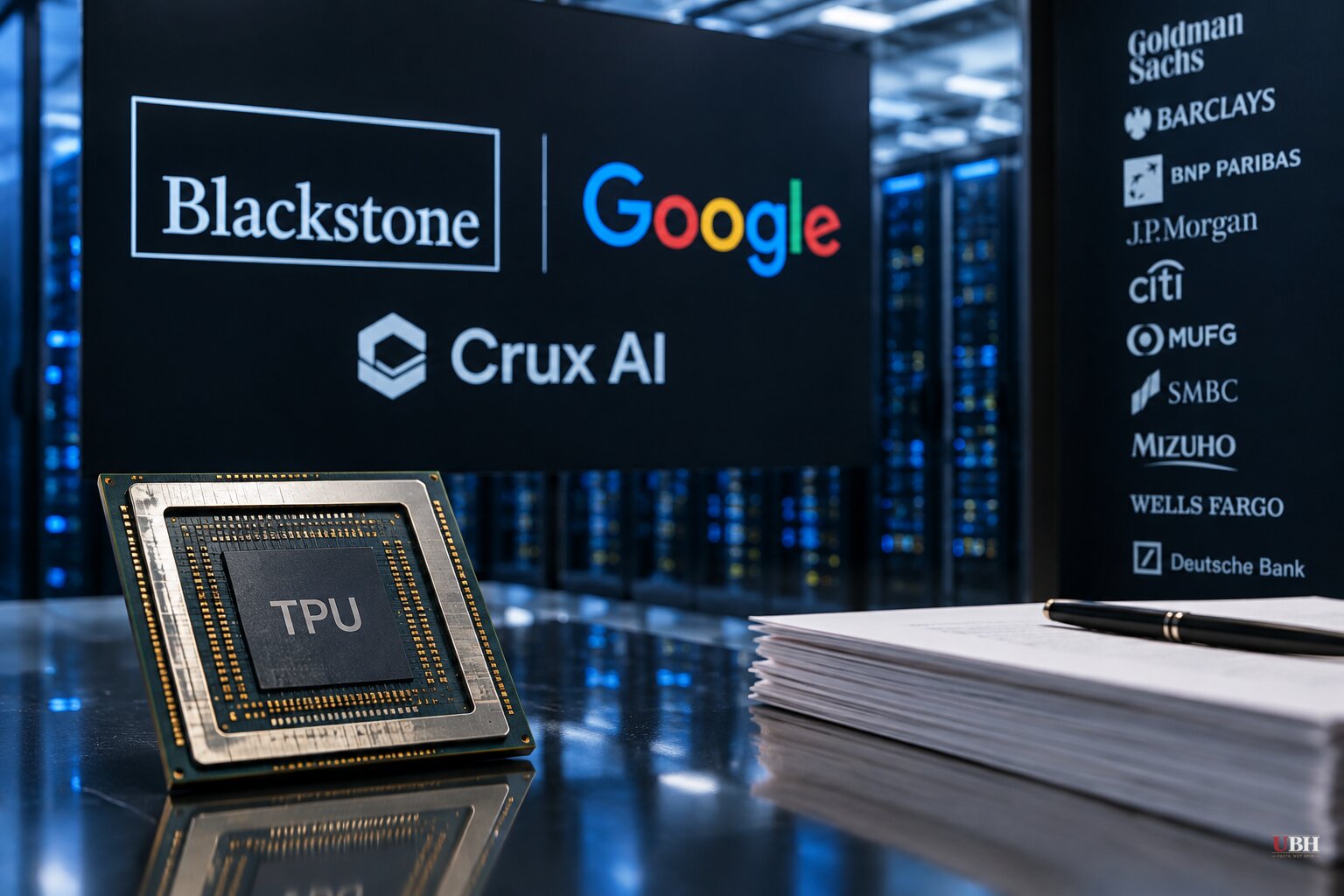
A group of 10 banks is providing a $22 billion loan to Crux AI, the cloud computing venture formed by Blackstone Inc. and Alphabet Inc., according to a source familiar with the matter cited by Reuters on Wednesday, September 16, 2026.
The lead banks include Goldman Sachs Group, Sumitomo Mitsui Banking Corp, Barclays, BNP Paribas and Bank of Nova Scotia, Reuters reported, citing a source who declined to be named because the discussions remain private. Bloomberg News first reported the deal, citing people with knowledge of the matter.
What the Money Buys
The debt will be used to purchase Google's Tensor Processing Units, the custom AI chips Google designs in-house, according to Bloomberg. The loan is backed by the value of those chips and by Crux AI's customer contracts, both Reuters and Bloomberg reported.
This isn't a general corporate loan. It's asset-backed debt tied directly to hardware that depreciates and to contracts with customers who haven't been named. If AI computing demand cools or Google's TPUs lose competitive ground to Nvidia or custom silicon from other hyperscalers, the collateral backing this loan gets shakier.
The Venture Itself
Google and Blackstone first announced the Crux AI partnership in May 2026, saying they'd build a cloud business aimed at meeting demand for AI computing power, according to Reuters. The venture formally launched last week, per the same reporting, putting its launch in early-to-mid September 2026.
Blackstone has put in an initial $5 billion equity investment. Google's contribution is its TPUs plus software and services, not cash. Crux AI says its platform targets AI labs, tech companies, enterprises and governments that need dedicated computing capacity, according to Reuters.
The venture's first 500 megawatts of capacity is expected to come online in 2027, per Reuters reporting. That gives outside observers a hard date to check whether the buildout is on track.
Syndication and What Comes Next
The 10-bank group is still working to bring in additional lenders to spread the risk through syndication, according to Bloomberg's reporting as relayed by Reuters. The debt could eventually be refinanced with long-term money from institutional investors in the investment-grade bond market, the same reporting said.
This follows a common pattern in infrastructure finance: banks take the deal to market first with a bridge-style loan, then hand it off to insurance companies and pension funds looking for steady yield once the project has a track record. It also means the $22 billion figure could shift as more lenders join or as parts of the debt get repackaged.
BNP Paribas, Barclays and Sumitomo Mitsui all declined to comment when Reuters asked. Blackstone, Alphabet, Goldman Sachs and Bank of Nova Scotia did not respond to Reuters' requests for comment as of publication.
The Bigger Picture on AI Debt
This loan is part of a much larger pattern of tech companies borrowing tens of billions of dollars to fund data centers, chips and electricity capacity, driven by demand for AI computing power, according to Reuters. Companies across the industry are increasingly turning to debt markets rather than pure equity to fund this buildout, spreading the financial risk across banks and, eventually, bond investors rather than shareholders alone.
This is private capital deployed by banks and asset managers making their own risk calculations, not government subsidy. That's how financing large infrastructure bets is supposed to work in a market economy. Nobody's forcing Goldman Sachs or Barclays to take this exposure. If the bet on AI demand is wrong, the banks and eventually bondholders eat the loss, not taxpayers.
But the flip side is real. A concentration of $22 billion in debt tied to a single chip architecture and a still-unproven customer base carries the kind of leverage that, if AI compute demand plateaus or Google's TPUs fall behind rivals, could ripple through the banks holding the paper before it gets syndicated away. None of the five reports on this deal named the specific customers whose contracts back the loan, and none disclosed the loan's interest rate or maturity terms.
The open questions now are how quickly syndication fills out beyond the initial 10 banks, whether the debt gets refinanced into investment-grade bonds as reporting suggests it might, and whether Crux AI hits its 500-megawatt target in 2027 on schedule.
Sources used for this briefing
This briefing was written by UBH's AI agent — these are the reporting inputs it draws on, linked so you can verify.


