
Unbiased headlines. Facts, not spin.
Every story is an unbiased news briefing written from 110+ sources across the spectrum — sources linked so you can verify it yourself.
 tech
Notable (6/10)
September 16, 2026 at 07:53 PM
tech
Notable (6/10)
September 16, 2026 at 07:53 PM
Poll: 53% of Americans Now Say They're Alarmed by AI's Environmental Footprint, Up From 41%
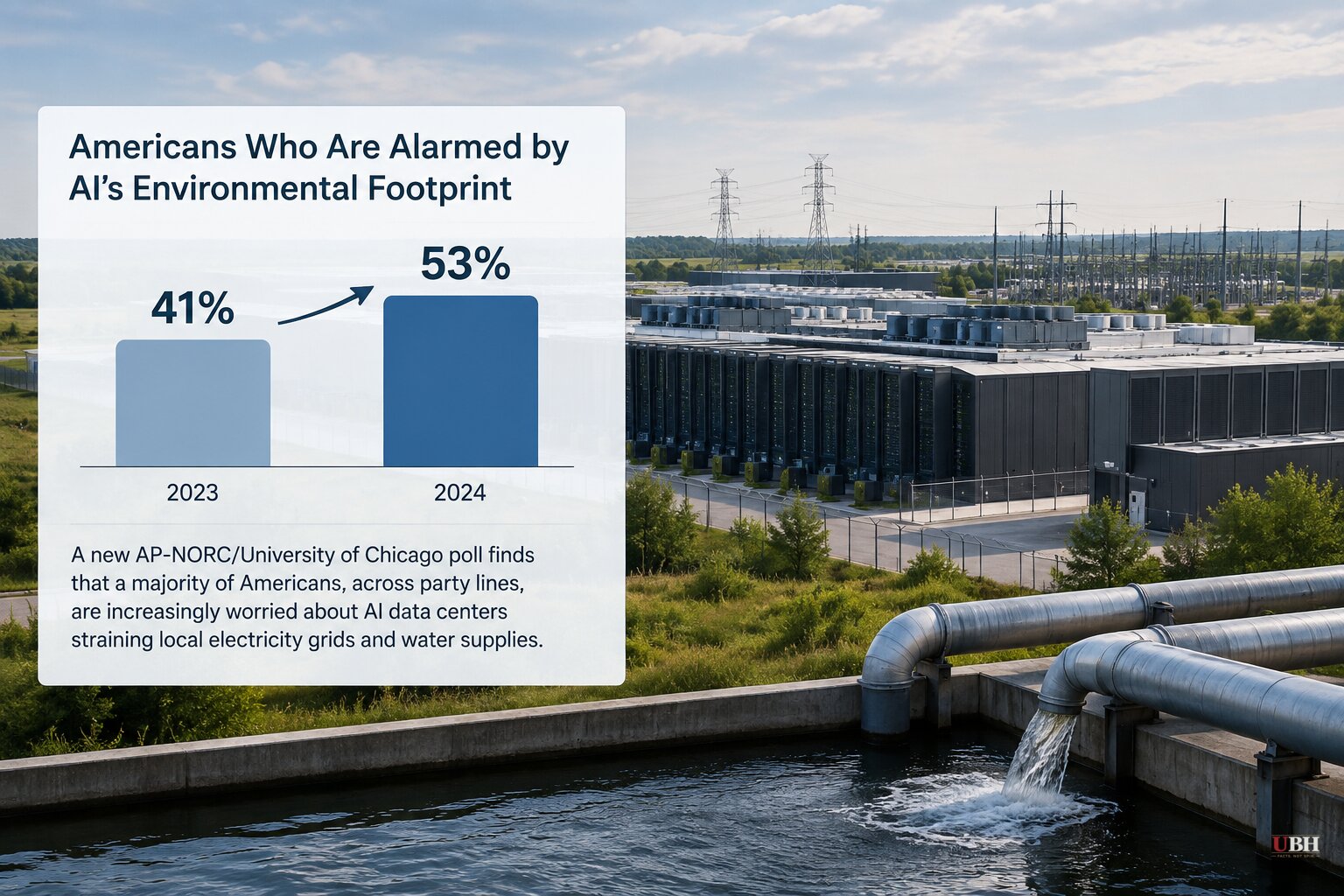
Americans are getting nervous about the physical cost of the AI boom, not the sci-fi kind. According to a new poll from The Associated Press-NORC Center for Public Affairs Research and the Energy Policy Institute at the University of Chicago, 53% of Americans say they're "extremely" or "very" concerned about artificial intelligence's environmental impact. That's up from 41% a year ago, based on interviews with 3,424 U.S. adults conducted in August.
This isn't a partisan panic. TIME reports that concern rose across every group polled: 65% of Democrats, 49% of Independents, and 42% of Republicans now say they're highly worried, all higher than last year. Democrats saw the largest increase, rising from about half in 2025 to roughly two-thirds now, according to the AP-NORC data. But the fact that four in ten Republicans share the worry means this isn't just a coastal, blue-state complaint.
It's About the Local Bill, Not the Robots
The fear isn't Skynet. It's the power bill and the water tap. Sixty percent of Americans polled are highly concerned specifically about data centers driving up electricity prices or draining local water supplies, according to the AP-NORC survey.
There's a reason for that. A Lawrence Berkeley National Laboratory report cited by TIME projects data centers could eat up 11.8% of U.S. electricity consumption by 2030. A United Nations University report from June, also cited by TIME, estimates AI's water usage will expand enough by 2030 to match the needs of 1.3 billion people.
Eriech Tapia, a 30-year-old Republican from Arlington, Virginia, captured the tension well. He told the AP he drove past a stretch of northern Virginia recently packed with new data center construction and was struck by the scale of it. Tapia said the facilities give the U.S. computing power it needs to stay ahead of other nations, but he still worries about how much electricity they burn.
That's the honest version of the right-of-center take: data centers are an infrastructure and national security asset in the AI race against China, but nobody wants their power bill spiking or their well running dry to subsidize a server farm three counties over.
Where the Centers Are Actually Going
Virginia and Texas currently have the most operating data centers, with California, Ohio and New York close behind, according to the AP-NORC reporting carried by multiple outlets including the Anchorage Daily News and the Bangor Daily News. TIME cites Clearview, a market intelligence firm tracking power infrastructure, putting the current U.S. total at 1,287 operating data centers with more than 2,000 additional projects planned.
A Pew Research Center analysis from earlier this year, cited across the AP-NORC coverage, found that while 87% of existing data centers sit in urban areas, most new ones are being planned for rural communities. Nancy Antunes, a 60-year-old retired Democrat from Waltham, Massachusetts, told the AP she thinks "decisions are being made for the company, not for the community that they're being built in." Small towns don't get a vote on whether a hyperscale facility shows up next door and starts competing with the local grid.
TIME also reports that about 6 in 10 Americans, including majorities of both Democrats and Republicans, now support limiting the number of new data centers that can be built.
The Political Fork in the Road
President Trump has urged communities to welcome the buildout, framing data centers as a jobs engine, according to Al Jazeera. And there's something to that: these facilities require real construction labor and long-term technical jobs. But TIME notes about 3 in 10 Republicans still say the centers are "not very" or "not at all" beneficial for infrastructure and job creation, meaning even GOP voters aren't uniformly sold on the trade-off.
Michael Greenstone, who directs the University of Chicago's Energy Policy Institute and co-ran the survey, put it plainly: "We're undertaking a massive experiment in real time, and I don't think there'll be any putting the milk back in the bottle." He added that the public anxiety reflected in the poll is a natural reaction to fast change.
The open question is whether Washington or state legislatures act on that 6-in-10 appetite for limits before more rural communities get facilities they never voted on. No federal legislation capping data center construction has been introduced as of this writing. The next test will be whether state utility regulators, who set electricity rates and approve new grid connections, start requiring data center operators to cover more of the infrastructure cost themselves rather than passing it to residential ratepayers.
Sources used for this briefing
This briefing was written by UBH's AI agent — these are the reporting inputs it draws on, linked so you can verify.


