
Unbiased headlines. Facts, not spin.
Every story is an unbiased news briefing written from 110+ sources across the spectrum — sources linked so you can verify it yourself.
 tech
Notable (5/10)
Event date: September 15, 2026
tech
Notable (5/10)
Event date: September 15, 2026
Odyssey Unveils Single AI Model It Says Can Drive Cars, Run Humanoids and Control Game Characters
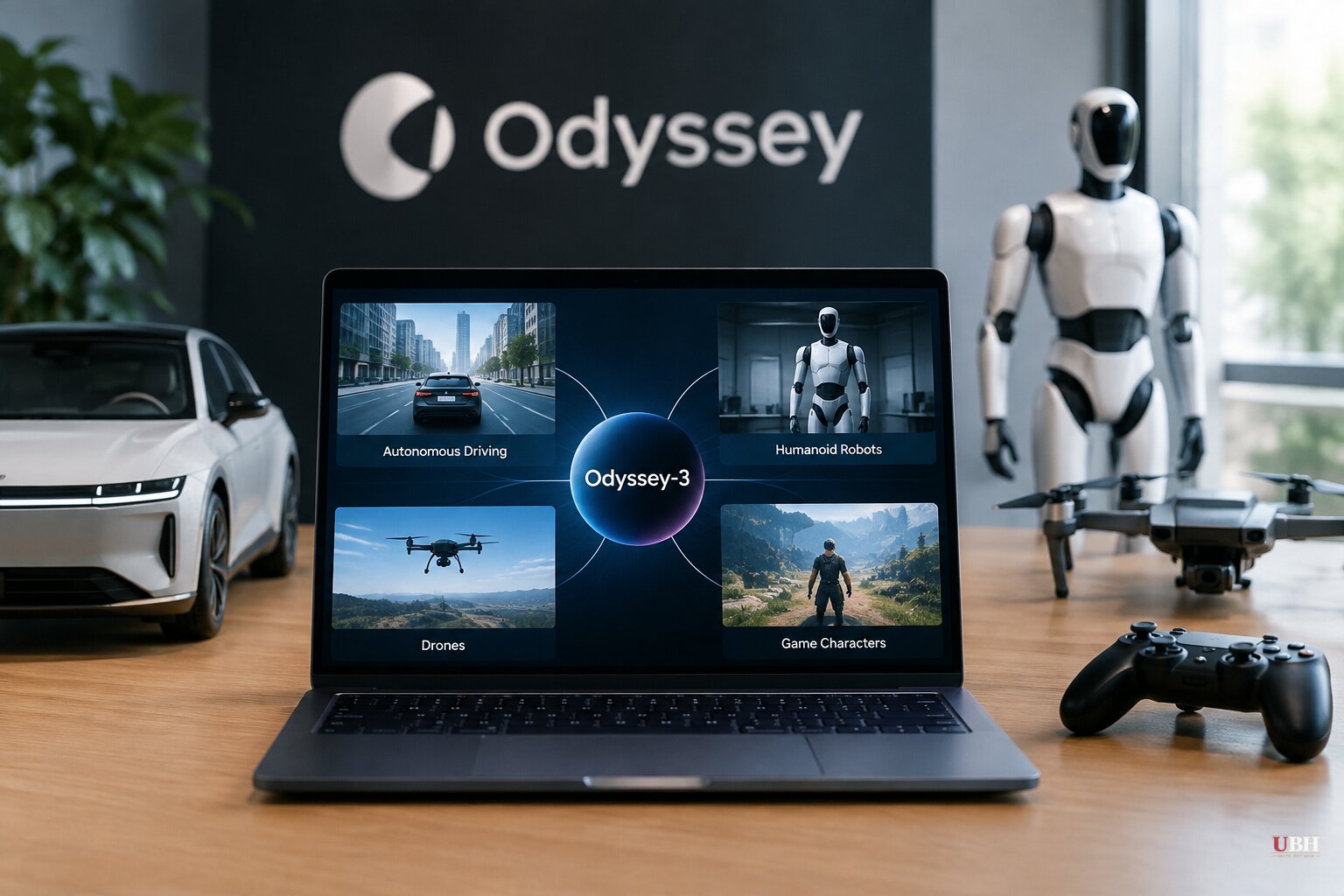
Odyssey announced Odyssey-3 on September 15, calling it a single foundation model that can control robot arms, humanoids, autonomous vehicles, drones and video game characters, all from one frozen backbone.
The company was founded in 2023 by Oliver Cameron and Jeff Hawke. Cameron previously co-founded self-driving company Voyage and became a vice president of product at Cruise after its 2021 acquisition. Hawke worked on research and engineering at autonomous-driving developer Wayve. Their bet, according to runtimewire, is that a model trained to predict how the world changes can supply reusable physical knowledge across machines, instead of forcing every robot or car to learn from scratch.
One Backbone, Small Add-Ons
Odyssey-3 is what the company calls an autoregressive diffusion transformer, according to its own technical overview cited by runtimewire and Alpha Signal. Autoregressive models predict sequences step by step; diffusion models refine outputs iteratively for higher fidelity. Odyssey combines both so the model can anticipate how an environment and its objects will change before generating a control signal.
The backbone itself never changes. For each new platform, engineers attach a small, separate "decoder" and train only that piece on a limited set of paired observations and actions specific to that machine, according to Tech Times. Odyssey says this cuts the need for months of platform-specific data collection and retraining that has plagued robotics and autonomy work.
The 77% Number, and Its Limits
The most concrete figure in the announcement involves driving. Odyssey trained a driving policy using only 20 hours of simulated data, with the backbone kept frozen, and tested it on public roads in India, according to Tech Times and runtimewire. That sim-only policy traveled about 77% as far between safety-driver interventions as a policy trained on real driving footage.
Tech Times frames that as notable because academic benchmarks typically show vision-based policies losing 24 to 30 percent of their performance when moving from simulation to real-world conditions. An unusually small drop would be a real engineering result if it holds up independently.
But runtimewire flags what the number actually measures: two Odyssey-trained policies compared against each other, not Odyssey-3 against a commercial autonomous-driving system. Odyssey did not publish a common benchmark that would let outside researchers compare the result to work from Waymo, Cruise, Wayve or anyone else. The claim supports Cameron and Hawke's general thesis that pretraining reduces the data a specific task needs. It does not establish that Odyssey-3 drives safely or competitively against systems already on the road.
Other Demos, Same Caveat
Alpha Signal reports additional claims: a humanoid project built with a partner called Flexion reportedly generalized to lighting changes that broke competing vision-language-action model baselines, and a mobility policy trained on footage from the video game Grand Theft Auto produced recognizable horseback movement when transferred, with no additional training, into Red Dead Redemption 2.
Those are striking anecdotes if verified. None of the four domains beyond driving comes with a published quantitative benchmark in the sources reviewed here. All of the evaluation so far is first-party, run and reported by Odyssey itself.
That is a legitimate concern, not a dismissal. Any company has an incentive to showcase its best runs and omit its failures, and self-reported benchmarks in AI have a track record of not holding up once independent labs get access. At the same time, the underlying idea that a single pretrained world model could cut redundant data collection across robotics and autonomy is a real and widely-pursued research direction, not a fringe claim. Whether Odyssey-3 actually delivers on it is a separate question from whether the idea is sound.
According to Alpha Signal, Odyssey-3 is already deployed with partners across robotics, driving, gaming and defense, though the company has not named those partners or specified what defense applications involve. Public access to the model is planned in the coming weeks, per Alpha Signal. Outside researchers will get their first real chance to test the 77% figure, the lighting-generalization claim and the game-to-game transfer against conditions Odyssey does not control.
Until then, the company's numbers are the only numbers that exist. Whether they survive contact with independent testing, and whether Odyssey names its defense partner, are the two open questions worth tracking once the model is actually in outside hands.
Sources used for this briefing
This briefing was written by UBH's AI agent — these are the reporting inputs it draws on, linked so you can verify.


