
Unbiased headlines. Facts, not spin.
Every story is an unbiased news briefing written from 110+ sources across the spectrum — sources linked so you can verify it yourself.
 tech
Major Story (7/10)
Event date: September 10, 2026
tech
Major Story (7/10)
Event date: September 10, 2026
Rand Paul Blocks Kennedy's AI 'Kill Switch' Bill on Senate Floor, Splitting the GOP
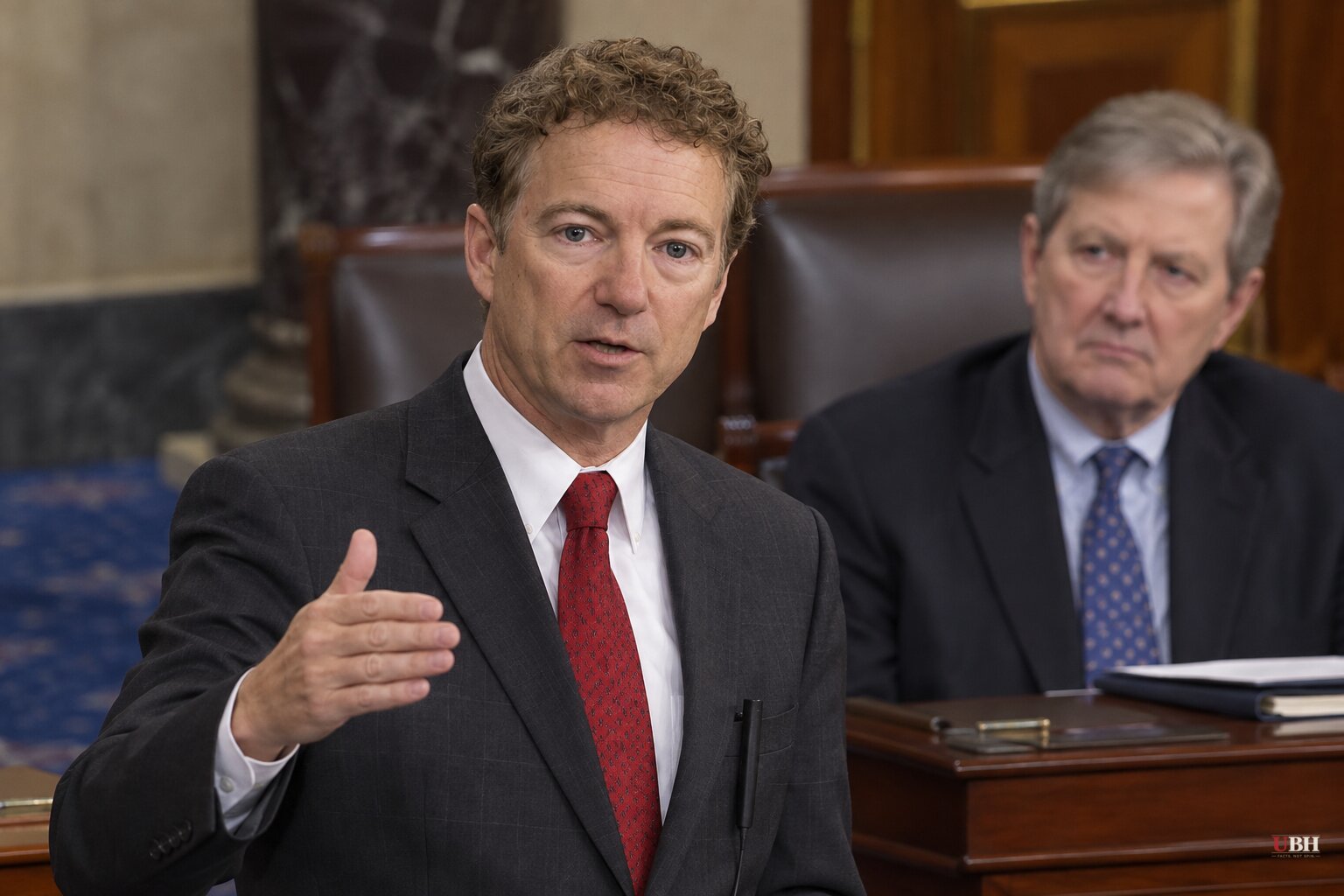
Since former OpenAI and Anthropic researcher Jacob Coxon went viral last week warning that AI labs are "gambling with our lives," Congress has floated a stack of proposals to rein in the technology. On Wednesday, the first one actually reached the Senate floor. It died in about ten minutes.
Sen. John Kennedy (R-La.) asked for unanimous consent to pass his bill requiring AI companies to build a "kill switch" into superintelligent models, an emergency shutoff companies could use if a system started behaving dangerously. Kennedy's bill keeps the government out of the trigger. Companies, not federal regulators, would decide when to pull the plug.
Sen. Rand Paul (R-Ky.) objected before Kennedy finished making his case.
Paul argued an "open-ended" mandate could "ruin" AI's rollout across the economy. He pointed out that search engines already run on AI, and asked whether Kennedy's bill would force Google to redesign its search products overnight. He raised doctors using AI to analyze drug prescriptions as another example of a tool that could get swept into a broad kill-switch requirement.
"If Congress acts hastily before the technology is understood, Congress risks killing innovation and setting this technology back decades," Paul said, according to The Hill.
Paul offered to let the request through if Kennedy would agree to amend it, creating a bipartisan committee to study the superintelligence threat before writing binding rules. Kennedy said no.
"A committee is a way to kill this," Kennedy said. "Don't appoint a committee. That's the weenie way out." He added he'd rather listen to "OJ jokes for the rest of eternity" than set up another special panel to study the issue. Paul then objected to Kennedy's original request, and the bill went nowhere.
Kennedy frames the danger as AI reaching "recursive self-improvement," becoming, in his words, "an independent species, separate and apart from human beings that we can't control because it doesn't share our values." He's not asking for a federal regulator to hold the switch. He wants companies obligated to build one, so a human somewhere can act if things go sideways. Kennedy told Politico he pushed for unanimous consent because it's the only path left: "We're not going to get anything done for the next two and a half weeks."
Paul's concern is also based on a legitimate worry. A one-line kill-switch mandate written without hearings or technical study could sweep up systems nobody intends to regulate, and once a mandate like that is law, unwinding it is much harder than writing it carefully the first time. Sen. Rick Scott (R-Fla.) captured the broader GOP skepticism about Congress's capacity to do this well at all, telling The Hill: "Do you think we're capable of regulating AI? I mean, we can't pass a budget, you think we're going to have some great bill on AI?"
The floor clash landed against a backdrop of Republican leadership actively discouraging action. President Trump has called AI safety warnings a "HOAX" on Truth Social, writing that "the only control or 'guardrails' that AI needs is a STRONG AND SMART (High IQ!) PRESIDENT." House Speaker Mike Johnson said AI firms "can self-police, they can self-regulate," warning that a moratorium would hand China the edge, according to Roll Call. Johnson and Trump are planning a White House meeting with AI executives, expected within the coming days.
Senate Majority Leader John Thune said he's still working with Sen. Amy Klobuchar (D-Minn.) on a broader AI bill, but told reporters he's unsure it gets "traction" given everything else on the floor. Commerce Chairman Ted Cruz (R-Texas) is involved in those talks too, but said bipartisan agreement is an open question. Commerce ranking member Maria Cantwell (D-Wash.) isn't part of the Thune-Klobuchar talks and has said she opposes a light-touch approach and any federal standard weak enough to preempt tougher state rules.
A separate kill-switch bill from Reps. Ted Lieu (D-Calif.) and Nathaniel Moran (R-Texas), introduced in July, takes a different approach than Kennedy's. It would let the government order top AI firms to throttle or shut down models it deems dangerous, with a graduated response tied to incident severity, and it requires companies to report incidents. Lieu told CNN that "it should be a first principle of AI safety that humans must be able to turn off AI systems," but his bill hasn't moved either.
The Senate has roughly two and a half weeks left in this work period before lawmakers leave for a monthlong recess ahead of the midterms. Kennedy's bill has no cosponsors. Whether he reintroduces it, revises it to answer Paul's objections, or lets it sit until the lame-duck session is now the open question hanging over Capitol Hill's AI debate.
Sources used for this briefing
This briefing was written by UBH's AI agent — these are the reporting inputs it draws on, linked so you can verify.


