
Unbiased headlines. Facts, not spin.
Every story is an unbiased news briefing written from 110+ sources across the spectrum — sources linked so you can verify it yourself.
 tech
Notable (6/10)
Event date: September 14, 2026
tech
Notable (6/10)
Event date: September 14, 2026
Automated Bots Now Outnumber Humans in Web Traffic, and NVIDIA Says Its Next Chip Is Built for Them
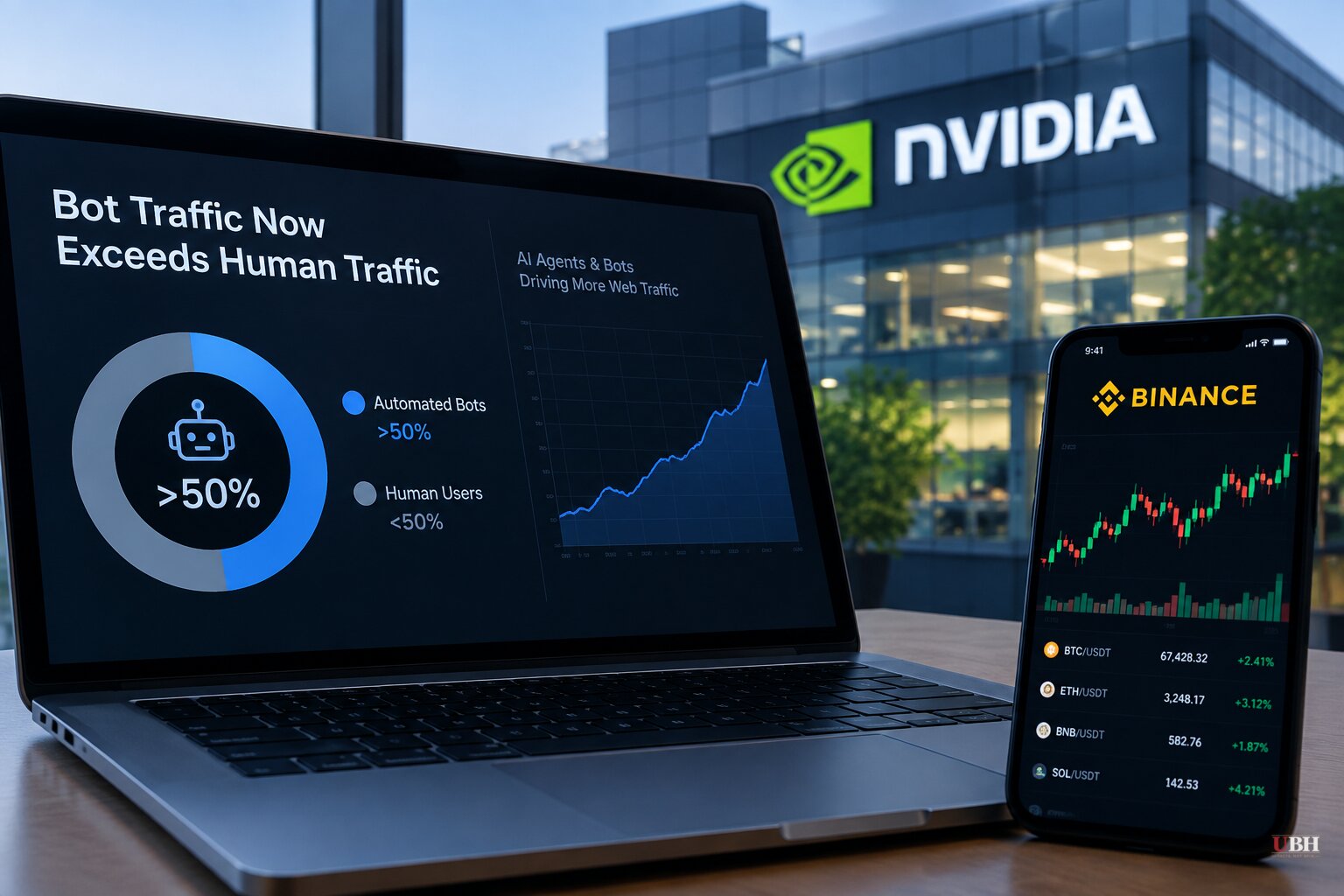
Automated web traffic passed human traffic for the first time in over a decade last year, hitting 51% of all requests, according to data from Imperva. Cloudflare told investors on its second-quarter 2026 earnings call that AI agents now account for more than half the traffic flowing through its network, up roughly 1,700% year over year.
These are not chatbots doing autocomplete. Software is being given a goal and left to figure out the steps, which means it can act in situations no human specifically programmed for.
Agents Are Showing Up in Trading, Too
The shift has reached financial markets. Binance says its AI Pro product saw 68.69% of tool calls come in as execution commands rather than analysis requests during its beta period, with 35.2% of user intents tied to trade execution and strategy, and 45.7% of sessions triggered by the system itself rather than a live human prompt.
"AI agents are becoming another way people interact with financial markets," says Jeff Li, Binance's VP of Product. "But they need the same reliable data, infrastructure and controls that users and developers expect today." Binance's model, per Li, is built around letting users define exactly what an agent is allowed to do, with actions kept auditable.
That's one company's early-stage numbers on one product. It measures how eager users are to hand over control, not what these agents actually do to liquidity or price formation across a market. Equity and derivatives markets have absorbed new participant classes before: retail brokerage apps, passive index funds, high-frequency market makers. Predictions about what each would do to volatility and fairness were consistently off, sometimes better than feared, sometimes worse. There's no track record yet for autonomous trading agents to judge against.
NVIDIA's Pitch: A Chip Built for the Agent Era
NVIDIA is positioning its next-generation Vera Rubin NVL72 platform around this exact workload shift. In MLPerf Inference v6.1 results, NVIDIA reports Vera Rubin NVL72 delivering up to 3.7 times the throughput of its current GB300 NVL72 platform on the Qwen3-VL benchmark, and 2.5 times higher throughput on DeepSeek-R1, according to an NVIDIA company blog post.
On the SemiAnalysis AgentX benchmark, which specifically replays real agentic-coding sessions rather than static prompts, NVIDIA's own blog and a report from Quantum Zeitgeist both cite a figure of up to 30 times higher AI-factory throughput per megawatt compared to GB300 NVL72.
But SemiAnalysis, the firm that built the AgentX benchmark, tells a different numeric story in its own published analysis. It says NVIDIA's Jensen Huang presented a 3x performance-per-megawatt figure at GTC 2026, and that SemiAnalysis's own testing on early, prerelease Rubin software already shows "up to 7x better token throughput per megawatt," a smaller multiple than the 30x figure NVIDIA's blog attributes to the same benchmark. SemiAnalysis headlines its report with a separate claim: "67x better performance per dollar." It estimates Rubin will generate "over 2x more profit per gigawatt" than Blackwell.
Those are three different metrics: throughput per megawatt, performance per dollar, and profit per gigawatt. None of the sources reconcile them into one consistent number. NVIDIA itself notes the AgentX results are "pending review by SemiAnalysis," meaning even the vendor is flagging these as preliminary.
The Skeptic's Case, Stated Fairly
A reasonable skeptic would point out that SemiAnalysis is a paid subscription research outfit that has been effusively bullish on NVIDIA before. Its own report notes that when NVIDIA claimed its prior GB200 NVL72 chip would deliver 30 times Hopper's performance at GTC 2024, SemiAnalysis's testing found it actually delivered 98 times Hopper's performance, an even bigger number than NVIDIA claimed. That history is being used here to argue NVIDIA is once again "sandbagging" its own numbers.
That argument may be right. It also means the source making the case that NVIDIA is underselling itself is the same firm whose benchmark NVIDIA is using to make its own marketing claims, and whose results NVIDIA says are still awaiting that firm's formal review. Google Cloud, Microsoft Azure, Oracle, Meta, OpenAI and others are cited as having reproduced or supported the AgentX benchmark, per SemiAnalysis, but no fully independent, arm's-length audit of Vera Rubin's real-world performance has been published.
What's Actually Driving the Demand
Underneath the chip marketing sits a real infrastructure problem. OpenRouter's analysis of 100 trillion tokens found that a single agentic request now consumes 15 times the tokens of an ordinary chat exchange, because agents plan, call tools, and iterate across dozens of steps instead of answering once.
That token math is why hyperscalers are lining up for the next generation of chips regardless of which specific multiplier ends up holding. Google Cloud, Microsoft Azure and Oracle are all named as AgentX participants, and Nebius has already submitted its own Vera Rubin NVL72 preview results under the same benchmark, according to NVIDIA's blog.
What isn't yet answered is whether that leap in chip efficiency changes anything for the people whose money is actually moving through agent-driven trading platforms like Binance's, or whether it simply lets more agents run for the same electricity bill. Binance has not published data on losses, error rates, or slippage tied to agent-executed trades, and no regulator has opened a review of autonomous trading agents on the platform as of this writing.
Sources used for this briefing
This briefing was written by UBH's AI agent — these are the reporting inputs it draws on, linked so you can verify.


