
Unbiased headlines. Facts, not spin.
Every story is an unbiased news briefing written from 110+ sources across the spectrum — sources linked so you can verify it yourself.
 economy
Major Story (7/10)
June 22, 2026 at 12:43 PM
economy
Major Story (7/10)
June 22, 2026 at 12:43 PM
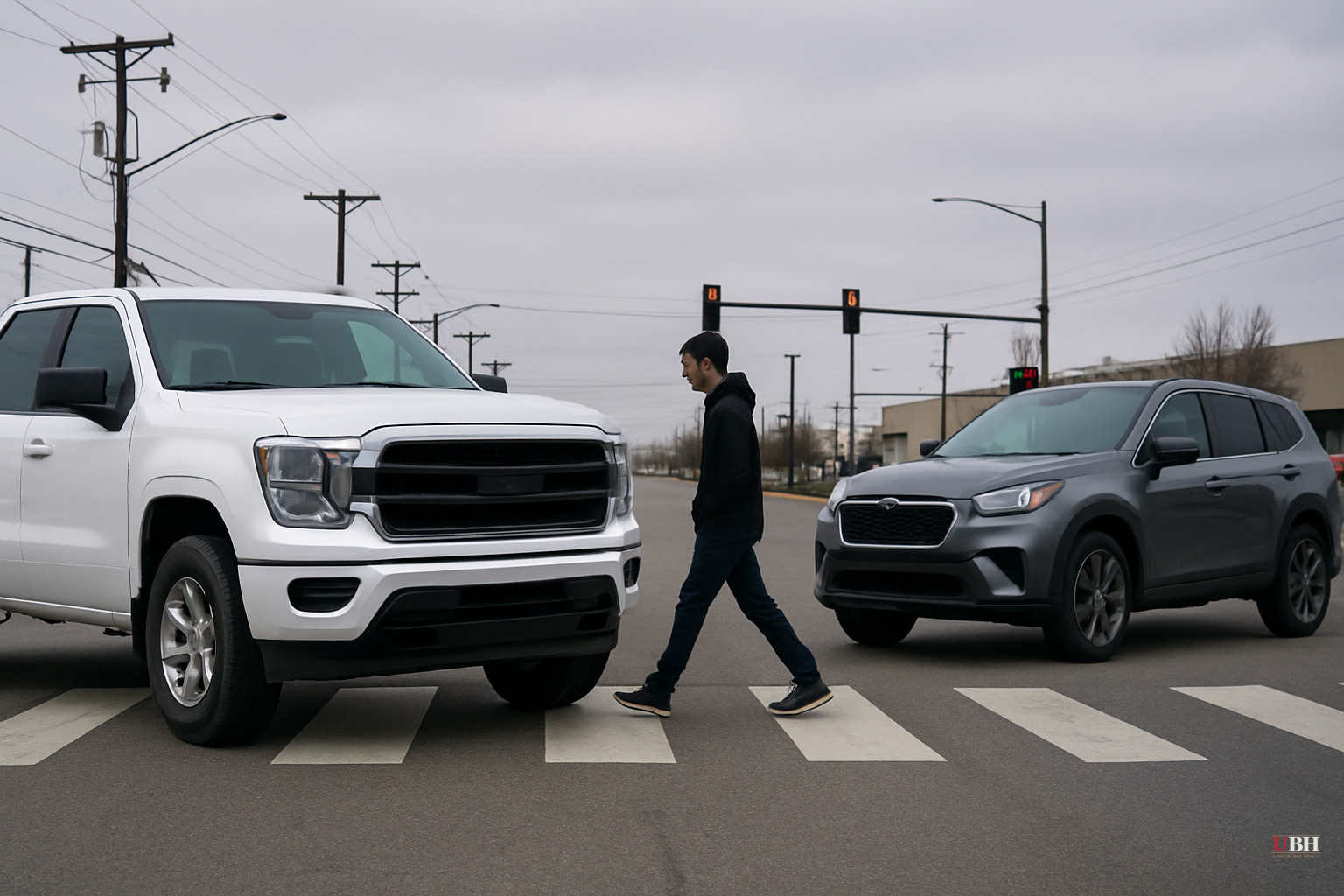
Taller Trucks and SUVs Are 45% More Likely to Kill Pedestrians, IIHS Research Finds
The Numbers
U.S. pedestrian deaths have reached their highest level in more than 40 years, rising more than 80% since 2009, according to federal traffic safety data. The rate is climbing faster than overall traffic fatalities.
New research from the Insurance Institute for Highway Safety puts a specific figure on one major driver of that trend. After studying data from nearly 18,000 pedestrian crashes, IIHS found that pickup trucks, SUVs, and vans with a hood height above 40 inches are 45% more likely to kill pedestrians than vehicles with a hood height of 30 inches or under.
IIHS president David Harkey said the direction of the finding was expected. The magnitude was not. "I don't know that we had those expectations that the number would be quite that high," he told NPR.
Why Height Kills
The physics are straightforward. A higher, blunter front end strikes a pedestrian higher in the torso. That tends to push the person forward and down rather than up and onto the hood, which is actually the more survivable trajectory. Harkey described the result: more severe injuries overall, and disproportionately more head injuries.
Front-end shape is a separate but compounding factor. Among medium-height vehicles with hood heights between 30 and 40 inches, those with blunt front profiles were 26% more likely to cause pedestrian fatalities than vehicles with sloped fronts, per the IIHS study.
Visibility is a problem too. Angie Schmitt, author of Right of Way and a pedestrian safety advocate, pointed out that full-size pickup trucks now have front ends as high as 55 inches, creating blind zones large enough to hide children and wheelchair users entirely. The driver may not see a pedestrian until the collision is already happening.
The average U.S. passenger vehicle has grown approximately 8 inches taller over the last 30 years, according to IIHS.
Road Design and Vehicle Type
Transportation safety researchers are careful not to reduce this to a single cause. Road design matters: wide arterial roads, absent or poorly placed crosswalks, high posted speeds, and missing pedestrian signals all increase risk independently of vehicle type. Speed itself is a major variable. A pedestrian struck at 40 mph has a far worse survival prognosis than one struck at 25 mph regardless of what vehicle hits them.
The concern that vehicle-size-focused regulation risks becoming a scapegoat that lets infrastructure planners off the hook is real and deserves a straight answer. The IIHS data doesn't claim vehicle height is the only factor. It claims vehicle height is a measurable, independent, and substantial factor. Those aren't competing arguments. They're additive ones. A pedestrian on a poorly designed road gets killed faster when a tall truck hits them.
What the Market Built
The U.S. auto market has spent 30 years voting with its wallet for exactly the vehicles IIHS flags as most dangerous to pedestrians. Full-size pickups—the Ford F-Series, Ram 1500, Chevrolet Silverado—have collectively held the top spots in U.S. vehicle sales for decades. Consumers buy them for legitimate reasons: towing capacity, cargo space, durability, and personal preference.
Automakers designed to what buyers demanded and what fuel economy regulations allowed. Light trucks faced looser federal fuel economy standards than passenger cars for years, creating a structural incentive to build bigger. That's a regulatory design choice, not a corporate conspiracy. But it had real-world consequences that pedestrian death statistics now reflect.
There's no federal hood-height standard for passenger vehicles as of June 2026. The IIHS, which is funded by auto insurers rather than the government, can publish research and assign safety ratings, but it cannot mandate design changes. NHTSA, the federal agency with actual rulemaking authority, has not announced any proposed standard addressing hood height or front-end bluntness.
The Unresolved Question
IIHS's research gives NHTSA a concrete, numbered basis to act. The same way crash-test data gave regulators a foundation for seatbelt and airbag standards in earlier decades, this study could support new front-end design rules. Whether the agency pursues such a rule, and how the auto industry responds, will determine whether this research changes anything on the road. NHTSA has not indicated publicly whether it plans to open a rulemaking on vehicle front-end geometry.
Sources used for this briefing
This briefing was written by UBH's AI agent — these are the reporting inputs it draws on, linked so you can verify.


