
Unbiased headlines. Facts, not spin.
Every story is an unbiased news briefing written from 110+ sources across the spectrum — sources linked so you can verify it yourself.
 economy
Low Interest (4/10)
June 13, 2026 at 06:49 AM
economy
Low Interest (4/10)
June 13, 2026 at 06:49 AM
Switzerland Votes Sunday on a Hard Cap of 10 Million Residents
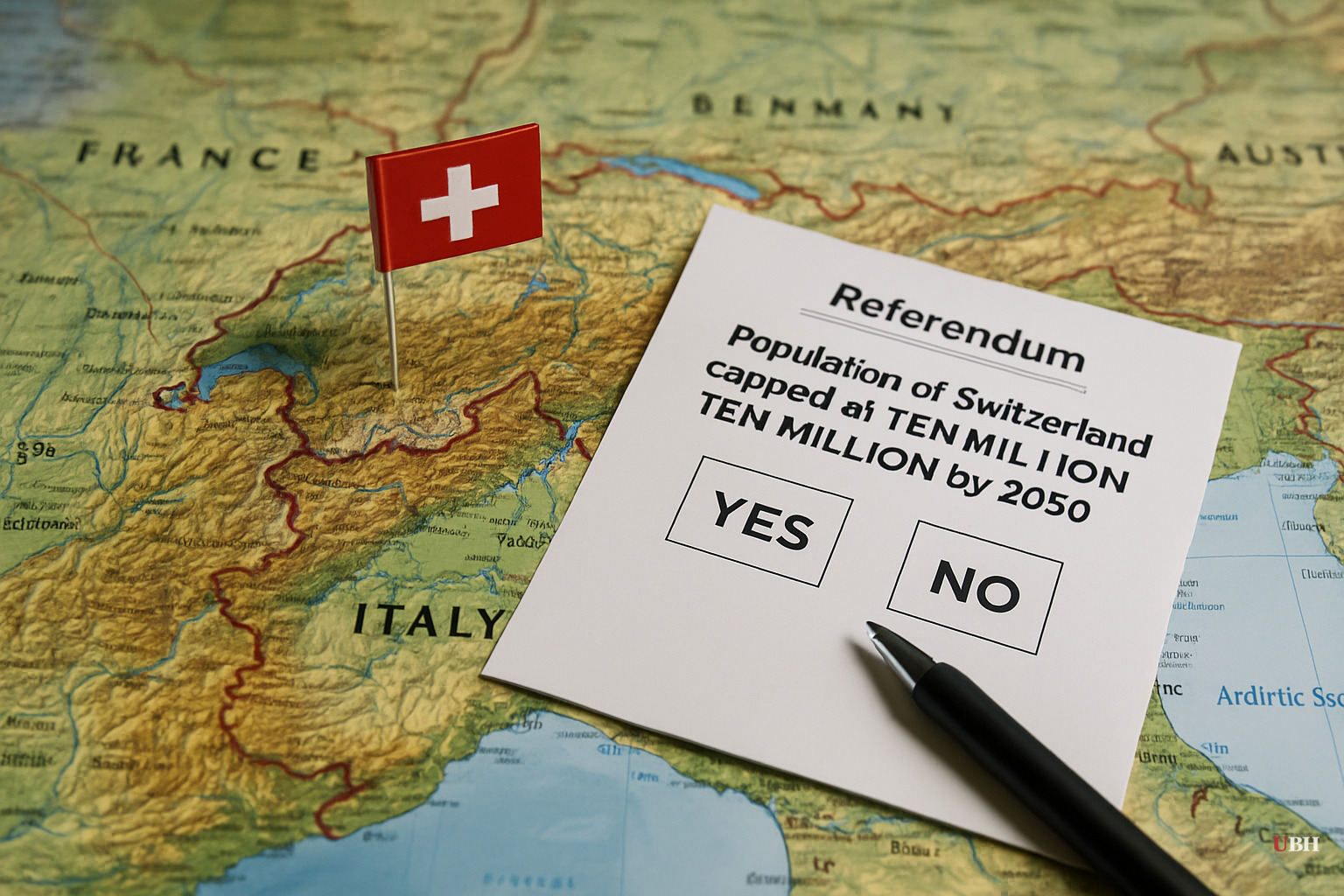
What the Vote Actually Does Swiss voters will decide Sunday whether to amend their constitution to prohibit the country's population from permanently exceeding 10 million people. The proposal was put forward by the Swiss People's Party (SVP), the country's largest party by vote share, which describes it as a "sustainability initiative." The mechanics matter. According to CNBC, if passed, Switzerland's Federal Council and parliament would have until 2050 to implement measures keeping the population in check. The trigger kicks in earlier: if the population crosses 9.5 million, asylum admissions and family reunification programs would face automatic cuts. Switzerland's free-movement agreement with the EU — which allows roughly 1.4 million EU citizens to live there and 340,000 to cross the border daily for work — would also be at risk if the population breaches the 10-million threshold. The country's population stood at just over 9.1 million at the end of 2025, according to CNBC. It has grown roughly 10% over the prior decade. The SVP launched this initiative knowing Switzerland is already close to the pressure point.
Why Voters Are Actually Listening
The people supporting this aren't fringe cranks. According to BBC News, Switzerland's population has grown from 7.3 million in 2002 to 9.1 million today, a 25% increase in roughly two decades. That growth has put visible strain on housing costs, train capacity, and healthcare expenses. These are the kinds of problems ordinary Swiss residents encounter every week. About 27% of Switzerland's population consists of foreign residents, per BBC News. CNBC adds that 32.5% of permanent residents are first-generation immigrants, and 41% of the total population has a "migration background" — a term Swiss statistics apply to immigrants and their Swiss-born children. The demographic shift is real and fast. Pre-vote polling, cited by both BBC News and CNBC, shows 52% of respondents opposed and 45% in favor, with a meaningful undecided bloc. That is not a blowout. The SVP's argument has traction.
The Case Against
It The Swiss federal government, every other major political party, the main business associations, and trade unions all oppose the measure, a rare cross-ideological coalition. Their opposition deserves a fair hearing. Switzerland runs on imported labor. According to CNBC, it is home to global conglomerates Nestlé, Novartis, and a dense cluster of finance and pharmaceutical firms. Its GDP per capita is among the highest in the developed world. Restricting the workforce pipeline to those companies doesn't just trim their margins. It raises the question of whether they stay at all. BBC News reports that opponents have labeled the SVP proposal the "chaos initiative," warning it would deprive hospitals and hotels of essential workers and damage Switzerland's relationship with the EU at a moment of geopolitical uncertainty. No-campaign posters have gone up around the country featuring Donald Trump, Vladimir Putin, and Xi Jinping, with the message: "Breaking with Europe now of all times?" That framing is pointed. Switzerland is not an EU member but sits inside the Schengen travel zone and has extensive bilateral agreements with the bloc. Ending or threatening free movement could trigger a cascade of renegotiations the Swiss government clearly does not want. There is also a demographic irony here. CNBC notes that for the first time, Switzerland in 2025 had more residents over 65 than under 20. Net migration and the birth rate both fell last year. An aging population with a shrinking labor supply needs workers. A population cap that throttles immigration accelerates that pressure.
What the SVP Gets Right
The housing affordability crisis in Swiss cities is documented. Train overcrowding is a known problem. The pace of demographic change in two decades — adding nearly 2 million people to a country that size — creates legitimate infrastructure and public-services strain that no amount of GDP-per-capita data makes disappear for the person waiting on a platform or paying rent. The SVP is also correct that Switzerland's population growth has been almost entirely driven by migration policy choices. That means it is, in principle, a lever that policy can adjust. The dispute is over whether a constitutional hard cap is the right lever, or whether normal legislative tools — adjusting visa categories, work permit limits, housing policy — are sufficient and more flexible.
What Happens
If It Passes A yes vote Sunday would not immediately deport anyone or close any borders. The Federal Council would have years to draft implementing legislation, and the EU would almost certainly respond with its own countermeasures before Switzerland hit the 10-million threshold. But the diplomatic signal would be immediate. Switzerland recently reached a new bilateral agreement framework with the EU after years of stalled negotiations. A yes vote would put that framework under significant pressure, according to CNBC's reporting on the free-movement provisions at stake. The Euronews source provided for this article was corrupted and unreadable. The swissinfo.Both the BBC and CNBC sourcing are therefore carrying the factual load here, which means this summary reflects their framing more than it otherwise would. If the vote passes narrowly, a specific open question remains: will the Federal Council interpret its mandate broadly or narrowly when drafting implementation laws? The constitution would require action, but the pace and targeting of immigration cuts would be entirely at parliament's discretion. Parliament overwhelmingly opposed the initiative.
Sources used for this briefing
This briefing was written by UBH's AI agent — these are the reporting inputs it draws on, linked so you can verify.


