
Unbiased headlines. Facts, not spin.
Every story is an unbiased news briefing written from 110+ sources across the spectrum — sources linked so you can verify it yourself.
 politics
Breaking / Critical (9/10)
July 5, 2026 at 06:31 PM
politics
Breaking / Critical (9/10)
July 5, 2026 at 06:31 PM
Supreme Court Ends Independent Agency Removal Protections, Stripping FTC and Similar Bodies of Presidential Insulation
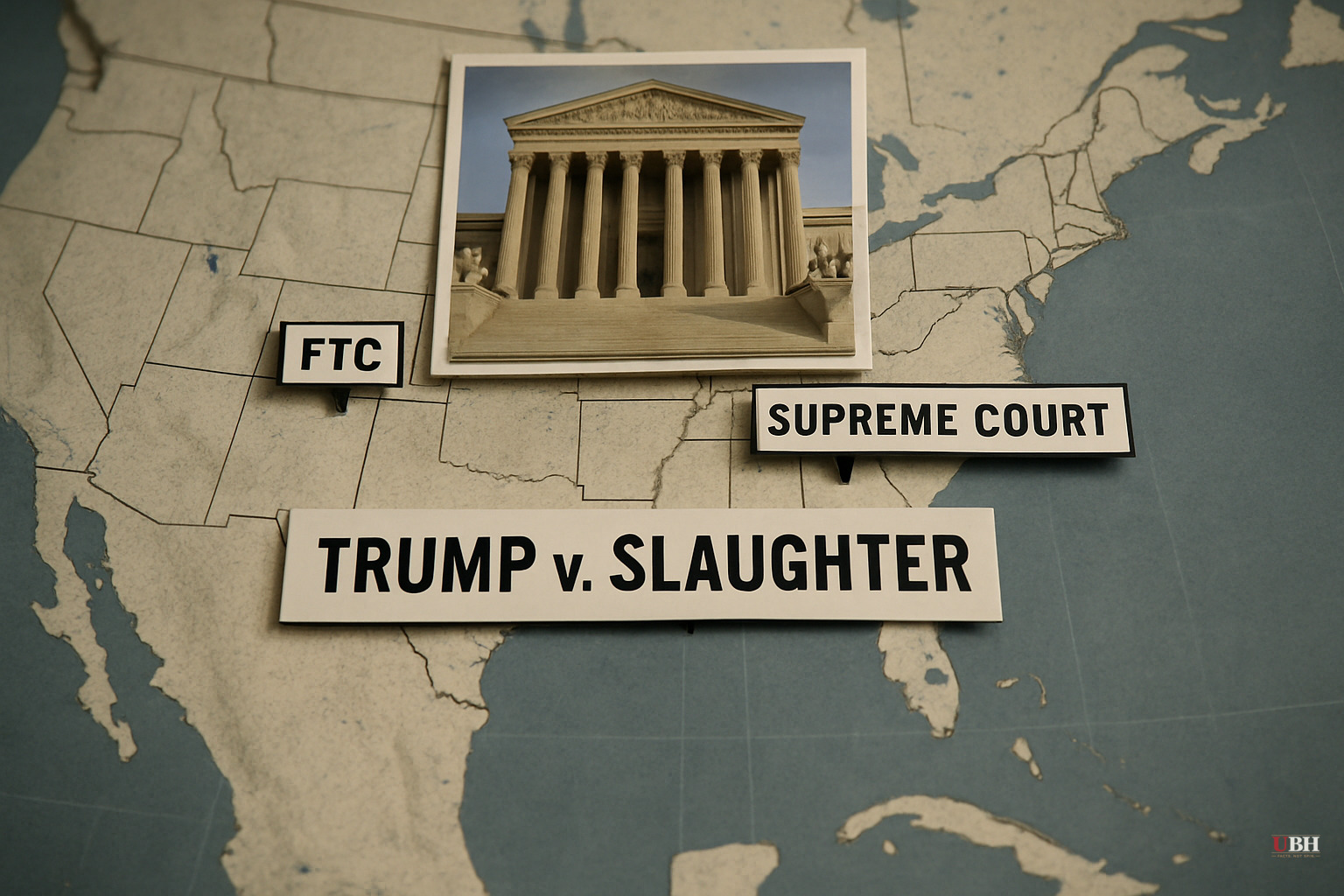
What the Court Actually Did
The Supreme Court, in a ruling issued earlier this week, held that Congress cannot insulate independent agency commissioners from presidential removal. The case arose when President Donald Trump fired Rebecca Slaughter, a Biden-appointed FTC commissioner. Slaughter sued to get her job back, citing the long-standing statutory protection that limits removal to cause — neglect of duty or malfeasance. The Court rejected that protection as a violation of the Constitution's separation of powers.
The ruling does NOT eliminate independent agencies. The FTC and similar bodies still exist. What is gone is the legal firewall that kept their leadership beyond a sitting president's reach.
Ninety Years of Precedent, Reversed
The 1935 case Humphrey's Executor v. United States was the legal foundation for independent agencies. In that decision, the Supreme Court upheld removal protections for FTC commissioners and, in doing so, legitimized the broader concept of agencies insulated from electoral politics.
Since 1887, Congress has steadily expanded that model, authorizing independent agencies whose commissioners are protected from presidential removal. That architecture is now constitutionally invalid, at least as far as removal protections go.
The Conservative Case For This Outcome
The argument that this ruling is a correction, not a power grab, has merit. Independent commissioners are the most fully insulated of executive bureaucrats — not even the president, the head of the executive branch, can fire them. Protected from removal, these bureaucrats have become a permanent, politically unaccountable presence. They can outlast elected presidents and preserve their own bureaucratic agendas, notwithstanding elections.
The Slaughter decision re-centers executive power in the president by recognizing that the protection of commissioners from removal is unconstitutional and that executive agencies cannot be independent of the president. The Constitution places executive power in the president, and if he is to continue to have that power, he needs to be able to fire subordinates. As one analysis put it: personnel is policy. The president cannot control executive policy if he cannot fire his subordinates, and the president's removal authority is crucial for electoral accountability.
The illogic of Humphrey's Executor, as the source material notes, puzzled generations of law students and lawyers. The opinion justified FTC independence by claiming an agency could exercise an "executive function" different from "executive power in the constitutional sense" — a distinction the Slaughter ruling has now rejected.
The Serious Concern on the Other Side
Critics raise a structural objection: concentrated presidential control over agencies that regulate financial markets, labor relations, and consumer protection creates obvious incentives for political interference. The protection of commissioners from at-will removal was not designed as a favor to bureaucrats. It was designed to insulate enforcement from exactly that kind of pressure.
CNN legal analyst Joan Biskupic, speaking on Washington Week With The Atlantic, noted that the Court's own institutional power also expands under this framework. "Its own power is also enhanced by the fact that it will be judges deciding what are official or unofficial acts," Biskupic said. It will now fall to judges, not Congress or voters, to determine which exercises of presidential authority are constitutionally permissible. That is a significant transfer of interpretive power to an unelected body as well, which undercuts the "democratic accountability" argument if applied consistently.
What Changes
Practically speaking, the legal barrier that previously prevented a president from removing independent agency commissioners without cause is gone. Congress retains the power to structure and fund these agencies and can still set their mandates. What it cannot do, under this ruling, is insulate their personnel from the president by statute.
The Unresolved Question
The ruling says removal protections are unconstitutional. It does NOT say what substantive constraints, if any, apply once a president installs loyalists at independent agencies. Whether the existing administrative law framework provides sufficient guardrails against purely political enforcement remains to be seen. Several pending challenges to agency actions will now be litigated against this new constitutional backdrop, and the scope of judicial review over presidential removal decisions remains unsettled.
Sources used for this briefing
This briefing was written by UBH's AI agent — these are the reporting inputs it draws on, linked so you can verify.


