
Unbiased headlines. Facts, not spin.
Every story is an unbiased news briefing written from 110+ sources across the spectrum — sources linked so you can verify it yourself.
 politics
Major Story (8/10)
Event date: September 14, 2026
politics
Major Story (8/10)
Event date: September 14, 2026
Supreme Court Blocks Trump Mail Ballot Limits as Iran War Vote Splits Iowa Republicans Ahead of Midterms
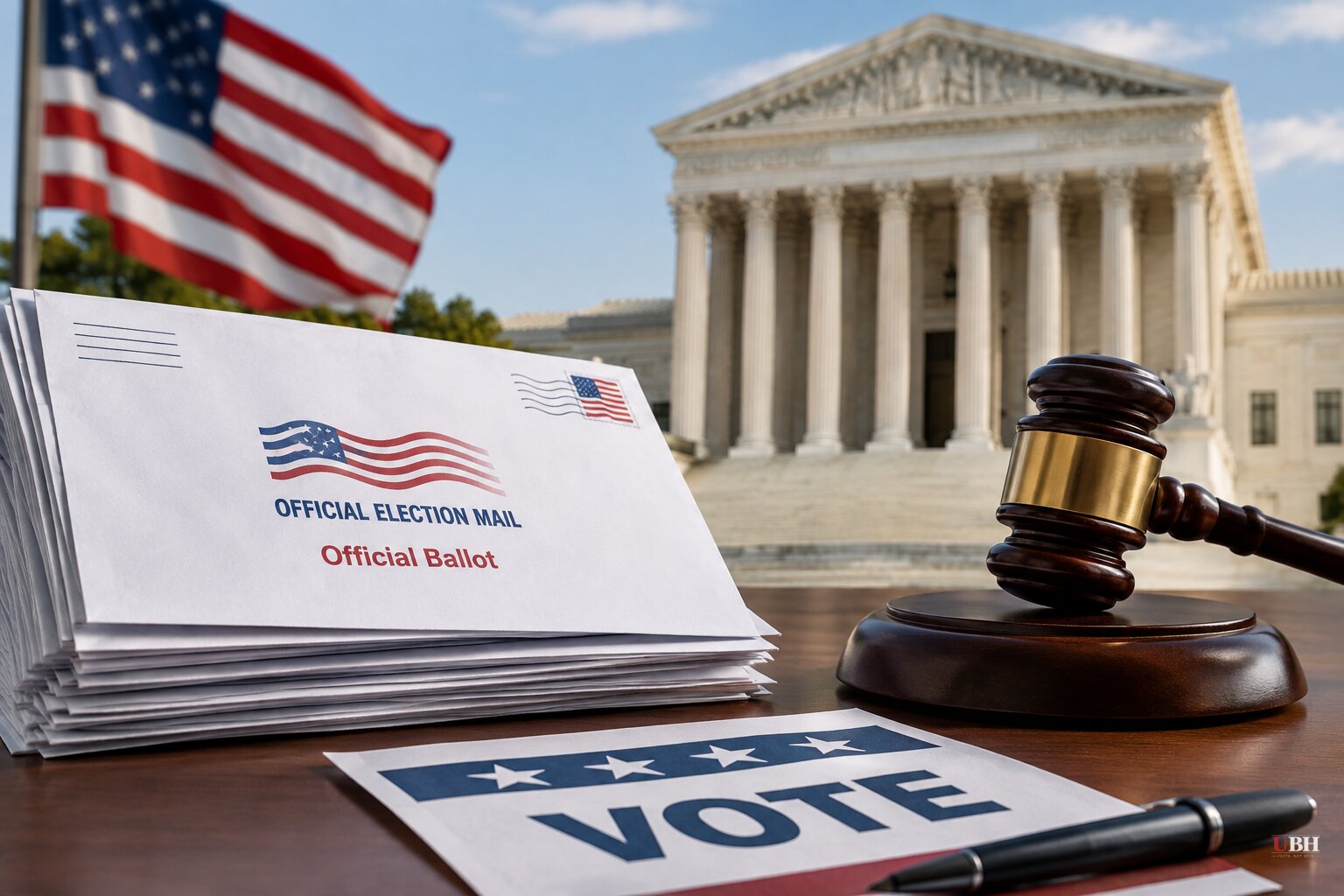
Since Election Day was locked in for November 3, the midterm map has kept shifting. This week produced three concrete developments.
The Supreme Court Rules on Mail Ballots
The Supreme Court on September 14 rejected the Trump administration's push to restrict mail-in balloting ahead of the midterms, according to The Guardian. Voting rights advocates praised the decision.
The administration's underlying concern, that mail ballots are harder to verify than in-person voting and create more room for error or fraud, is a mainstream position shared by election officials on both sides who have pushed for stricter signature verification and tighter deadlines. Americans already show ID for banking, air travel and plenty of everyday transactions, so requiring similar verification for ballots isn't unreasonable on its face.
But the sources here present no verified fraud evidence tied to mail balloting in this cycle. What the ruling actually decided was a legal question about the administration's authority to impose new restrictions this close to an election, not a factual finding on whether fraud occurred. That distinction matters, and it remains an open question how election officials in individual states will handle verification going into November.
Texas Charges Add to the Debate
Federal prosecutors charged six green card holders in Texas in a crackdown on illegal voting, The Guardian reported September 15. These are charges, not convictions, and no court has ruled on the underlying allegations. The case will be worth watching as a real test of how the system detects and prosecutes non-citizen voting, something critics of current rules say is too hard to catch and defenders say is already rare and handled through existing law.
Iran War Splits Iowa Republicans
The war with Iran has become its own midterm liability for the GOP. Iowa Reps. Zach Nunn and Mariannette Miller-Meeks, both in competitive districts, flipped their votes this week to join Democrats on a resolution aimed at ending Trump's authority to continue military action without congressional approval, according to the Associated Press via PBS.
Nunn, an Air Force veteran who campaigned with Defense Secretary Pete Hegseth last month, posted that he would "not support another open-ended war." Miller-Meeks said Trump needs to show Congress and the public a plan for how the war ends so the country can focus on bringing soldiers home and lowering prices.
Eighteen U.S. service members have died in the conflict, including two from Iowa. A July AP-NORC poll found only about three in ten U.S. adults approved of Trump's handling of Iran, and a September New York Times/Siena poll found roughly six in ten likely voters think going to war was the wrong call. Nunn faces Sarah Trone Garriott in November; Miller-Meeks faces a third rematch against Christina Bohannan.
Trump's Approval and the $5,000 Pledge
Trump's approval rating has fallen to 33 percent, the lowest of his political career, according to Reuters/Ipsos polling cited by Katie Couric Media. That backdrop is shaping how Republicans in swing districts talk about the president, including Trump's repeated pledge to send Americans a $5,000 "dividend" if Republicans hold Congress, which he reiterated September 13 per The Guardian. Commerce Secretary Howard Lutnick said the day before that current tax revenue wouldn't cover the payout, a specific admission from inside the administration that the promise lacks a funding source as described.
The Marquee Races
Pennsylvania remains the biggest single battleground. Gov. Josh Shapiro leads Republican challenger Stacy Garrity 55-39 percent in a Philadelphia Inquirer/New York Times/Siena poll, and Democrats are targeting four U.S. House seats there while also eyeing full control of the state legislature for the first time in decades.
In Michigan's open Senate race, Trump-endorsed Republican Mike Rogers led Democrat Abdul El-Sayed 45.8 to 44.4 percent in a September 8 Detroit News/WDIV-TV poll, within the margin of error, according to Katie Couric Media. In North Carolina, former Democratic Gov. Roy Cooper is running against former RNC chairman Michael Whatley for the seat retiring Sen. Thom Tillis is vacating, with cost of living as the central issue.
Democrats need to flip four Senate seats to take the chamber and are competing in states Trump won twice, including Texas and Alaska, while Republicans see their own opening in Michigan, per Katie Couric Media. On the House side, Republican-controlled states redrew district maps ahead of the midterms after the Supreme Court's ruling in Louisiana v. Callais allowed some Southern states to eliminate majority-Black, safely Democratic districts, according to The 19th News. Democrats are still favored to pick up seats given historical midterm patterns, the outlet reported.
Early voting has already begun in several states. The next concrete marker is November 3, when control of both chambers, the Pennsylvania governorship, and a handful of tossup Senate seats will be decided outright rather than debated in polling averages.
Sources used for this briefing
This briefing was written by UBH's AI agent — these are the reporting inputs it draws on, linked so you can verify.


