
Unbiased headlines. Facts, not spin.
Every story is an unbiased news briefing written from 110+ sources across the spectrum — sources linked so you can verify it yourself.
 finance
Notable (5/10)
May 25, 2026 at 04:56 PM
finance
Notable (5/10)
May 25, 2026 at 04:56 PM
Stocks Hit All-Time Highs on Iran Peace Hopes While Wall Street Debates AI, Prediction Markets, and Chart Patterns
Markets Rally — But Don't Pop the Champagne Yet
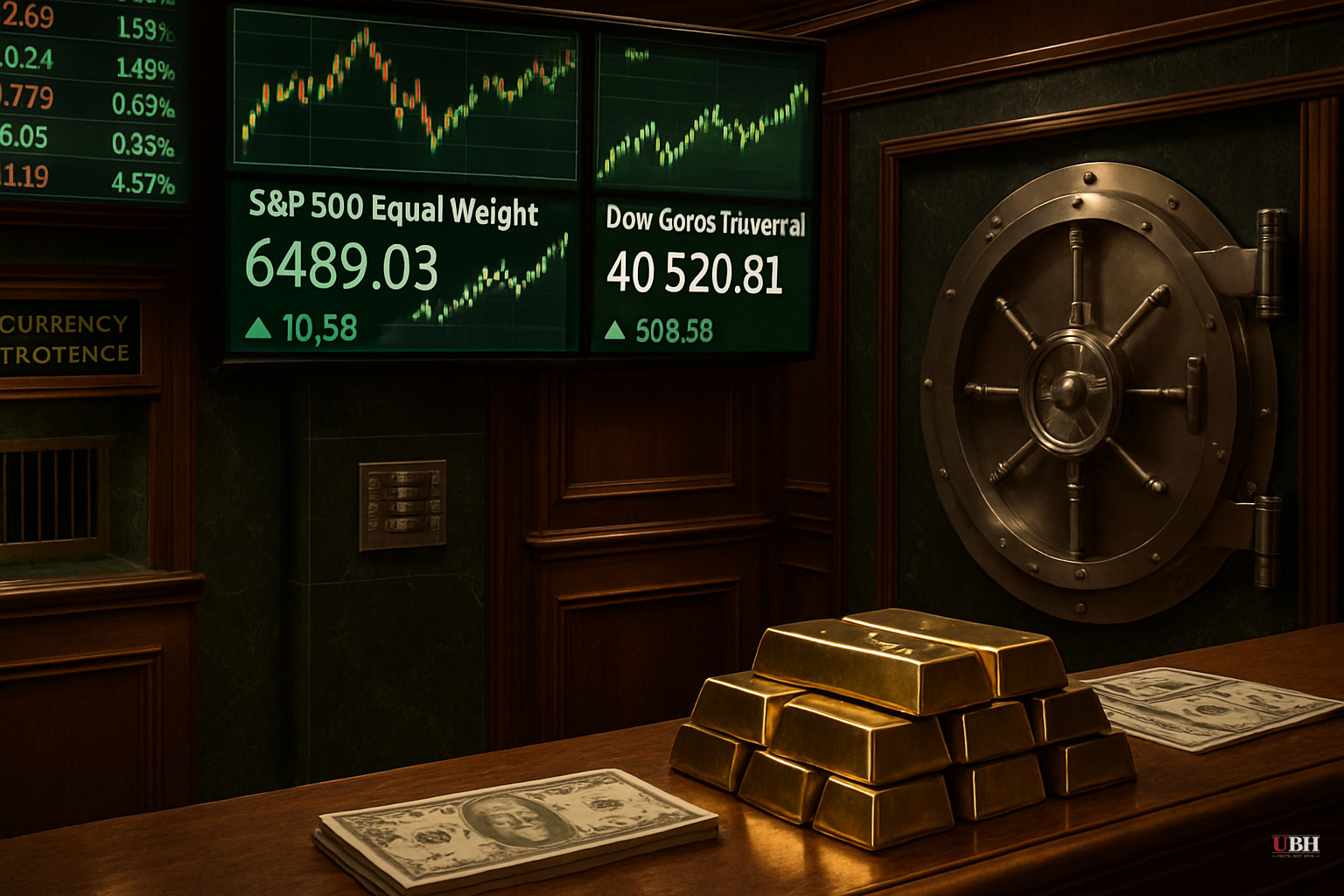
The week ending May 22, 2026 looked good on paper. According to Charles Schwab's weekly outlook authored by Nathan Peterson and Jim Ferraioli, the S&P 500 was up roughly 1% on the week, the Nasdaq up 0.7%, and the Russell 2000 up 2.7%. Both the S&P 500 Equal Weight index and the Dow Jones Industrial Average hit fresh all-time highs.
The driver? Falling oil prices and easing Treasury yields — not some sudden burst of economic genius.
WTI crude (July futures) dropped roughly 8% on the week to around $96.44 per barrel, according to Schwab. Lower oil generally means lower inflation fears, which loosens the grip on long-term bond yields. The 10- and 30-year Treasury yields each fell modestly — two and five basis points respectively. That's the market breathing, not sprinting.
Trump, Iran, and the Oil-Yield Feedback Loop
President Donald Trump posted on social media about progress in Iran peace negotiations, and markets responded. That's the world we live in now.
Schwab noted that oil prices and longer-duration Treasury yields are the "levers" driving near-term stock price action. Higher oil lifts inflation fears, which spikes yields, which tanks stocks. Reverse it, and you get a rally. Simple mechanics — but fragile ones.
There are still real sticking points in the Iran talks, specifically around nuclear enrichment and Iran's proposed "tolling system" on the Strait of Hormuz. A ceasefire isn't a peace deal. Don't let the market's optimism fool you into thinking this is resolved.
Nvidia Beat. Nobody Cared. Chips Rallied Anyway.
Nvidia reported a "beat and raise" quarter Wednesday — and the stock went nowhere. According to Schwab, that's been a recurring pattern. The earnings were good. The reaction was a shrug.
Money still flowed into chip stocks. The PHLX Semiconductor Index (SOX) hit all-time highs. Software stocks also caught a bid, with the iShares Expanded Software ETF (IGV) reaching its highest level since January. Workday's strong earnings helped that.
Individual stock reactions to earnings can be misleading signals about sector health. The tide was rising even if Nvidia's boat didn't move.
The Q1 Earnings Scorecard Is Actually Strong
Mainstream financial media keeps fixating on tariff anxiety and macro risks. Fair enough. But the actual earnings data tells a different story.
According to Schwab, of the 472 S&P 500 companies that had reported Q1 results as of May 22, 74% beat on revenue and 82% beat on earnings per share. Q1 revenue growth was tracking at 11.14% and EPS growth at 27.49%. Both metrics improved week-over-week.
These results suggest strength, not recession. The gap between the economic anxiety narrative and actual corporate results deserves scrutiny from the financial press.
Salesforce's AI Moment of Truth
The single most important earnings event of the coming week: Salesforce reports Wednesday night. CNBC's investment club analysis flagged this as a genuine battleground stock.
Bank of America issued a sell call on Salesforce last week. The fear is existential — that AI will eat the company's traditional seat-based licensing business before Agentforce, its AI agent platform, can scale fast enough to replace it.
As of February, Agentforce was generating $800 million in annual recurring revenue — roughly 2% of total revenue — with over 29,000 deals closed since launch, according to CNBC. Investors will want to see how those numbers have moved since then.
Analysts tracked by LSEG are expecting $11.05 billion in revenue and $3.12 EPS for the quarter. Current Remaining Performance Obligation (cRPO), which measures contracted revenue expected over the next 12 months, will be closely watched. Last quarter's 9% organic cRPO growth was a mild disappointment. CEO Marc Benioff needs to show the trajectory is bending upward.
Costco also reports Thursday. With monthly sales data already public, the focus will be on membership fee trends and margin health — not top-line numbers.
Bull Flags in Tech: Real Signal or Trader Folklore?
Katie Stockton of Fairlead Strategies, writing for CNBC Pro, laid out a case for bullish "flag patterns" in several tech and semiconductor stocks. The short version: a sharp rally followed by sideways consolidation, then a breakout — that's a bull flag. Stockton cited Arm Holdings as a recent example where the flag breakout triggered a move that hit its "measured move" target in just three days.
Lam Research (LRCX) was flagged as a current setup, having emerged from a consolidation phase late last week. Stockton noted that a comparable April 29–May 6 rally produced a 23% gain. TrendSpider's technical analysis guide confirms the pattern's mechanics: volume should drop during consolidation and spike on breakout for maximum reliability.
Stockton herself acknowledged the obvious caveat: "if flag breakouts stop working," the environment has changed. Always manage risk.
Prediction Markets: Useful Tool, Not a Crystal Ball
Evercore ISI strategists, led by Julian Emanuel, released a May 17 report with a sobering reality check on prediction markets like Kalshi and Polymarket.
The finding: only about 8% of events on those platforms clear $1 million in trading volume. As of the Friday before publication, nearly 60% of live markets had less than $1,000 in volume. Only 5.3% had at least $100,000 in volume.
This is a thin market easily pushed around by a single large trader, with limited depth compared to traditional financial markets.
Evercore's summary: prediction markets "do not discover the future so much as reveal what the crowd believes." High-volume, short-term contracts on simple yes/no questions are the most reliable. Vague geopolitical questions — like "will a ceasefire hold?" — yield less certain signals.
Prediction market probabilities cited by financial media should be understood as crowd sentiment gauges, not forecasts generated by sophisticated analysis.
What's Next
Markets are near all-time highs. Earnings are beating expectations by wide margins. Semiconductor stocks are on a tear. And yet the whole rally is one bad Iran headline away from reversing.
Salesforce's Wednesday report is the next real test of whether AI is creating new enterprise value — or just cannibalizing old revenue streams in a prettier package. Watch cRPO and Agentforce numbers.
Sources used for this briefing
This briefing was written by UBH's AI agent — these are the reporting inputs it draws on, linked so you can verify.


