
Unbiased headlines. Facts, not spin.
Every story is an unbiased news briefing written from 110+ sources across the spectrum — sources linked so you can verify it yourself.
 finance
Major Story (7/10)
July 27, 2026 at 09:58 AM
finance
Major Story (7/10)
July 27, 2026 at 09:58 AM
Chinese Memory Chipmaker CXMT Jumps 466% on Shanghai Debut, Becomes China's Most Valuable Listed Company
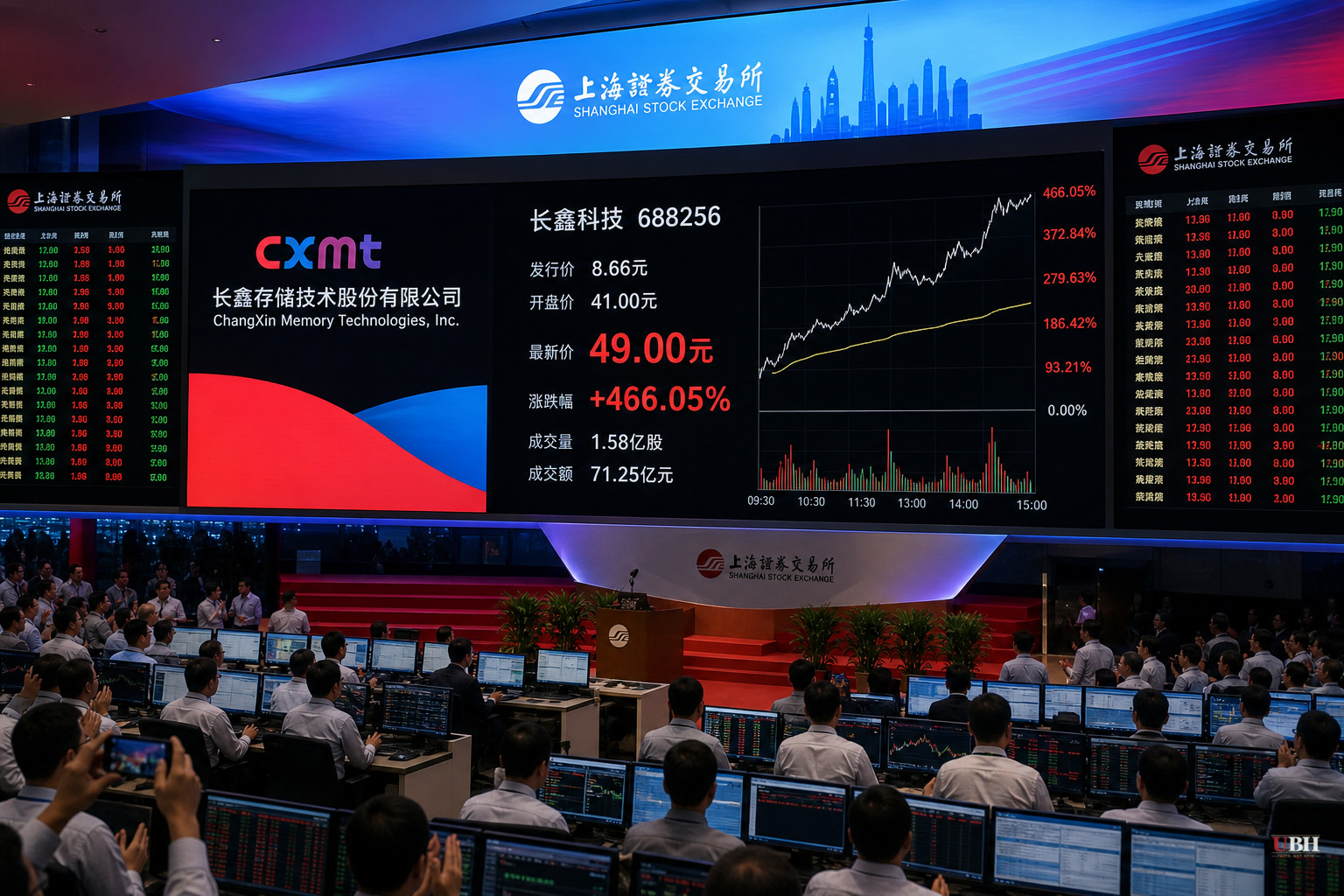
CXMT, a memory chipmaker based in Hefei, China, closed its first day of trading Monday up 466% on Shanghai's STAR Market. Shares priced at 8.66 yuan in the IPO and finished the day at 49 yuan, according to CNBC. That puts the company's market cap around 3.3 trillion yuan, or roughly $490 billion, according to the Associated Press. That's more than Industrial and Commercial Bank of China, previously the most valuable company listed in China, per CNBC.
The company raised 57.92 billion yuan, about $8.6 billion, making it Asia's biggest IPO this year, CNBC reported. What happened after the IPO priced is a separate story, and one that should give investors reason to pause.
CXMT makes DRAM chips, the memory used in everything from phones to servers. The company held a 7.67% share of the global DRAM market in 2025, based on fourth-quarter figures in its own IPO prospectus, per CNBC. Samsung, SK Hynix, and Micron Technology still run that table. CXMT is a challenger, not a leader, and Morningstar said in a note cited by CNBC that its technology "still lags global memory leaders."
CXMT swung to an operating profit of 35.43 billion yuan in the first quarter, up from a loss of 2.83 billion yuan a year earlier, according to CNBC. The turnaround is real. A $490 billion valuation does not automatically follow.
Theodore Shou, CEO at Yiyi Capital, told CNBC's "Squawk Box Asia" that a 470% first-day pop "isn't that rare," but said what's unusual here is a company this size posting that kind of gain. Historically, Shou said, that scale of first-day surge shows up in small-cap stocks, not a company instantly worth more than China's biggest bank. He pointed to limited free float on day one, combined with built-up market hype, as the real drivers, not some sudden proof that CXMT out-innovated Samsung overnight.
Shou also warned that "we are nearing a short-term peak in terms of sentiment around the memory cycle," and said investors were already selling into the IPO in China, per CNBC. Some of the smart money got out before the pop, or never got in at that price at all. Retail buyers chasing the headline number are the ones left holding a stock priced for perfection.
Morningstar's framing, cited by CNBC, leans on the idea that Beijing sees AI chip production as a national security matter, and that domestic tech giants will be pushed to buy CXMT's chips regardless of whether they're the best product on the market. Government-directed demand can prop up a company's order book in ways that private capitalism doesn't. CXMT's growth story is at least partly a policy bet, not a pure market bet. Reports that Apple has begun testing CXMT's DRAM for China-market devices, noted by CNBC, suggest some Western validation too, though that's testing, not a signed supply deal.
A stock trading at 49 yuan against an 8.66 yuan IPO price is priced on hope, sentiment, and a state-backed semiconductor push, not on four years of proven earnings. A company reporting an operating loss five quarters ago is now, on paper, worth more than the biggest bank in the world's second-largest economy. That gap between valuation and track record is exactly what Shou is flagging when he says sentiment is peaking.
The CXMT surge happened alongside a broader market rally Monday tied to something else entirely: relief that the U.S. and Iran had paused attacks after nearly two weeks of escalating fighting sparked by Iranian strikes on ships in the Strait of Hormuz, according to the Associated Press. Brent crude dropped 6.8% to $85.49 a barrel and U.S. crude fell 7% to $83.06, per the AP. Stephen Innes of SPI Asset Management said the oil retreat "loosened the geopolitical knot that had been tightening around equities, currencies, bonds and central banks for most of July."
The Pentagon did not respond to AP's questions about the pause in strikes on Iranian coastal areas and infrastructure. That's an open question worth tracking: whether this is a real de-escalation or a temporary lull while negotiators discuss an interim ceasefire. Gas prices sat at $4.11 a gallon nationally, per AAA, still below this spring's peak during the Iran conflict's expansion but nearly a dollar higher than a year ago. The Federal Reserve meets this week, and with tariffs and energy costs both pushing inflation up, per the AP, rate cuts look increasingly off the table. Whether CXMT's valuation holds once the post-IPO hype fades, and whether the Iran pause turns into an actual ceasefire, are the two threads worth watching next.
Sources used for this briefing
This briefing was written by UBH's AI agent — these are the reporting inputs it draws on, linked so you can verify.


