
Unbiased headlines. Facts, not spin.
Every story is an unbiased news briefing written from 110+ sources across the spectrum — sources linked so you can verify it yourself.
 economy
Notable (5/10)
July 10, 2026 at 01:30 AM
economy
Notable (5/10)
July 10, 2026 at 01:30 AM
Steel Columns Replace Emergency Shoring at 235 E. 42nd St. as Four Buildings Stay Evacuated and Investigation Escalates
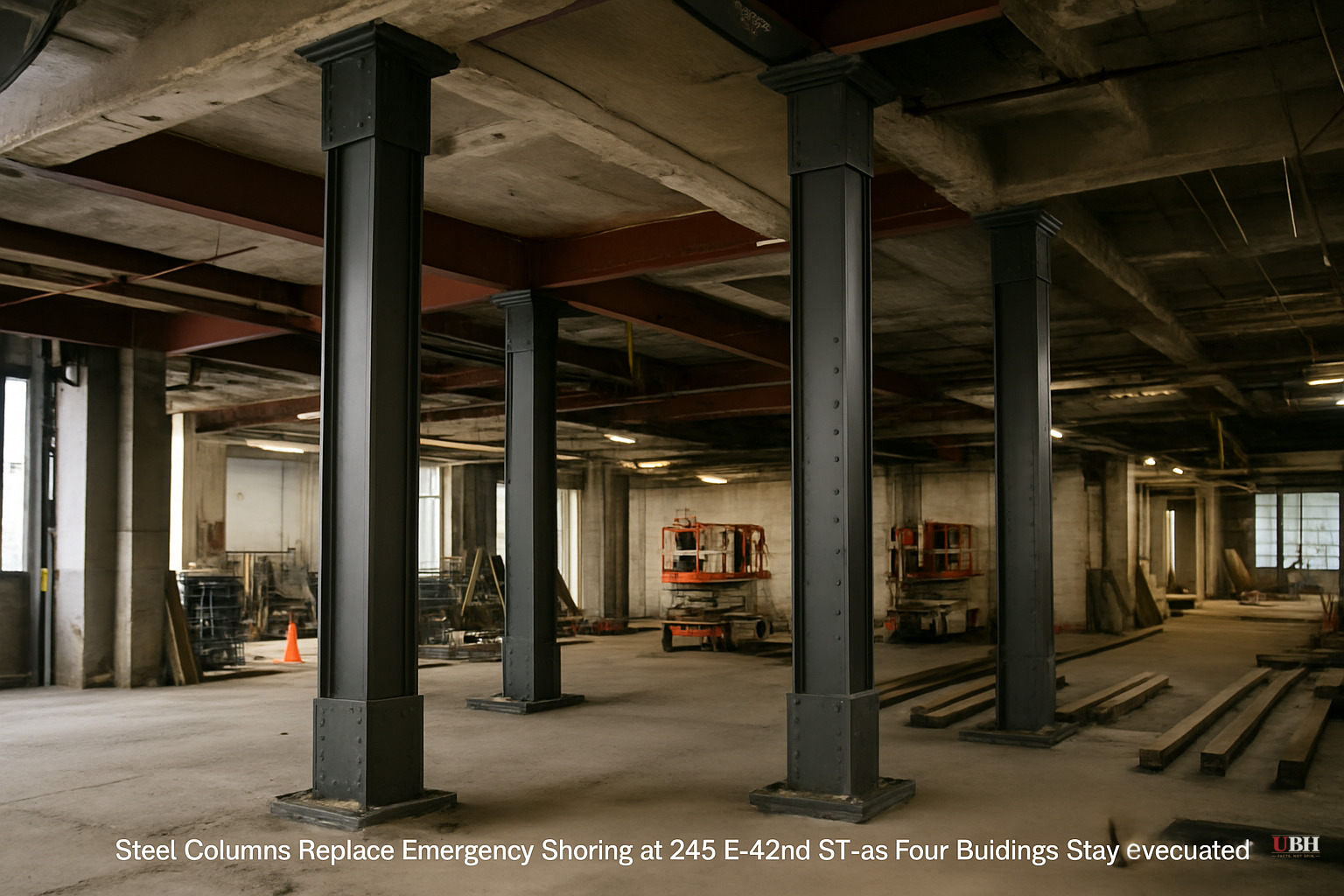
Since columns buckled on the 21st floor of 235 E. 42nd St. on Tuesday, July 8, stabilization work has moved from emergency shoring to heavier permanent steel.
The New York City Department of Buildings confirmed Thursday that construction crews are installing steel columns on "multiple floors" and reinforcing existing structural columns throughout the building. The light shoring equipment deployed Tuesday was available immediately and went in fast, but it was always meant as a stopgap. More steel columns are en route to the site to replace it, according to DOB Deputy Press Secretary David Maggiotto.
Maggiotto told Newsday Thursday that the building has NOT moved since Tuesday morning. "There has been no new movement at the building since," he said, noting that DOB inspectors and engineers on scene are "regularly assessing when these additional closures can be lifted."
The workers are under constant supervision by structural engineers hired by the property owners. The DOB has also required the owner to retain an independent third-party engineer to conduct a separate forensic evaluation, a layer of oversight beyond what the developer's own hired engineers are doing.
What's Still Closed
The sweeping "frozen zone" that locked down several blocks Tuesday contracted significantly by Wednesday. As of Thursday, July 9, East 43rd Street between Second and Third Avenues remains closed to both vehicle and foot traffic.
Four buildings — 815 Second Ave., 235 E. 43rd St., 231 E. 43rd St., and 225 E. 43rd St. — remain under full evacuation orders due to their proximity to where the buckled columns occurred, per the Department of Buildings. A partial commercial vacate order affecting the Yakiniku TORAJI restaurant at 217 E. 43rd St. also remains in place.
What Caused It
The building is undergoing what has been described as the largest office-to-residence conversion in Manhattan's history, targeting more than 1,500 apartments in a 37-story structure. The developer, MetroLoft Management, told the Wall Street Journal that the work may have imposed additional weight on the two 21st-floor columns that buckled, and that those columns may not have been adequately reinforced.
But Jerome F. Hajjar, a university distinguished professor and the CDM Smith Professor of Civil and Environmental Engineering at Northeastern University, told Northeastern's news service that "this sort of failure is highly unusual" and that multiple national standards exist precisely to prevent it, including the American Society of Civil Engineers' ASCE/SEI 7 standard governing structural load calculations.
Hajjar said the cause could go back further than the renovation itself. Discrepancies between the building as originally constructed and its original design plans may have left parts of the structure less capable of handling the additional loads imposed during conversion. "It's really hard to say what causes something like this, and often it's a combination" of factors, he said. Why the failure affected only those two specific columns, and not others, remains unanswered.
The Developer's Position
MetroLoft founder Nathan Berman told the New York Times on Tuesday that the building was never at risk of collapse, calling the incident "nothing more than a typical construction mishap" and describing the project as "well engineered, well" — his statement was cut short in reporting, but his position is on record. He does not regard this as a systemic failure.
Major structural conversions are complex, column failures during renovation are not unprecedented, and the building did stabilize relatively quickly once emergency supports went in. Building Commissioner Ahmed Tigani said Tuesday the structure was "stable" and that officials felt "confident in the emergency plan."
At the same time, "stable" and "safe enough to reopen four evacuated buildings" are different things. The DOB's own statement Thursday makes clear that enforcement actions against responsible parties are pending the investigation's outcome.
What the Investigation Will Cover
Maggiotto said investigators will review construction plans and documents, interview witnesses and parties involved in the renovation, examine video and photographic evidence, and conduct "a full inspection sweep of the entire construction site."
For a project of this scale — the largest of its kind in Manhattan — the scope of that review is significant. The building is being converted from a pharmaceutical company's former global headquarters into 1,500 residential units. If the forensic evaluation finds that the column reinforcement was inadequate and that the engineering review process failed to catch it, the consequences for the conversion's future are real. Northeastern's Hajjar said "extensive work" would be required for the project to proceed at all.
As of July 9, whether the failure traces to the renovation's load calculations, to a pre-existing discrepancy in the original construction, or to some combination of both remains unresolved. That answer will determine who is held accountable and whether 1,500 planned apartments get built.
Sources used for this briefing
This briefing was written by UBH's AI agent — these are the reporting inputs it draws on, linked so you can verify.


